What Blessing Do You Say During an Earthquake?
A rabbi discusses when to say the earthquake blessing and when safety takes priority.
I read that there is a special blessing for an earthquake. If I am inside or near a building when an earthquake begins and need to get away quickly so nothing falls on me, may I say the blessing, or should I escape as quickly as possible?
If a strong earthquake objectively threatens your life, do not stop to say the blessing; try to get to safety as quickly as possible. If you feel afraid, take safety measures immediately.
In brief
- There is a blessing to say when an earthquake occurs.
- It is said during the earthquake or within two to three seconds after it ends.
- When an earthquake threatens your life, getting to safety takes priority.
- A story about Rabbi David Baharan illustrates how he prepared to say the blessing.
The Talmud says that one should recite a blessing upon experiencing an earthquake: “Blessed are You, Lord our God, King of the universe, Who makes the work of creation” [בָּרוּךְ עוֹשֶׂה מַעֲשֵׂה בְרֵאשִׁית] (Berakhot 59a). This law also appears in the Shulchan Aruch (Orach Chaim 227:1). The blessing should be said during the earthquake or within toch kedei dibur (the time it takes to speak), two or three seconds after it ends.
Now, let us return to the heart of your question: how can you say a blessing during an earthquake?
If a strong earthquake begins and objectively threatens your life, you have no right to stop and say the blessing. You must try to escape to a safer place or find shelter as quickly as possible. This follows the rule that saving a human life takes priority over almost all the mitzvot of the Torah.
However, as far as I know, most earthquakes are actually weak enough that they pose no real danger to life. The number of people killed by earthquakes is very small. (There may be seismically active areas where this is not quite true.) Therefore, if you feel the ground shaking but are not panicked or terrified, you may say the blessing and then begin to consider whether you need to escape. If you are afraid, however, you must take safety measures immediately.
There is also a middle situation: you suspect that the earthquake may be dangerous, but you do not feel panicked. In that case, I would advise you to quickly enter a designated protected room, if you have one, or go to a stairwell landing. These are known to be the most stable parts of a building. It is often possible to reach a protected part of the building very quickly. There, you may still have time to say the blessing as required by Jewish law—while the shaking continues or no more than two or three seconds after it ends.
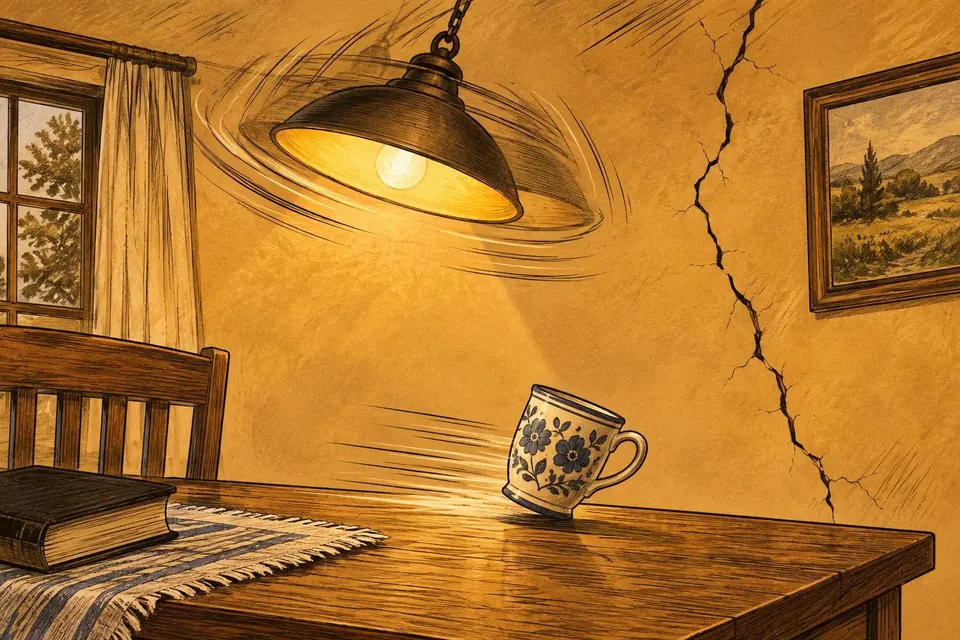
There is a well-known story about a great righteous man of Jerusalem, Rabbi David Baharan. When he was a boy studying in cheder (a traditional Jewish elementary school), an earthquake struck Jerusalem. All the children panicked, ducked under the tables, and tried to run outside. Only little David stood up and recited the blessing in a loud, calm voice.
Afterward, he was asked how he had managed to keep his composure. He replied that when they had studied the relevant Mishnah (Mishnah Berakhot 9:2), he had pictured an earthquake beginning, books falling from shelves, and everyone running in different directions or hiding under tables. That was exactly when the blessing had to be said! Because he had rehearsed the scene in his imagination, he was able to say the blessing at the right moment.
Answered by Rabbi Berel Nabutovsky
Practical law. This page reports a ruling given for a specific question. For your own situation, ask a rabbi who knows you.
Keep reading
More →Hebrew Words for Prayer in the Haggadah
Three Hebrew words describe cries that rise to God when ordinary words fail.
ParashaKorach: The Power of Prayer
Why did Moses pray that God would not hear the prayers of Korach and his followers?
ParashaPinchas: The Trap of Routine
The daily offering teaches us to bring fresh attention and inspiration to familiar mitzvot.
PrayerCleansing the Soul Before Sleep
A bedtime prayer and other practices can help us release resentment and begin again.







