Purim, Lots, and the Meaning of Chance
The name Purim invites us to consider the difference between chance and divine providence.
In brief
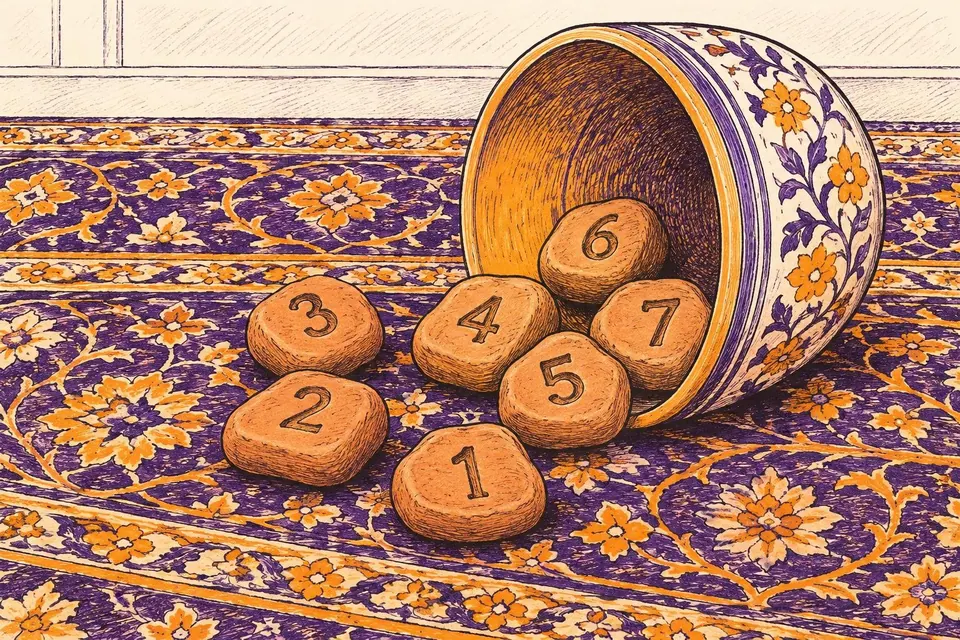
- Purim takes its name from the lots Haman cast to choose a date for the destruction of the Jews.
- Haman saw events as matters of chance, while a person of faith can see God’s providence in them.
- The essay distinguishes between human choices and circumstances determined for each person from Heaven.
- Each person receives the circumstances needed for their role in serving God.
Purim and the Lot#
The day is called Purim because, as the verse says, “They cast pur, that is, the lot, before Haman” (Esther 3:7). The liturgical poem Asher Heni also says, “For Haman’s lot became our lot.” And another verse says, “Therefore they called these days Purim, after the word pur” (Esther 9:26). A name defines the essence of a thing, so the name Purim expresses and defines the root of everything the days of Purim teach us.
We need to understand how the name Purim expresses the essence of the day. The pur that Haman cast, which became “our lot,” was only one detail in determining the date on which the Jews were to be destroyed. Haman did not want to set the date himself, so he cast lots. Why does this seemingly minor detail in the events of those days give the festival its name?
There is another question. If the festival is named for the pur that Haman cast, it would seem that it should be called Pur. What is the meaning of Purim, the plural of pur?
Two Ways to View a Lot#
To understand the essence of this day and what its events teach us, we must first clarify something important about our service of God: the concepts of choice and chance.
Ordinarily, when people make a choice, they decide how to act according to their own perception and understanding. But sometimes, for one reason or another, a person finds it difficult to decide and casts lots instead. A decision made this way is not, of course, the person’s own choice. It is a decision from above, whose source is mazal: the influence of spiritual forces from a particular level of the higher worlds.
We see that lots are also used in matters of holiness. On Yom Kippur, for example, a lot is used to choose between two goats, which the mitzvah requires to be alike in appearance, height, and value (Mishnah Yoma 6:1). The lot alone determines which is to be offered to the Almighty and which is to be sent to Azazel in the wilderness. The Land of Israel, too, was divided by lot, as it says, “You shall assign the land by lot among your families” (Numbers 33:54).
We need to understand what a lot means and how to regard it. A person of faith can see it as a way of revealing the Creator’s will, showing that the decision is not in human hands at all. That was the case with the Yom Kippur lot: Heaven determined the purpose of each goat, which would be offered to the Almighty and which would be sent to Azazel. The same was true when the Land of Israel was divided by lot: in accordance with the Almighty’s will, Heaven determined which portion each tribe would receive.
A person without faith, on the other hand, sees a lot differently. When such a person does not want to make a decision based on reason, they leave it to chance: let chance decide.
Haman’s Denial of God#
When Haman left the date of the attack on the Jews to a lot, he was not acting as a person of faith who sought to rely on the Almighty’s will. He wanted chance to decide.
Our Sages write (Esther Rabbah 8:5):
“Mordechai told him all that had happened to him (karahu)” (Esther 4:7). Mordechai told Hathach the whole course of events. “He said to Hathach: Go and tell her, Esther: A descendant of Karahu has risen against you.” Karahu is the one of whom the Torah says, “who met you (karcha) on the way” (Deuteronomy 25:18).
Mordechai described Haman’s character by calling him a “descendant of Karahu”—that is, of Amalek. Amalek had seen all the miracles of the Exodus from Egypt and the splitting of the sea. At a time when all the nations saw and heard of them, as the Torah says, “Then the chiefs of Edom were dismayed, the leaders of Moab were seized with trembling, and all the inhabitants of Canaan melted away” (Exodus 15:15), Amalek refused to understand what everyone else saw and understood. He rose up against Israel and fought it.
How could he have dared to do that after seeing all the miracles? The answer is in the words “who met you,” or “cooled you off,” “on the way.” Amalek did see the whole course of events, the Exodus from Egypt and the splitting of the sea, but he saw them only as a series of coincidences—one chance event after another. He denied the Almighty’s watchfulness and governance. Haman was just the same, as Mordechai said when he called him a “descendant of Karahu.” He saw every event as mere chance and was not at all surprised by miracles, because he denied the Almighty’s rule.
Haman’s outlook, which saw nothing but chance, is evident not only in his casting lots but throughout the events described in the Book of Esther.
After building a gallows on the advice of his counselors, Haman went to King Ahasuerus to ask permission to hang Mordechai on it. That night, the Almighty caused the king’s sleep to leave him (see Esther 6:1), and the book of chronicles “was being read” before him. When Haman arrived, the reading had reached the story of Bigthan and Teresh, royal guards who had plotted to kill the king. Mordechai had heard their conversation and reported it in his own name. The guards were executed, and the king was saved.
The Yalkut (1057) says: “When the readers reached Mordechai’s deeds, they skipped that passage, but the book read itself at that point, for it says ‘was being read,’ not ‘they read it.’ Others say that the prophet Elijah came and wrote about Mordechai’s deeds, for it goes on to say ‘it was found’ written in the book, and the word ‘found’ is used only for something that was previously lost.”
At precisely that moment, Haman appeared in the king’s courtyard to obtain permission to hang Mordechai. The king asked him what should be done for a man the king wished to honor. And so the king ordered Haman, whom he had elevated above all his other officials, to honor Mordechai by leading him on horseback through the city streets. Divine providence had arranged this entire chain of events.
And how did Haman react? “Haman told Zeresh his wife and all his friends everything that karahu—had happened to him” (Esther 6:13). He told it as a matter of chance. He was not at all surprised by such personally directed providence, nor did he see the events as punishment from Heaven for his evil deeds. He saw only coincidences, one chance event after another, over which he had no control.
Those who advised him likewise saw no guiding hand in these events and did not understand that the Almighty did not want Mordechai hanged. Looking at things as Haman did, they answered him: “His wise men and Zeresh his wife said to him: If Mordechai, before whom you have begun to fall, is of Jewish descent, you will not overcome him, but will surely fall before him” (Esther 6:13).
In their view, everything was chance. “If he is of Jewish descent”: a person who acts against the Jews succeeds when the time is favorable. But if that person happens to fail, their mazal is bad, and chance continues to drag them down and down. Therefore, “you will surely fall before him.”
This is the essence of Mordechai’s description of Haman as a “descendant of Karahu.” No event could lead him to see the Almighty’s watchfulness and governance; he saw only chance in everything. If he was fortunate, it meant that a chance event had been within his control. If he suffered a setback, he felt no guilt: it was a chance event beyond his control.
Chance Is Determined From Above#
There is something else we need to understand. Both Mordechai and Haman use the word karahu. Of Mordechai it says, “Mordechai told him all that karahu—had happened.” The derash, or interpretive reading, of this verse is “a descendant of Karahu has risen against you.” But the plain meaning is “everything that happened”—an occurrence. Haman uses the same word: “Haman told … everything that karahu—had happened to him,” also as something that occurred by chance.
Scripture contains other passages that speak of chance. When Eliezer, Abraham’s servant, had to carry out his mission to find a wife for Isaac, he stopped by a well and prayed to the Almighty: “Lord, God of my master Abraham, grant me a chance today” (Genesis 24:12). It would seem that he was relying on chance.
Ruth the Moabite, too, returned with Naomi from the fields of Moab and happened upon the field of Boaz, the goel: a relative of her late husband, who had died childless, and who was to marry her and restore the deceased man’s name in Israel. As it says, “She went and came to glean in the field behind the reapers, and it so happened that the field belonged to Boaz, who was of Elimelech’s family” (Ruth 2:3). She came by chance to the field of Boaz, who was to become her goel.
Everything beyond our choice is called “chance.” But what appears accidental to us is in fact planned and “arranged” by the Almighty Himself.
The explanation is this: There are two basic ways in which the world is governed. The first concerns what we do by our own choice, of course under Heaven’s watchful eye. These things actually happen because we chose them. The second concerns what lies beyond our choice: things predetermined from above rather than brought about by choice. These are chance events, prepared by Heaven in advance according to what a person needs to fulfill their role in serving the Almighty.
The Torah says about the cities of refuge, “You shall designate cities for yourselves; they shall be cities of refuge for you” (Numbers 35:11). Rashi explains the word vehikritem, “you shall designate,” by saying that words from this root always mean “preparation.” The same is true in another verse: “Because the Lord your God made it happen for me” (Genesis 27:20). Thus everything that happens by chance is actually prepared from above. Otherwise, it simply does not happen.
This governance by the Almighty, which depends not on a person’s choice but only on what has been determined for them from above, is also called governance through mazal. In its literal sense, mazal is an influence that flows from above: what Heaven has determined for a person as their portion in serving the Almighty, rather than as a reward or punishment for their deeds.
Each person receives abundant or limited influence from Heaven according to their role in perfecting creation.
The Talmud says (Niddah 16b): “The angel in charge of conception takes a drop of seed, presents it before the Almighty, and says before Him: ‘Master of the universe, what will become of this drop? A strong person or a weak one? A wise person or a foolish one? A rich person or a poor one?’ But the angel does not ask, ‘A wicked person or a righteous one?’ Rabbi Chanina said of this: ‘Everything is in the hands of Heaven except the fear of Heaven.’”
Before a person is formed from the drop of seed, the Almighty determines their role in this world. Accordingly, each person receives the qualities and “tools” they need. In the future, they will experience everything determined for them from above that lies outside the sphere of their choice. One example is the trial of poverty, assigned as a person’s portion in serving the Almighty. There is also poverty that was not assigned to a person but came as punishment for wrongdoing.
The Talmud also says (Moed Katan 28a): “Longevity and sustenance depend not on merit but on mazal.” What does mazal mean here? It does not mean chance, God forbid. It means the events and “tools” sent to a person, “planned” for them even before birth in accordance with their portion in serving the Almighty. Fear of Heaven is different: “Everything is in the hands of Heaven except the fear of Heaven” (Berakhot 33b). This fear depends on a person’s choice, whether good or, God forbid, bad.
The Talmud says (Taanit 25a):
Rabbi Elazar ben Pedat suffered poverty and hardship. He practiced bloodletting, and he had no sustenance. Once he ate a clove of garlic and fainted. The Sages came to visit him. When he regained consciousness, they asked him, “Why were you crying and smiling?” He answered, “The Almighty was with me, and I asked, ‘How long will I suffer in this world?’ He answered me, ‘Elazar, My son, would you like Me to destroy the world down to its foundations? Then perhaps you would be born with the mazal to have sustenance.’ I asked, ‘Even then, at the cost of destroying the world, is it only a possibility?’”
Is the Almighty’s hand too short? To provide Rabbi Elazar ben Pedat with sustenance, must the Almighty really overturn His world and create it anew?
Governance through mazal is hidden at the root of creation, and the reasons behind what is decreed are concealed from us.
Rabbi Moshe Chaim Luzzatto (the Ramchal) explains one of the foundations of divine governance of this world in his book Daat Tevunot:
Indeed, the Almighty divided the overall task of perfecting creation among all the souls He created to serve Him, according to what He knew was suited to the essence of each one.
This matter is hidden very deeply and has not been grasped by any prophet or seer. It belongs to the causes of the decrees mentioned above, which are beyond the reach of created beings and which we know only through their effects. For example, one person is rich and another poor, and we do not know why wealth has been assigned to one and poverty to the other. It follows that, in accordance with their root, one person receives abundant influence from the Almighty … while another, in accordance with their root, must receive a limited influence … as required for the perfecting of creation.
None of this depends on those people’s deeds. It depends only on what has been assigned to them according to the way the Almighty divided the work of perfecting creation among His creatures. Both abundance for one and scarcity for another bring about this perfection, each in its own way.
The Creator made everyone according to their role in creation. Creation reaches its goal when all its parts come together, and each person, fulfilling their individual responsibility within it, complements the others.
The reason each person has one particular role in creation rather than another is hidden in their roots and is entirely beyond our understanding. Knowing it is not essential to our service of God. On the contrary, if we knew it, that knowledge would damage our service, which is founded on our freedom of choice.
We do, however, need to know that the goal of creation is achieved by bringing all its parts together, and that each person is given the circumstances for serving the Almighty in accordance with their task.
A person born wise or foolish, poor or rich, must make use of creation in accordance with these “starting conditions” to fulfill their purpose in serving the Almighty. That is the goal of creation.
Keep reading
More →Why Did Mordechai Refuse to Bow to Haman?
Mordechai’s choices in the Purim story reveal his understanding of spiritual and material effort.
PurimWhy Do Jews Drink on Purim?
The Talmud’s teaching about drinking on Purim has inspired different interpretations and a reflection on closeness to God.
Guide · PurimIs It Permissible to Wear Costumes on Purim?
The reasons for Purim costumes and the boundaries Jewish law places on them.
PurimThe Joy of Adar and Purim
True joy strengthens our connection to Torah, good deeds, and the Creator.







