How Can We Get Closer to God in Elul?
Elul and the days leading to Yom Kippur invite us to take a first step toward God through Torah study and support for Torah scholars.
In brief
- Elul and the Ten Days of Repentance are a time when God awaits our first step toward Him.
- The Talmud describes ways to draw close to God through relationships with Torah scholars.
- These include marriage into a scholar’s family, business partnerships, and financial support.
- Respect for those who study Torah is essential to this connection.
Rosh Hashanah is not only an awesome and fearsome Day of Judgment. It is also a time for us to draw closer to God. Our sacred books teach that Elul and the Ten Days of Repentance that follow correspond to the 40 days in which God finally forgave the people of Israel for the sin of the golden calf. During those days, Moses carved new Tablets of the Covenant on Mount Sinai. At the end of this period, on Yom Kippur, he descended to the people of Israel after God said, “I have forgiven, as you have asked” [Numbers 14:20].
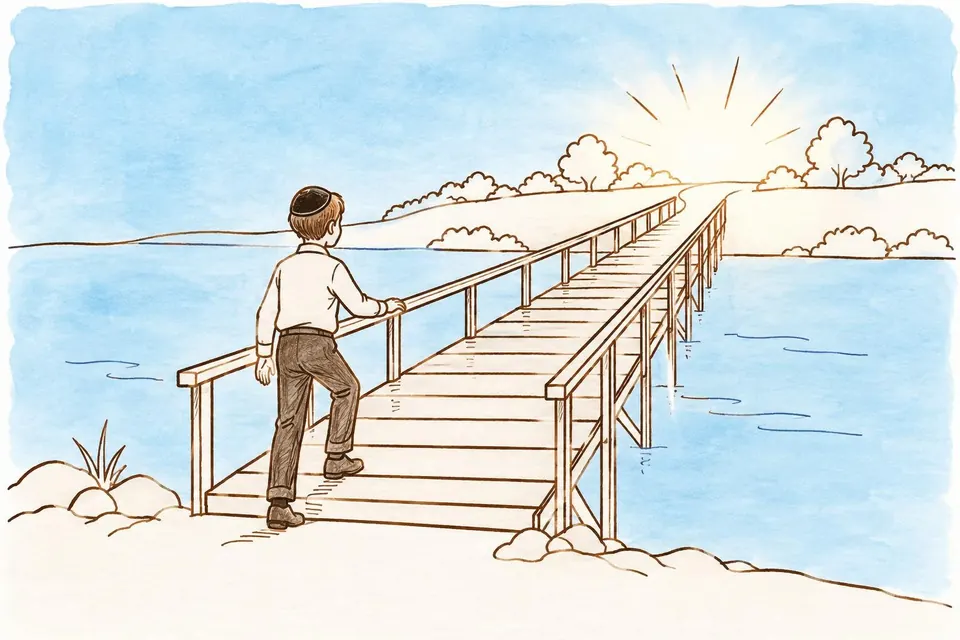
It is no coincidence, then, that God established these days for all time as a period when He is ready to draw us close and forgive our sins, however serious they may be. During these days, God waits for us to take the first step toward Him.
The name Elul is an acronym for ani ledodi vedodi li: “I am my beloved’s, and my beloved is mine” [Song of Songs 6:3]. These words come from the Song of Songs (Shir Hashirim), written by King Solomon. The wisest of men reminds us that God waits for us to take the first step toward Him—“I am my beloved’s”—so that He can take a step toward us: “My beloved is mine.”
This is an extraordinary opportunity to draw close to the person at the very top.
I deliberately use that language to help us imagine the importance of the occasion. Imagine that the head of a country, on whom you depend entirely, is waiting to meet with you—and is in a good mood. A meeting with the person at the very top inspires tremendous hope. But there is another side to it: Imagine what would happen if you ignored this overture and showed the head of state that you had no interest in them.
Closeness to God, called dvekut in Hebrew, is a central theme in Judaism. Yet for all its importance, it is hard to understand. How can we draw close to God? How can we “cling” to Him, the literal meaning of dvekut? We are physical; God is entirely spiritual. We are mortal; He is immortal. We are bound by time and space; He is beyond both. How can we “cling” to Him and, in effect, become one with Him?
The Talmud asks this question and, of course, answers it. Let us try to understand its answer.
It is said in Deuteronomy: “But you who cling to the Lord your God are all alive today.” But is it possible to cling to God? Is it not written in Deuteronomy that “the Lord your God is a consuming fire”? Rather, this means that anyone who gives his daughter in marriage to a Torah scholar, and/or conducts business for Torah scholars, and/or uses his property to support Torah scholars, is considered to have “clung to God” (Ketubot 111b; Deuteronomy 4:4, 4:24).
As is fitting when studying the Talmud, we should pay attention to the smallest details.
- First, what is the connection between God and Torah scholars? Why should helping them bring us to “cling” to God?
- Why does the Talmud frame the question this way, rather than as we did—that we are physical and He is spiritual, and so on? Why is the problem that He is a “consuming fire,” and what does that mean?
- How does giving one’s daughter in marriage to a Torah scholar help?
- What does it mean to conduct business for Torah scholars? If it means supporting them through tzedakah and a tithe, maaser, from one’s earnings, that is already covered by the third suggestion.
- Why does the Talmud list three suggestions?
- What does “considered” mean? Has the person clung to God or not?
Let us take these questions in order.
Torah Scholars#
It is hard to overstate the greatness and importance of Torah scholars. They carry the knowledge of Torah and pass it on to the next generations. Thanks to them, Judaism has survived as a religion and a body of teaching for thousands of years, despite persecution and hardship. They are holy, and we should learn much from them and strive to follow their example. But surely equating them with God goes too far. This brings us immediately to the last question: What does “considered” mean?
A Torah scholar cannot be equated with God. But we can try to hold Torah scholars in the highest possible regard. They convey to us the wisdom and will of the Creator. In them and in the knowledge they pass on to us, we see a manifestation of God in our world.
To put this in more familiar terms, imagine a Torah scholar as the deputy to the person at the very top. The more we interact with the deputy and the closer we become to them, the closer we become, in practice, to the person at the top.
Moreover, the more highly we value Torah scholars and the more reverence we show them, the more we regard them as “deputies”—or, more accurately in this context, as channels—of God Himself. And to that same degree, we are considered to have “clung” to God. In that proportion, it seems to me, lies the deeper meaning of the Talmud’s word “considered.”
A Consuming Fire#
Fire cannot be fooled. Even if you paint wood the color of water, fire will still consume it. God cannot be fooled either. We can deceive people by presenting ourselves as righteous, but we cannot deceive God.
The Talmudic passage we are discussing concerns how people who are not knowledgeable in Torah can merit the resurrection of the dead and the life that follows in a world where God is clearly revealed. Until the Talmud arrived at the answer we quoted above—our passage is the answer to that question—it maintained that such people really would not be resurrected.
But what is the problem? Suppose a person did not study Torah but did other things: treated patients, taught, repaired things, put on tefillin, prayed, and so on. They were, on the whole, a good person.
The problem is that you cannot fool “fire,” while we are accustomed to overlooking the “flammable” acts we commit every day: harmful speech, irritability, disrespect, and a tendency to be less than honest, to put it gently, when it serves our interests. The list could go on forever. Among ourselves, we can agree: “Come on, everyone does it, and there’s nothing terrible about it. It doesn’t make us bad people. After all, he didn’t kill anyone. He just embarrassed someone a little, put him in his place—and, honestly, he deserved it.”
In our world, this really is not considered terrible; values have long since lost their worth here. But in the World to Come, where everything is truth, where values are values and wrongs are wrongs, we will receive a reward for our smallest good deed—saying “good morning” to a store security guard—and punishment for our smallest transgression, if we do not repent and change our ways.
In Avot, we are told that “a person ignorant of Torah cannot be truly pious” [Mishnah Avot 2:5]. Without refining our knowledge of what is permitted and forbidden every day, and without working daily to improve our character as the Torah requires, it is impossible to avoid sin. Yes, these may not be grave sins, but potassium is not the only thing that burns. Coal burns too, if the fire is strong enough.
But what about Torah scholars? They are not without sin either. Of course, they have far fewer sins, but if the fire is that strong, it will burn gold too.
And this is where things get interesting.
The Most Interesting Part#
There is a well-known story about Rabbi Akiva, who, until the age of 40, was more than simply ignorant of Torah. He hated the scholars with every fiber of his being. There is a beautiful, romantic story about why he eventually began studying Torah and how he reached extraordinary heights. We will not tell it now, but we will mention one part.
At the beginning, study was extremely difficult for Rabbi Akiva. It was so difficult that he seriously considered giving it up. With these thoughts in mind, he was walking home from the study hall when he saw water from a spring dripping onto a stone and wearing it away. Rabbi Akiva thought that if soft water, drop by drop, could penetrate hard stone, then the Torah, which is “fire,” could surely enter the heart.
Our sacred sources tell us that when the Torah was given at Mount Sinai, the people’s souls left them with every utterance of God. Only in the merit of their willingness to accept the Torah did God restore them to life. In effect, the Torah brought them back to life [Shabbat 88b]. “It is a tree of life to those who hold fast to it” (Proverbs 3:18).
The Zohar says that “God, the Torah, and the people of Israel are one.” The Sages explain it this way: Through the Torah, which is essentially spiritual but has a material form—“an ox gored an ox,” and so on—physical human beings can connect with the wholly spiritual essence of the Creator.
We see from these passages that Torah can become part of a person, their very essence, and that it has the power to sustain life. Because of this, we physical beings can connect with the spiritual. Torah is the only instrument that makes this possible. That is why Torah scholars do not “burn up”: Torah is the only protection in the world against the “consuming fire.” We can go further: In Rabbi Akiva’s words, Torah is fire. Torah scholars therefore already have fire within them, and fire does not burn fire.
A Brief Summary#
To draw fully close to God—to “cling” to Him, as it is called in Hebrew—is possible only through an instrument created for that purpose: the Torah. The resurrection of the dead, the world’s transition from a lowly material state to an elevated spiritual one and to full union with the Creator, is possible only for those who have managed to draw close to God.
Those who have studied Torah seriously have every chance of “clinging” to the Creator. But what about those who are not especially knowledgeable in Torah? How can they merit the World to Come? The Talmud offers three suggestions.
Giving a Daughter in Marriage to a Torah Scholar#
The Talmud begins with the most precious thing a man has: his daughter. A person would have to be extremely cruel to sacrifice his daughter’s happiness for his own benefit. Could the Torah really ask this of us? Of course not.
If someone thinks the lives of Torah scholars are unhappy and sad, they are looking only at the material side and missing what matters most. Rich people cry too, and poor people rejoice too. The lives of Torah scholars are filled with deep meaning. Their homes are filled with joy, respect, and love, and above all, they have a direct connection to Torah.
The Chazon Ish famously said that people are mistaken when they think that if a daughter marries a Torah scholar, she will lose this world but gain the World to Come. He maintained that she gains both worlds—this one and the next. Giving your daughter in marriage to the second most powerful person in the country? That sounds like a good prospect.
It is now clear how this helps the Torah scholar’s wife. But how does it help her father? The answer is simple. Any normal father wants a good life for his daughter. Understanding that her husband will give her spirituality and surround her with respect and love, the father will take responsibility for the family’s material needs. In this way, he will provide a comfortable, if not luxurious, life for the Torah scholar’s family and allow him to concentrate on studying Torah.
Of course, this option is for someone who values Torah scholars so highly that he sees a Torah scholar as a match for his daughter at least equal to the second most powerful person in the country.
This suggestion also comes first because, by becoming part of a Torah scholar’s family, a person will often be in the company of scholars. His grandchildren will grow up knowledgeable in Torah, and gradually he himself will begin to study Torah. Moreover, every good deed performed by his descendants will increase his merit in the World to Come.
Business For Torah Scholars#
Few people know that one of the wealthiest people in Israel was the great Torah scholar and leader of the generation, Rabbi Aharon Yehudah Leib Shteinman, of blessed memory. How could that be? The answer lies in the Talmudic passage we are discussing: Many people wanted the privilege of doing business for Rabbi Shteinman and thereby receiving a share in his Torah. He distributed this money to yeshivas and kollels—institutions where married men study Torah—and kept none for himself. But that was his personal decision. The money was entirely his, and he could have used it however he wished.
This approach is called an “Issachar and Zebulun partnership,” and several Talmudic commentators believe this is what the Talmud means by conducting business for Torah scholars.
The agreement is simple. Two people recognize that one is more effective at studying Torah and the other at business. Both understand the importance of Torah and the need to work in our material world so that they have a place to live, food to eat, and clothes to wear. They form a partnership: One studies Torah, and the other earns money. They divide the profits equally, both spiritual and material. If the businessperson earns $1,000,000 in a year, they give their partner $500,000, and the Torah scholar, in turn, gives them half the merit of his Torah study. This is not tzedakah or maaser from earnings—we will come to that later. It is a business partnership for people who see real value in Torah and want to acquire it.
It is also a great segulah—a spiritually favorable practice—for success in business. To support His scholar, God will help the businessperson succeed. As the Torah says, “Rejoice, Zebulun, in your going out, and Issachar, in your tents” (Deuteronomy 33:18). Zebulun was the brother—the sons of Jacob are being discussed—who engaged in business, while Issachar engaged in Torah. The Sages explain that Zebulun should rejoice as he leaves the harbor—he was a merchant—because success awaits him in the merit of Issachar’s Torah study.
There is another explanation of this suggestion: doing business with Torah scholars. What kind of business do Torah scholars have? A spiritual one. Their yeshivas, schools, and kollels are what they see as their capital. Another student in a cheder, a Jewish elementary school; another yeshiva student; another kollel student: These are all great spiritual achievements, but they all cost money. Doing business with Torah scholars means supporting their Torah-study institutions and thereby receiving a share in Torah.
Supporting Torah Scholars#
The third suggestion is to support Torah scholars so that they do not live in hardship. This does not involve bringing a Torah scholar into one’s family or entering a full partnership. Rather, a person sets aside maaser—10% or 20% of their earnings—and also gives tzedakah, using these funds to support Torah scholars.
This corresponds to the way the tribes of Israel once supported the tribe of Levites, in the days of the Temple. The Levites’ role was to serve in the Temple and study Torah, so they had no land allotment of their own in the Land of Israel. Otherwise, to support themselves, they would have had to farm and raise livestock instead of carrying out the task God gave them. How did they live? God ordained that everyone else should set aside a tenth of their entire harvest for them. Through their service in the Temple and their study and teaching of Torah, the Levites provided a connection between God and the people of Israel.
For all the importance and holiness of supporting Torah scholars, this path clearly brings a person less close to a Torah scholar—and therefore to God—than the other two. Even so, the Talmud tells us that, in principle, it is enough to draw close to God and merit the resurrection of the dead and the World to Come.
There is, however, a great risk here that needs to be mentioned.
Unfortunately, people sometimes support Torah scholars on the one hand, while on the other they speak poorly of them, treat them with undue familiarity, shame them, and so on. This is terrible, because in such a case it is hard to speak of drawing close to the Creator by drawing close to His “channels.” Someone might say: “Of course, Rabbi Shteinman—now there’s a rabbi. But this one, Rabbi X, is just a beggar. I’ll help him a little, of course, but he shouldn’t expect me to treat him well. He even keeps calling when I’m busy!”
The Talmudic passage we are discussing addresses how a person who is not knowledgeable in Torah can merit the World to Come. Its answer is not that such a person must attach themselves to the leader of the generation, the most righteous and greatest rabbi. They must attach themselves to someone who engages in Torah. The issue is not greatness or status, but whether a person engages in Torah or not—of course, we are speaking of righteous people.
If someone treats those who study Torah disrespectfully, what connection to Torah can they possibly have? After all, Torah is revealed in our world only through those who study it. This is the great danger of this approach: We feel superior to those we help.
Why Three Suggestions Rather Than One?#
As we have seen, these suggestions differ in level and are arranged from greater to lesser. In translating the passage, I wrote “and/or” in the list because, for the strongest possible connection, one should use every resource. Yet the Talmud also gives us the encouraging news that even by simply setting aside maaser from our earnings and giving tzedakah to support Torah scholars, we can merit the World to Come alongside them. Maaser and tzedakah are somewhat different, but that is a subject for another time.
Conclusion#
The period from Elul through Yom Kippur is a time when God waits to meet us, waits for our first step. How can we draw close to Him and take that step? The Talmud gives us reliable advice: through serious Torah study and/or through supporting Torah scholars. Let us make the effort.
May you have a good and sweet year. I wish you inscription in the Book of Good Life, and may God seal that inscription with His seal.
Keep reading
More →What Is Elul and Why Is It Special?
The month of Elul invites us to draw closer to God through gratitude, Torah study, and repentance.

The King's Son and the Small House
Rosh HashanahThe Chafetz Chaim on Judging Others Favorably
The way we judge others can shape the way we are judged.
Rosh Hashanah“Restrain Your Voice From Weeping”: The Matriarchs’ Prayer
The stories of the matriarchs reveal the power of prayer born from suffering.







