Tisha B'Av Laws and Customs When the Fast Moves to Sunday
A rabbi's Friday lesson on what is forbidden, how to move from Shabbat into the fast, and the prayers and questions of the day.
In brief
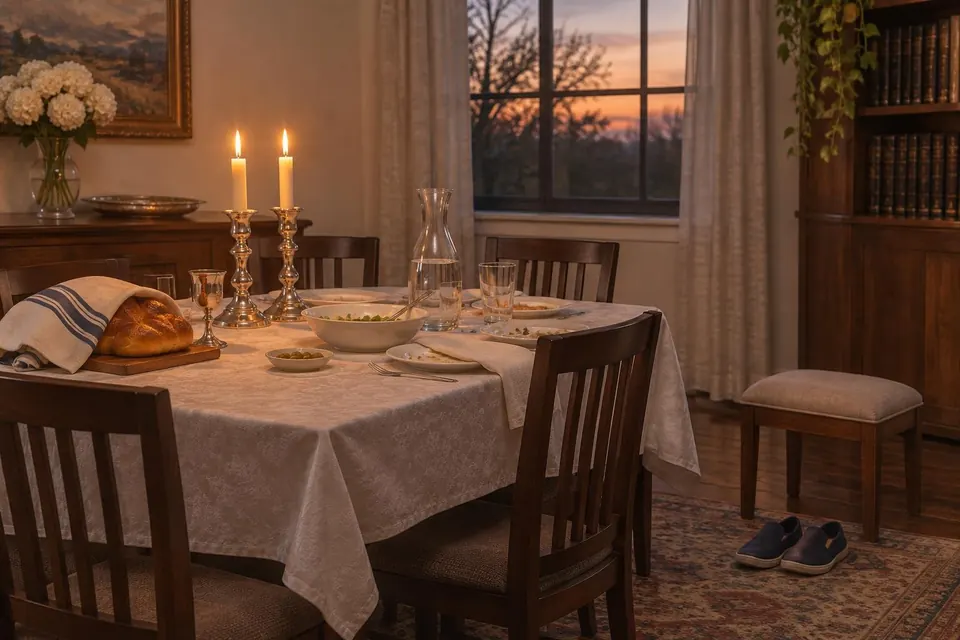
- When Tisha B'Av falls on Shabbat, the fast is postponed to Sunday.
- We may eat on Shabbat only until sunset, and Havdalah is postponed to the end of the fast, with a short sentence said to leave Shabbat.
- The sick and certain pregnant women who may not fast make Havdalah before eating, over beer or grape juice.
- The day is also for repairing what destroyed the Temples: idolatry, sexual immorality, bloodshed, baseless hatred, and harmful speech.
Tisha B'Av has its own laws and its own customs. This year, according to the calendar, Tisha B'Av falls on Shabbat. We do not fast on Shabbat, so the fast is postponed to Sunday.
What Is Forbidden on This Day#
Tisha B'Av is a day of mourning, established in memory of the destruction of the First and Second Temples, and it has its own prohibitions. It is a fast: we may not eat or drink. In addition, we may not wash, anoint ourselves with oil or cream, or wear leather shoes, and marital relations are forbidden.
Studying Torah is also forbidden. The reason is that Torah study gladdens the heart: "The precepts of the Lord are right, gladdening the heart" (Pikudei Hashem yesharim mesamchei lev, Psalms 19:9). Tisha B'Av is a day of mourning. There are exceptions, though: we may study what relates to mourning. We may study the history of the destruction of the Temple; the Book of Lamentations (Eichah), which Jeremiah wrote in mourning for the destruction of the Temple, along with the Midrash on Eichah and the commentaries on it; the laws of a mourner from the tractate Moed Katan in the Talmud; the Book of Job; Jeremiah's prophecies of mourning; and the mourning passages in Ezekiel's prophecies.
There is one more exception: a person's "daily order." Someone who reads the chapter about the daily offering (the Tamid) every day may read it on Tisha B'Av as well, because it is part of their seder hayom, their daily routine.
Pregnant Women, Nursing Mothers, and the Sick#
It is interesting that, as a matter of basic law, pregnant and nursing women are not required to fast on the other fasts (the 17th of Tammuz, the Fast of Gedaliah, and the 10th of Tevet), but they are required to fast on Tisha B'Av. This year, however, Tisha B'Av falls on Shabbat and the fast is postponed to the next day. The Mishnah Berurah, citing Rabbi Akiva Eiger, who in turn cites the responsa Shvut Yaakov, says that pregnant women who find it hard may ease the fast for themselves and not fast.
The sick, who may not fast because of their health, and pregnant women who may not fast, must make Havdalah. (Children who do not fast do not make Havdalah.) They should make it when their health requires them to eat: at night for someone who needs to eat at night, and during the day for someone who needs to eat during the day. It must be made right before eating. The question is what to make Havdalah over. Rabbi Elyashiv and Rabbi Shlomo Zalman held that it should be beer, since in very many places in the world beer is an ordinary drink. If someone cannot drink beer, they should make Havdalah over grape juice. It is best not to drink wine on Tisha B'Av, so if not beer, then grape juice. Over grape juice we say "Borei peri hagafen," but it is still not wine. Rabbi Elyashiv and Rabbi Shlomo Zalman held that Havdalah may also be made over natural, freshly squeezed orange juice. This does not mean the bottled kind, where it is not known how much actual juice it contains. If the bottle does contain natural orange juice, then perhaps that works too. If the doctors say that you should not fast, you should not fast.
Shoes, Washing Hands, and Sitting Low#
We do not wear leather shoes; we wear non-leather slippers. Nowadays there are many kinds of non-leather footwear. Some people try to wear shoes that let them feel the hardness of the ground they walk on. According to the Shulchan Aruch, though, it is enough simply not to wear leather shoes.
In the morning, when we get up, we wash each hand three times. This is permitted, but we wash only up to the end of the fingers, that is, to the knuckles where the fingers meet the hand [Orach Chaim 554:10]. If the hands get dirty, they may be washed as much as necessary to remove the dirt.
On the night of Tisha B'Av and in the morning, we do not sit on chairs but on something low, such as low stools or a cushion, and we recite the Kinot (elegies). A question: Rabbi Yosef Karo writes that on Tisha B'Av we sit on the floor, but he does not mention stools or benches, so where did they come from? Sitting on something very low is like sitting on the ground, and that is the custom. According to Kabbalah, it is generally not customary to sit directly on the ground; instead, people put something underneath. In our synagogue the stools are very low, up to about 25 centimeters (about 10 inches) high. I know that mourners, by law, are also supposed to sit on the ground, but usually they sit on very low stools. It is permitted to sit on the bottom step of a staircase.
The Transition from Shabbat to Tisha B'Av#
Yesterday I gave a detailed lesson on the transition from Shabbat to Tisha B'Av. Not everyone heard it, so I will repeat it. On Shabbat we may eat anything without any restrictions, including meat, wine, and grape juice, but only until sunset. The reason is that twilight of Tisha B'Av is forbidden: "On Tisha B'Av, twilight is forbidden" (Tisha B'Av bein hashmashot shelo asur). Bein hashmashot is the time between sunset and the appearance of the stars. It is a doubtful time, which may belong either to the day that has just ended or to the next one. Since twilight of Tisha B'Av is forbidden, we may no longer eat or drink. The Talmud asks: but isn't public mourning forbidden on Shabbat? And it answers that a person's not eating or drinking is neither public mourning nor a fast, because they ate and drank all day and are not hungry. That is why we must finish eating before sunset.
Leather shoes are different. On the one hand, we may not show public mourning on Shabbat, and taking off leather shoes and walking without them is a sign of mourning. For that reason, people wait until the stars come out. But it seems to me that nowadays very many people have comfortable non-leather slippers and are ready to walk in them on Shabbat too; they even find it more comfortable. They may put on these slippers before sunset. Then they will not be walking in leather shoes even at twilight, and at the same time, on Shabbat, this will not be public mourning.
Two conditions are needed before we may do work after Shabbat. First, Shabbat must end. It ends when three stars appear, and that time is given in the tables. Second, the person must "leave Shabbat" on their own. Usually we leave it with the words "Atah chonantanu" in the prayer that mentions the departure of Shabbat, or afterward with Havdalah over a cup of wine, which speaks of the separation between Shabbat and the weekdays. This time we may not drink or eat, so we do not make Havdalah at the end of Shabbat. It is made the next day, at the end of Tisha B'Av. Until Havdalah, we may not do work. So that women who do not pray Maariv can also work, and men can light a fire, we say a short sentence that does not mention God's Name: "Baruch hamavdil bein kodesh lechol" ("Blessed is He who separates between the holy and the ordinary"). It can also be said in Russian. With this we leave Shabbat and may light a fire, do work, and so on.
Tomorrow's Havdalah is fairly short, just two blessings. If it is made over beer: "Shehakol nihyah bidvaro" and "Baruch hamavdil bein kodesh lechol."
If a woman always makes Havdalah herself and says "Borei meorei haesh," then in the evening she needs to say only that one blessing. "Borei meorei haesh" is said only at the end of Shabbat. The next day, as they say, the train has left. At the end of this Shabbat we do not say the blessing over spices (besamim) at all: it is Tisha B'Av, and we do not seek pleasure. And the next day, at the end of Tisha B'Av, we say only "Borei peri hagafen" and "Baruch hamavdil."
The Order of Prayers#
In the evening, we go to the synagogue. Usually two candles are lit and "Borei meorei haesh" is said over them; this is usually done in the synagogue. Whoever wants to may do it at home, but first they must say "Baruch hamavdil bein kodesh lechol," then light the candles and say the blessing, and in this way they also fulfill the obligation for their wife. Then, in the synagogue, we pray, read Eichah and several Kinot, and then say "Veatah kadosh" and "Aleinu."
The next morning in the synagogue, we read from the Torah and, as the Haftarah, a passage from the prophet Jeremiah. Then we sit on the ground or on something low and recite the Kinot. This lasts until noon: in ordinary minyanim the Kinot stretch out almost to noon, while those who pray early (vatikin) finish sooner. After noon, some customs ease the mourning slightly. I stress that these are only customs, not laws. The laws of Tisha B'Av apply all day. Not sitting on chairs also applies only until noon.
In the morning we do not wear a tallit and tefillin. We wear only the small tallit under our clothes, without a blessing. At Mincha we already put on the tallit and tefillin. At Mincha we read from the Torah and from the Prophets and we pray, but we do not say Tachanun on Tisha B'Av. Mincha may be prayed half an hour after noon, and some pray close to sunset. I am used to praying Mincha early, as my father, of blessed memory, did. I will tell you, it feels somehow unpleasant and awkward not to have put on tefillin yet. That is why we put on tefillin at Mincha.
In the Amidah of Tisha B'Av, nothing is left out; we say it as usual. We only add what is added on every fast day, "Anenu," and on Tisha B'Av also "Nachem," in the blessing "Veleyerushalayim ircha" ("Return to Jerusalem, Your city"). "Anenu" is added in the sixteenth blessing, "Shema kolenu" ("Hear our voice"). We Ashkenazim say both "Anenu" and "Nachem" only at Mincha, while the chazan (shaliach tzibbur) says them in the morning as well. Sephardim in Jerusalem say "Nachem" and "Anenu" in all the prayers.
At Shacharit, the Korbanot (the passages on the sacrificial offerings) are read only by someone who always reads them; for that person, they are part of the daily routine, and the same goes for the chapter on the Tamid. As for the Ketoret (the passage on the incense offering), some read it and others move it from the morning to the time before Mincha. Pesukei DeZimra (the introductory psalms of praise) are read as usual. In some customs people are more lenient after noon, but by law the whole of Tisha B'Av is subject to the same rules.
A question: is there a difference between the evening and morning readings of Eichah? Of course there is. The evening reading is a more binding custom than the morning one. I will go further: in the minyan where I pray in Jerusalem, when it is read from a scroll, the blessing "Al mikra Megillah" is said.
Meat and Wine After the Fast; Showering, Nails, Cleaning#
A question: Rabbi Yosef Karo writes that on the night of the 10th of Av, to which the fast has been moved, we may not eat meat or drink wine, but from early morning on the 10th we may. The Ashkenazi community, however, says that the fast lasts until noon of the 10th of Av. Where does the difference come from? The difference is between the Mechaber, that is, Rabbi Yosef Karo, and the Rema (Rabbi Moshe Isserles). According to the Mechaber, we may not eat meat or drink wine for the entire 10th day, because it was on that day that the Temple was burned. The Rema is more lenient: by custom, we refrain only until noon, and after noon it is permitted. That is in ordinary years. This year the fast of Tisha B'Av is postponed to the 10th, and when our fast ends, the 10th of Av has also already ended: we are in the 11th. So the reason of "the tenth" does not apply. But the Rema still writes that in the evening we do not eat meat or drink wine, but in the morning we may. The explanation is in the Magen Avraham: it is not that this is the tenth, but something else. The severity of a fast and mourning like Tisha B'Av is still felt in the evening, when it ends, and we do not leave it with meat and wine. But the next day, everything is permitted. Cutting hair, bathing, and doing laundry are permitted already in the evening. This is written unambiguously by Rabbi Shlomo Zalman.
A question: may we cut our nails now, in honor of Shabbat? I did not find a clear answer. The Mishnah Berurah writes that the ban on cutting nails applies only to the week in which Tisha B'Av falls. The Shulchan Aruch gives two opinions on whether a week when the fast is postponed is called "the week in which Tisha B'Av falls": the first opinion is no, the second is yes. I have not clearly seen how this is followed in practice.
A question: may we wash the floor today in honor of Shabbat? It seems to me that the question here is a practical one. If the house is in order and you just want it to shine, then probably not. But if it is truly dirty, then for the honor of Shabbat it should be cleaned and put in order.
A question: may we take a shower before Shabbat? As I think I said at yesterday's lesson, it may be possible to take a shower that is neither hot nor cool but lukewarm. First, we do not have a cold climate; we sweat and get rather dirty. Perhaps there is a permission here for a sensitive person, combined with the honor of Shabbat. Probably yes. And in Europe? I do not know. It depends on the climate, on how much you sweat, and also people differ in sensitivity, as do different groups of people.
A question: if we wash with cold water, does that mean the body should be washed with warm water? This is a question not of pleasure but of washing. Washing in hot water is definitely bathing; in cold water it is not quite bathing. People bathe in hot or moderately hot water. I meant that we may wash the body with cold or slightly warm water, which is not quite bathing. A further question: and what about washing with cold water and soap, or at least the head with shampoo? The Mishnah Berurah writes that someone who washes in hot water every Friday may wash their face, hands, feet, and head in hot water this Friday; and it says: without soap, without shampoo. There is a lenient opinion permitting shampoo, and I am speaking of the face, hands, feet, and head, not the whole body. As for cold water, that is, as you said, not really washing. I will say it simply: I believe that taking a shower with water that is not hot but medium, since we have been sweating, is permitted.
A question: may we walk in parks on Shabbat before Shabbat ends? It seems to me that in the first half of the day, until noon, we may. For the second half, the Rema writes that we should behave somewhat as on Tisha B'Av. I think there is no problem until noon, but after noon, probably we should not.
The "Fast Pill" and Grape Juice#
A question: may we take a "fast pill" on the eve of Shabbat? If it is a liquid (there are special liquid preparations, some kind of concentrate, I think made from herbs; I am not an expert), then it is all clear: they can be prepared before Shabbat, half mixed with water in one cup and half in another. As for a pill, there is an opinion that it may be put in advance, before Shabbat, into, say, compote or fruit jelly, and eaten together with it.
By the way, someone told me an interesting thing. After the Six-Day War, he served in the Israeli army in Sinai, where the supply of food was very poor at that time. On the eve of Yom Kippur they had almost nothing, but they had a lot of grape juice, and that year before Yom Kippur he mostly drank grape juice. Suddenly he felt that the fast had passed very easily. I heard this from him, and now I try to drink grape juice before Yom Kippur: a glass, two, two and a half. Usually on the eve of Tisha B'Av we may drink neither wine nor grape juice, but this year Tisha B'Av falls on Shabbat, and on Shabbat grape juice may be drunk freely. Specifically juice, not wine? We may drink wine too; there is no prohibition, but that person was talking about grape juice. Perhaps it is the glucose, which enters the bloodstream and makes the fast easier. Obviously, a person with diabetes must not do this. For someone whose blood sugar is normal, I do it, and I think it eases the fast for me.
What We Remember on This Day and What We Must Repair#
Tisha B'Av is a great day. We serve God in different ways. On this day we remember the destruction of the Temple and, in addition, the tragedies that befell the Jewish people throughout all the years of exile: the crushing of the Bar Kochba (Ben Koziba) revolt, the Crusades, the expulsion from Spain, the pogroms of Bohdan Khmelnytsky, and the terrible tragedy of the Jews in the Second World War. There are special elegies about the Crusades, inserted into the Kinot. People of the previous generation who lived through the Second World War wrote about its tragedy; among them is Rabbi Michael Dov Weissmandl, who went through all of it and tried to help and save many people.
On the meaning of the mourning of Tisha B'Av, and of mourning in general, Maimonides (the Rambam) writes that one of its spiritual purposes is to understand what caused these disasters and why the First and Second Temples were destroyed. The Talmud in tractate Yoma says that the First Temple was destroyed because of three grave transgressions: idolatry, sexual immorality, and bloodshed (Yoma 9b). In Pirkei Avot we read that exile comes because of idolatry, sexual immorality, bloodshed, and the desecration of the holiness of the Holy Land of Israel in the seventh year, that is, failure to keep the Sabbatical year (Shemitah) (Mishnah Avot 5:9). Thank God, there are farmers who keep Shemitah. I am not a farmer, so what can I say. But we must repair this.
The opposite of idolatry is keeping Shabbat: it is a declaration that God created the world and that He alone is the Master of the world. The Talmud in tractate Shabbat says that whoever keeps Shabbat with all its rules and laws is forgiven, even if they once served idols (Shabbat 118b). The Taz explains that this refers to someone who has repented and stopped serving idols; but idolatry is a terrible transgression, and it is not easy to make up for it. Keeping Shabbat according to all its laws repairs past idolatry. That is why it is so important to study the laws of Shabbat: how can you keep them properly if you have not studied them? Someone who already knows the laws of Shabbat can study them in depth. Someone who has not yet had time to learn them should ask what is permitted and what is forbidden, and what they do not know, they should not do: anything that might turn out to be forbidden work, they should not do.
The Second Temple, according to the Babylonian Talmud in tractate Yoma, was destroyed because of baseless hatred. According to the Jerusalem Talmud, also in tractate Yoma, it was destroyed because of lashon hara (harmful speech). Harmful speech and baseless hatred pull toward each other, and these are the two reasons why the Second Temple was destroyed. This too we must repair: not to speak ill of other Jews and not to harbor hatred toward other Jews.
Answers to Other Questions#
A question: which prayers does a woman say on Tisha B'Av? A woman who prays the morning prayer and Mincha prays them on Tisha B'Av too. She may say the Kinot in part or in full, as she is able.
A question: what is permitted and what is forbidden for children on the fast? Children are children. First of all, they are given food and drink, but not candy or sweets on Tisha B'Av. They are told about the destruction of the Temple at their own level and understanding. Demanding that children not play and so on is not our job: that is what children are for.
A question: which mussar (ethical teaching) books may we read? This question was also discussed with regard to mourners, and the laws of Tisha B'Av are the same as those of mourners. The opinion of the Meiri is cited that mussar books may be read. The question is which ones and how much. It seems to me that Mesillat Yesharim (The Path of the Just), Chovot HaLevavot (Duties of the Heart), or Orchot Tzaddikim are fine. But books that are more like research, for example Daat Tevunot by Rabbi Moshe Chaim Luzzatto, are not a mussar book. But on the Meiri, I think, there is someone to rely on, as in the case of Mesillat Yesharim and Orchot Tzaddikim.
A question: may we go to the cemetery on Tisha B'Av and recite Psalms at the grave of ancestors or righteous people? There is a custom to go to the cemetery on Tisha B'Av; the Rema writes that people go to the graves. Whether Psalms are recited there on Tisha B'Av is not clear, and I do not know. Another question: they say that we may not put a book of Psalms on a bed because of the spirit of impurity on the body, so how can we recite them over the deceased? I did not understand: a person sits next to the deceased and recites Psalms, so what does a bed have to do with it? Where is it written that we may not put Psalms on a bed? Putting a book of Psalms next to you while you are lying down is disrespectful to a holy book, but there is no prohibition.
A question: how can one convert to Judaism? The answer is a general one. There are two sides. First of all, a person must know what Judaism is: study it, and see Judaism in life and in practice, because when making a decision you need to know what it is about. Second, how to convert in practice: only through a beit din that handles conversions. The question is where the person lives and where such batei din exist.
From a lesson by Rabbi Ben Zion Zilber
Practical law. This page reports a ruling given for a specific question. For your own situation, ask a rabbi who knows you.
Keep reading
More →
Why Did Rabbi Akiva Laugh at the Temple Ruins?
Tisha B'AvCan Freely Given Love Heal Baseless Hatred?
A Midrash about Rachel’s plea helps explain how love can repair the damage caused by hatred.
Guide · Tisha B'AvShowering and Bathing During the Nine Days
Customs differ, and the restriction on washing applies to washing for pleasure.
Guide · Tisha B'AvThree Weeks Laws: What Is Forbidden?
- The Fast of the 17th of Tammuz
- Mourning Laws Beginning on the 17th of Tammuz
- An Unfavorable Period







