The Candle of Trust
Stories of trust in God, from the splitting of the sea to the yeshiva of Novardok.

In brief
- The tribe of Benjamin trusted God and entered the sea before it split.
- A candle in Novardok commemorated an unexpected answer to Rabbi Yosef Yozel’s need for light.
- When the candle melted in a fire, the rabbi saw a lesson in its loss.
- The rabbi of Ponevezh told how he obtained land for a Torah education complex.
Trust at the Sea#
The Talmud (Sotah 36b) relates that Rabbi Meir said: “When the people of Israel stood at the sea, the tribes argued with one another, each wanting to enter the sea first. While they were arguing, the tribe of Benjamin sprang forward and entered first. As it says in Psalms (68:28): ‘There is Benjamin, the youngest, ruling over them.’ Do not read it as rodem (‘ruling over them’), but as rad yam (‘descended into the sea’).”
At that moment, Moses was praying at length. God said to him, “My beloved ones are drowning in the sea, and you stand here praying to Me at length?”
Moses asked, “Master of the universe, what can I do?”
God answered, “Speak to the children of Israel and tell them to go forward. And you, lift your staff, stretch out your hand over the sea, and split it, so that the children of Israel may pass through the sea on dry land” (Exodus 14:15–16).
The Maharsha explains that the tribe of Benjamin trusted the Creator’s words, spoken through Moses: “Speak to the children of Israel and tell them to go forward.” They understood that they had to go, because the sea would not stand in their way. The other tribes did not rely on this command to the same degree and were afraid to enter the sea. They needed Moses to lift his staff and stretch out his hand, and the sea to split. Then they too went forward.
Leviticus (25:19) says, “The land will yield its fruit, and you will eat your fill and live securely in the land.” Rashi comments that they would not have to worry about years of drought. Rabbi Elimelech of Anipoli explains this verse in his book Noam Elimelech, in the name of his brother Rabbi Zusha: When people rely on the Creator and do not worry, they are promised abundance from Heaven.
But if they say, “What will we eat in the seventh year, when we will neither sow nor gather our crops?” God answers, “I will command My blessing for you in the sixth year, and the land will yield a crop sufficient for three years” [Leviticus 25:20–21]. When people worry and do not rely sufficiently on the Creator, a special command is needed to bring that abundance into the world.
The same thing happened at the sea: The tribe of Benjamin relied on God and entered the water, and the sea split before them. The other tribes, who hesitated, needed a special command for the sea to split.
The Candle of Novardok#
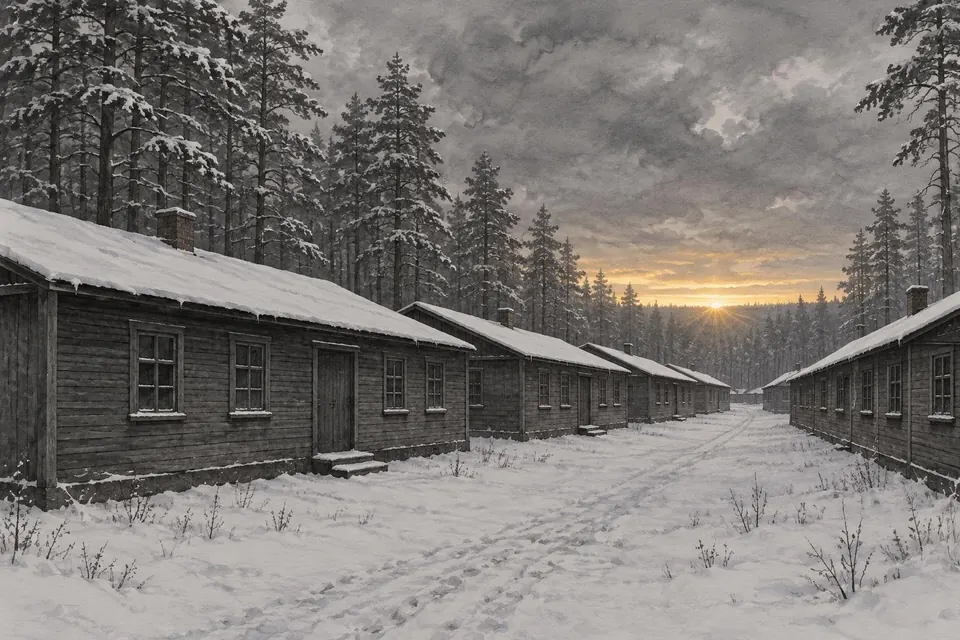
On the eastern wall of the Novardok yeshiva, beside the seat of the head of the yeshiva, an extinguished candle was once mounted. It was called the “candle of trust.” The entire yeshiva knew about it. The Elder of Novardok himself mentions it in his book Madregat HaAdam (Darkei Bitachon, chapter 2), and the Steipler even wrote a poem about it in Karyana DeIgarta (part 1, letter 334).
What was this candle? Once, Rabbi Yosef Yozel went to a nearby forest to examine his life and pray to the Creator in solitude, and he discovered an abandoned hut. Woodcutters had once lived there, but when they finished their work in that area, they left the hut as it was.
The rabbi was delighted. He cleaned the hut and put it in order, brought his books there, and made it his place of study and prayer. From time to time, when he wanted to reach a new level in his service of the Creator, with nothing to interrupt his self-examination and deep reflection, he would take his tallit and tefillin and stay in the hut for several days.
One night, Rabbi Yosef Yozel lit a candle and began studying Torah by its light. He studied with inspiration and devotion for one hour, then another, then a third. The candle went out, leaving him in darkness.
He sat down and waited, without even beginning to pray. After all, God was right there with him and surely knew that he was in the dark and needed light. Surely He would take care of him. All the rabbi needed to do was wait calmly.
Suddenly, the door of the hut opened. A man came in with a lit candle, placed it in the holder in place of the one that had gone out, and left without a word. The rabbi did not puzzle over who the man was: Elijah the prophet, or even an angel from heaven. What difference did it make who the messenger was? What mattered was Who had sent him: a kind Father in Heaven.
The rabbi returned to his studies and worked diligently until morning. At daybreak, Rabbi Yosef Yozel put out the candle. Later, he returned to the yeshiva and placed it beside his study lectern as a keepsake, calling it the “candle of trust.”
Some time passed, and a fire broke out in the town. The houses were made of wood, with thatched roofs, and fires burned them to the ground. The yeshiva students rushed to carry the Torah scrolls, tefillin, and all the sacred books out of the building. Then they prayed to God with all their might, pleading with Him to revoke the harsh decree.
The Master of the universe heard their prayers. The wind changed direction, and the fire went out. The entire yeshiva building remained safe and intact. Only the “candle of trust” had melted in the heat. Everyone was very upset that they had forgotten it and had not taken it out with the sacred books.
Only Rabbi Yosef Yozel himself was not troubled. God had given the “candle of trust,” and He had taken it away, to show us that we do not need symbols in order to trust Him.
The Rabbi of Ponevezh’s Story#
The rabbi of Ponevezh told me: “When I taught in Novardok, the ‘candle of trust’ no longer existed. But I don’t need it to know how well trust in the Creator is rewarded.
“When I became chief rabbi of Ponevezh, I decided to make it a stronghold of Torah. I opened a cheder, a Jewish elementary school, a yeshiva for younger students, a yeshiva for older students, and a kollel, a place of Torah study for married men. I also opened a high school and a college for girls.
“All these institutions were scattered among different buildings that we rented from local residents. This was very difficult, especially from an educational standpoint. It also made it hard to increase the number of students. I decided to buy a large tract of land and build all the institutions together in one place.
“I learned that the local priest, a descendant and heir of a noble family that had ruled the area, wanted to sell a large tract of forest near the town. His asking price was very favorable, just 25,000 rubles, but on one condition: The entire sum had to be paid in cash.
“Where was I supposed to get that kind of money? But I decided to sign a preliminary contract with him and then go to various philanthropists and inspire them to help with this ambitious project. I asked the priest to wait three months. But he insisted: The land was really worth 100,000. Discounted, it would be 50,000. The price of 25,000 was only if it was paid in cash.
“I had 5,000 rubles that I had received as my wife’s dowry. My father-in-law, the chief rabbi of Vidzh, had saved the money he received for conducting court proceedings and the like, and had given it to me so that, in due course, I would be able to marry off my children without financial worry. I consulted my wife, and she agreed.
“I offered the priest the money as a down payment. If I failed to bring him the remaining 20,000 in three months, he would keep it as a penalty. The priest agreed, and we signed a contract.
“I went from one wealthy man to another, knocking on doors and telling them about the great merit they could earn. They all answered that they would be happy to help—but not just now. One had invested his money in a business deal and would make a profit in six months. Then he would give me a generous sum. Another was due to be repaid a large debt in four months and would gladly give me 2,000. And so it went.
“In short, I received promises totaling enough not only to cover the purchase but also to begin construction—but I had no cash.
“The payment date kept getting closer. There were just two days left: On Sunday, I had to pay the promised sum or lose the 5,000. And for Shabbat, we were honored with distinguished guests: my father-in-law and mother-in-law.
“When they arrived, they noticed that their daughter was worried about something. They asked her, and she told them. Oh, how angry they were, and how they criticized me. What was this rush? What reckless carelessness! A young rabbi in a small town, dreaming of a huge educational complex—and for this he was giving away everything he had, his financial foundation.
“In short, the kind of Shabbat I went through is something I could wish only on the enemies of Israel.
“At the end of Shabbat, after Havdalah, I hurried to say goodbye to my distinguished guests and went to the synagogue, trying to drown my sorrow in the study of Torah, which brings joy to the heart. I became absorbed in the subject and forgot everything else in the world. I remembered neither the debt nor the deadline for paying it.
“Then I suddenly grasped a principle that answered all the questions on the subject and clarified everything that had been unclear. I was filled with joy and looked up from the Talmud. It was two in the morning. Surely, I thought, the guests had already left, and I could go home.
“The town was asleep, and no lights were on anywhere except in one house: mine. I realized that my father-in-law and mother-in-law had apparently decided to wait for me. Oh well, there was nothing to be done. I opened the door and saw that people were indeed waiting for me. But it wasn’t my wife’s parents. It was the two wealthiest men in town.
“When they saw me, they stood up and announced that congratulations were in order: Their children were engaged.
“Of course, I congratulated them with all my heart. But people don’t wait for someone until two in the morning just for that. It turned out that they had each set aside a generous dowry for their children: 10,000 from each side. The wedding would take place in six months, and in the meantime they wanted to leave the money with the rabbi for safekeeping. Twenty thousand in cash.
“‘Look,’ I said, ‘I don’t have a safe at home, and I can’t accept that responsibility. I can take it only if you allow me to use the money in the meantime to build the educational complex. I’ll undertake to return it to you in six months.’
“They nodded. Of course, they agreed. No problem.
“I counted the bills and wrote a note acknowledging the debt. We drank lechaim, a toast to life, and they left. I didn’t go to sleep; I stayed up to guard the money. I attended the earliest morning service, vatikin, timed so that the Amidah is said at sunrise, and immediately afterward went to the priest.
“Oh, how disappointed he was when I gave him the required sum and the land became mine. And what do you think? We built an educational complex there with about 2,000 students.
“But that morning, I was walking home happily when I suddenly saw the wealthy men waiting for me again. What had happened? Serious disagreements had arisen, and the engagement was off. They had come to ask for their money back.
“‘I no longer have the money,’ I answered. ‘As we agreed, I’ll return it in six months. Perhaps even sooner.’ I should add that all my sponsors fulfilled their commitments, and the entire sum was repaid.
“So who needs a ‘candle of trust’?”
Keep reading
More →Do Segulot and Red Strings Really Work in Judaism?
Why Did God Create the World? A Reflection on Eikev
A reading from Isaiah and a teaching of Nachmanides explore the purpose of creation and the role of the Jewish people.
Jewish BeliefsWhat Does God’s Image Mean for Human Power?
Being created in God’s image gives human actions consequences that can reach far beyond what we can see.