Nitzavim-Vayelech: Free Will and Choosing God
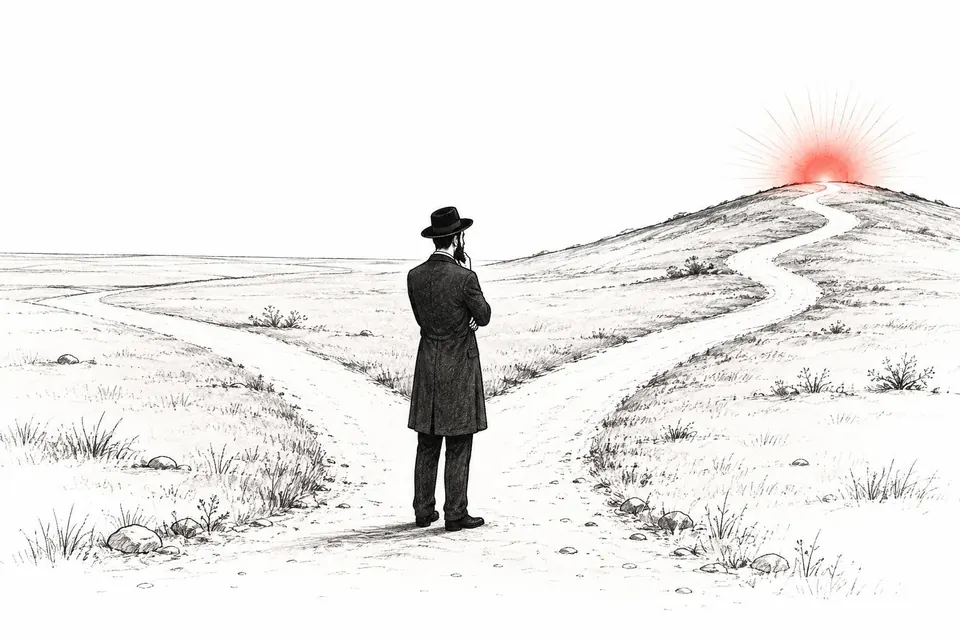
The Torah’s account of free will reaches beyond the choice between individual actions.
In brief
- Free choice is more than a decision between two actions.
- The Torah teaches that people have a power of choice that is not merely a response to prior causes.
- A person can choose to define life by attachment to God rather than by the pursuit of pleasure.
- Tefillin on the head allude to this attachment to the Creator.
Parashat Nitzavim#
“Choose life” (Deuteronomy 30:19).
We usually think of free choice as the ability to say yes or no—for example, to study Torah or waste time. That is indeed part of choice. In our sacred books, choice is called daat, the ability to make a well-considered decision.
But there is a deeper level of choice, which is true choice.
When we say, “Who chose good prophets” in the blessing before the Haftarah (the reading from the Prophets), we do not mean that God, Heaven forbid, was unsure whether to rest His Shechinah (Divine Presence) upon bad prophets or good ones, and ultimately chose the good ones. And when we say, “You chose us from among all the nations” [Festival Amidah], we do not mean that there was uncertainty about whether to choose the people of Israel or other nations. We mean that the choice was absolute. God chose the good prophets and the people of Israel absolutely.
In the same way, a person has been given freedom of choice. Each of us can decide with absolute certainty who we are and what we want from life.
Today, however, if a boy in a family constantly fights and hurts others, his mother rushes to take him to a psychologist to find out why he behaves this way. And what do modern psychologists say? “The child is not to blame. When he was little, he was treated in such and such a way, and that shaped his personality. An emotional wound inflicted in childhood is showing itself now.”
The mother says, “If that’s true, then I’m to blame…” But the psychologist answers without hesitation: “No, you’re not to blame. Your parents…” The psychological approach maintains that no one is to blame. A person is a chain of reactions, and every reaction has a cause, every cause has a cause before it, and there is no first cause at all. It follows that a person is not responsible or to blame for their actions. A person is merely a computer that operates according to the data programmed into it. This is the widespread approach today: A human being is really an animal endowed with intelligence.
What is the approach of the holy Torah?
The Torah says that, yes, there are chains of reactions. But at the starting point there is a power called free choice—and that choice is absolute, existence from nothingness.
God gave human beings the power to choose, and each person chooses good or evil. It is hard to understand how this actually works, because it is a point of the Divine. A person chooses, and that choice is not a reaction to something else; it is the person’s own point of choice.
A person has two choices: to choose God or to choose idolatry. We know what it means to choose God, but what does it mean to choose idolatry?
If we ask an ordinary person what they want in life, they might say: “I want a comfortable life, without pain, suffering, or debt. I want joy from my children and a good, peaceful life.”
Although at first glance there is nothing wrong with these desires, the Sages tell us (Shabbat 105b): “‘There shall be no foreign god within you, and you shall not bow to an alien god’ [Psalms 81:10]. What foreign god is within a person? It is the yetzer hara, the evil inclination.” In other words, if a person’s life is defined by the desire for pleasure, however kosher those pleasures may be, that is idolatry. Such a person’s “self” is their evil inclination.
A person’s true obligation is to choose to be defined by attachment to God. The point responsible for this choice is at the top of the head, where the brain is. This is where tefillin are placed. When tefillin are on a person’s head, they allude to the fact that the essence of a person is attachment to the Creator.
This is the essence of a person: to connect their very first, highest point to God, blessed be He.
By Rabbi Shimshon Pincus
Keep reading
More →Do Segulot and Red Strings Really Work in Judaism?
Why Did God Create the World? A Reflection on Eikev
A reading from Isaiah and a teaching of Nachmanides explore the purpose of creation and the role of the Jewish people.
Jewish BeliefsWhat Does God’s Image Mean for Human Power?
Being created in God’s image gives human actions consequences that can reach far beyond what we can see.








