Does Everything Happen for a Reason in Judaism?
Maimonides and the Sages urge us to reflect on hardship rather than dismiss it as chance.
In brief
- Maimonides teaches that hardship should prompt repentance rather than be dismissed as chance.
- The Sages looked for lessons in events that happened to them.
- Recognizing God’s hand in hardship is a spiritual achievement, even when a person’s conclusions are mistaken.
- A story about the author of Baruch Taam illustrates how easily such a lesson can be misunderstood.
Maimonides (the Rambam) writes that one path to repentance is to recognize, when hardship strikes, that it has come because of one’s wrongdoing. As the prophet Jeremiah says: “Your iniquities have turned these things away, and your sins have withheld good from you” (Jeremiah 5:25). This outlook can also help a person bring the hardship to an end (Maimonides, Laws of Fasts 1:2–3).
But if a person does not awaken and cry out to God in prayer, and instead says, “What happened to me was a natural event; it was just chance,” that is a cruel path (cruel, first of all, to oneself—translator's note). On that path, a person becomes ever more deeply mired in wrongdoing, and further troubles are added to the first. As it says in our Torah portion: “If you continue to act toward Me as if by chance, I will act toward you with the fury of chance” [Leviticus 26:27–28].
In other words, God says: I will send you hardship so that you repent. But if you say it was chance, I will add to your troubles on account of that very belief. In addition to punishment for the sin, there will be punishment for the outlook that troubles come about by chance.
Recognizing God’s Hand#
The Talmud tells us that Rabbi Yochanan heard his nephew, the young son of Reish Lakish, reading a verse from Proverbs aloud: “A person’s foolishness twists his path, yet his heart rages against God” (Proverbs 19:3). Rabbi Yochanan wondered how a verse in the Writings could have no hint of it in the Torah, the Five Books of Moses.
The boy answered him: “How can you say there is no hint of it in the Torah? It says, ‘Their hearts sank, and they turned to one another, trembling, and said, “What is this that God has done to us?”’” (Genesis 42:28). This was when Joseph’s brothers had been accused of spying, Shimon had been imprisoned, and they had been ordered to bring Benjamin. Then they found their money in their sacks (Taanit 9a).
There is criticism of the brothers here. A well-known commentary explains the verse in the Book of Ruth, “I went away full, and the Almighty has brought me back empty” (Ruth 1:21). When a person is full of blessing from Heaven, they say, “I did this. I achieved it through my own strength, my talents, and my hard work.” But when they are “empty,” poor and struggling, they do not say it is because of their foolishness, laziness, and the like. They say, “The Almighty has brought me back”—their “heart rages against God,” as if to ask, “What is this that God has done to us?”
Yet, honestly, even that is a fairly high spiritual level. The person does not say that it is all chance, that their luck has simply run out. They know that “God has done this to us,” that “the Almighty has brought me back.”
The Driver’s Prayer#
I heard Rabbi Elchanan Wasserman say:
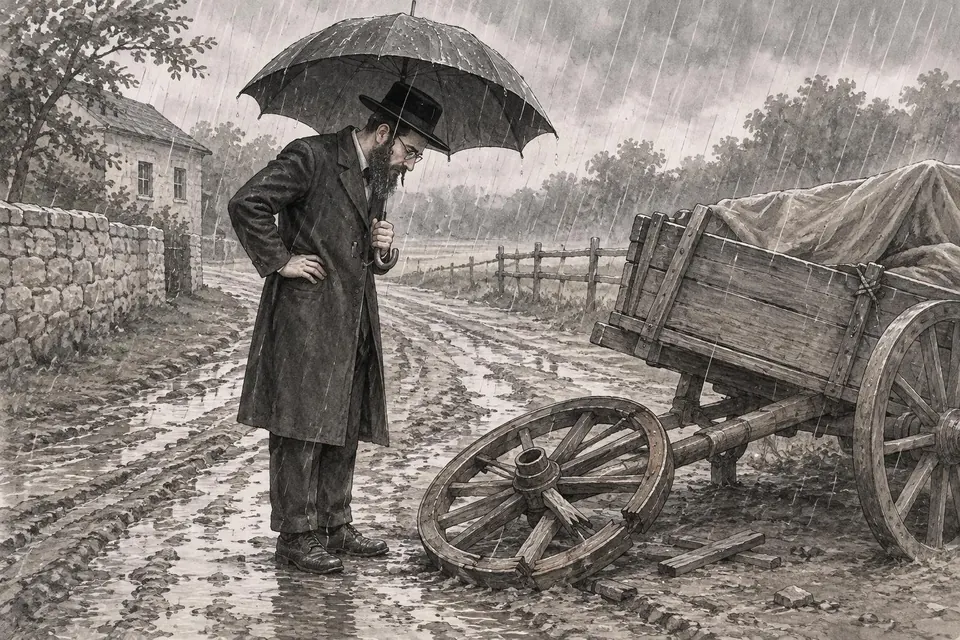
“I remember that about 40 years ago, I was sitting and studying in a synagogue when a carriage driver came in. Everyone knew that his horse had died and that he now had no way to earn a living. Well, these things happen; horses don’t live forever.
“The driver went up to the aron hakodesh (the Torah ark), drew back the curtain, and began to sob bitterly. ‘Master of the world, I have a wife and children to feed. Why did You take my only horse away? Why did You do this to me?’
“I know some people would criticize him. They would say we should accept Heaven’s decree with love, as it says, ‘Should we accept good from God and not accept hardship?’ (Job 2:10). That is true. But at least that driver knew that God had done it!”
Today, if a person gets sick, they go to the doctor. If their car breaks down, they have it repaired. Who asks themselves why God did this to them?
The Angel of Death#
There is a story—honestly, I do not know where it comes from—that the angel of death came to God with a complaint. What kind of injustice was this? He was an angel, just like Michael, Gabriel, Uriel, and Raphael. So why did people admire them and name their children after them, while they trembled at the mention of him and were afraid to say his name aloud? And, of course, no one would dream of naming a son “angel of death.” Why was he so unlucky?
God said to him, “Well, what can I do? I can’t make people love you and name their children after you. But I’ll meet you halfway: no one will mention you anymore, either for good or for bad!”
Since then, they say, his name has disappeared from our lips. What did that person die of? Oh, a heart attack. And this one? Such-and-such an illness. And the next? Oh, he was hit by a car. As a last resort, when there is nothing else to say, people say someone died of old age. Anything but the angel of death.
Looking for a Lesson#
Let us remember what happened when Rav Huna’s 400 barrels of wine turned sour and became vinegar. His friends came to encourage him to reflect and examine his conduct. When he did so and found where he had acted wrongly, the price of vinegar rose, and Rav Huna sold it for the price of wine [Berakhot 5b].
When Rav Pappa slipped and almost fell from a ladder, he examined his conduct to understand why he had nearly received the punishment of sekilah (execution by stoning). And he found something he needed to correct.
When a guest arrived unexpectedly at the home of Rabbi Zeira and Rava, they asked themselves what Heaven was hinting to them through his arrival, and they found an answer (see Moed Katan 17a and Ketubot 67a).
Of course, a person can examine events this way and reach the wrong conclusion.
A Mistaken Conclusion#
The author of Baruch Taam devoted himself to Torah study day and night, with all his strength. His wife worried about his health and urged him to drink at least a glass of tea toward morning, after he had studied from midnight until dawn. But he would not agree to drink before the morning prayer. Only afterward, when he was completely exhausted, would he have a light breakfast.
The rabbi had a wonderful daughter. His son, Rabbi Yehoshua Eshl of Komarno, wrote to him that a great light had appeared in the town of Shargorod: a brilliant young man who studied Torah deeply, feared God, and possessed wonderful character. His son urged him to act quickly and arrange a match with the young man.
The rabbi invited him to visit. When the prospective groom arrived, the rabbi’s heart sank: the young man walked with a limp; one of his legs was paralyzed. What had his son done? Why had he recommended him?
Still, the young man was already there, so the rabbi decided to discuss Torah study with him. Within a couple of minutes, he shared his son’s enthusiasm completely. Such quick understanding, such broad knowledge, such a phenomenal memory, such depth! He was a diamond, the kind one could search for everywhere and never find. Without a doubt, he would be one of the greatest sages of his generation. His son had been right. Fortunate was the woman who would have the privilege of becoming his wife!
He told his wife and daughter everything. His daughter agreed to the match, but his wife objected. Why should their daughter have to marry a man who limped?
As usual, the rabbi rose at midnight and began to study. His wife came in and gave her opinion. The rabbi gave his, but she would not accept it. The atmosphere grew tense. As usual, she offered him a glass of tea. He agreed, not wanting to start another argument that would only make matters worse.
She went to the kitchen, boiled the kettle, and poured a glass of tea. As she carried it to the dining room, she slipped and fell. The glass broke, she broke her leg, and, to make matters worse, the hot tea scalded her. The rabbi hurried to help her up from one side, and their daughter from the other.
She rose with a groan; the pain in her leg was unbearable. But she said she accepted the decree with love: it was a sign from Heaven that she should not have urged her husband to drink tea before prayer!
She had missed the true hint from Heaven: a physical disability does not diminish a person in any way, and Heaven was displeased that she would not agree to the match with the young man.
Nevertheless, the match was eventually made, and she was blessed with a great son-in-law: Rabbi Chaim of Sanz, author of Divrei Chaim.
And she truly deserved him, because she at least understood that Heaven was hinting at something!
By Rabbi Yaakov Galinsky
Keep reading
More →Do Segulot and Red Strings Really Work in Judaism?
Why Did God Create the World? A Reflection on Eikev
A reading from Isaiah and a teaching of Nachmanides explore the purpose of creation and the role of the Jewish people.
Jewish BeliefsWhat Does God’s Image Mean for Human Power?
Being created in God’s image gives human actions consequences that can reach far beyond what we can see.








