What Is the Purpose of Pain and Suffering in Judaism?
Pain can become a source of spiritual growth and a deeper connection with God.
In brief
- The Torah permits a person to seek treatment for illness.
- The Sages teach that God shares in a person's suffering.
- Pain can be a signal to draw on our desire to live and grow.
- Suffering can bring us closer to God, but it can also lead us away from Him.
“And the doctor shall heal” (Exodus 21:19).
“From here we learn that a physician has permission to heal” (Berakhot 60a).
When God sends a person an illness, that person is permitted to try to cure it.
Yet one of the broadest fields in medicine today is pain relief. In the past, doctors concentrated mainly on treating illness. Today there is a whole science devoted to relieving pain, even when the illness itself cannot be cured.
Any pharmacist can tell us that only about 15 percent of the medicines they sell are intended to cure, while all the rest relieve physical or emotional pain.
In the past, people generally thought of pain as part of life. There is a story about a righteous man who suffered terribly from pain in his legs. When he grew old, his family persuaded him to see a doctor, who cured him, and the pain went away. The man said, “Suddenly I discover that it's possible to walk through God's world without pain. I always thought pain was an inseparable part of life. Just as a person sees and hears, so too a person suffers pain.”
Today, however, if something hurts, a person rushes to take a painkiller. If one pill does not help, they take two. Someone in pain cannot function; the whole world comes to a halt. So they hurry to get rid of the pain. Today a good dentist is considered one who treats patients without pain. Even before giving an injection, the dentist sprays the spot with a painkiller.
Let us consider the Torah's perspective on this subject: Is pain really unnecessary, or does it have a role in a person's spiritual work?
When a Person Suffers#
The Sages teach (Sanhedrin 46a) that when a person suffers, the Shechinah (Divine Presence) suffers with them.
My grandfather once told me about a righteous Jew who was caught on the street and beaten by a group of thugs. As they beat him, he cried out, “It doesn't hurt! It doesn't hurt!” Later he was asked what he had meant. He replied, “When a Jew is in pain, God suffers too, and I don't want God to suffer because of me, God forbid!”
When a person suffers, the Shechinah does more than sympathize. The teaching goes much further: the Shechinah, as it were, also suffers and is in pain. We are familiar with the idea of sharing another person's burden. When a friend or loved one suffers, we feel for them and look for ways to ease their distress. But here it is not only that God, as it were, “shares the burden” of the person who suffers. It is more than that: “I am with him in trouble” [Psalms 91:15]. God does not merely “sympathize” with the person in pain; He Himself, as it were, suffers.
When we have a headache, the problem is not only our pain, but God's pain. There is nothing more powerful than pain to bind us closely to God.
But we need to understand how to make this remarkable connection a reality.
Pain is not an end in itself. In the physical world, pain signals that something is wrong in the body. When an infection enters the body, a fever develops. The fever is a warning light: there is a problem in the body, and it needs attention. A vital system is not working properly.
If a person has inflammation but no fever, they are in great danger, because the infection can spread unnoticed throughout the body.
Pain is a signal from God, and it has one clear purpose: to make us draw on the potential of our desire to live.
The Secret of the Ink Drop#
Consider an example. A child is learning to draw with a teacher. Under the teacher's guidance, the child has drawn a wonderful picture of a staircase. The child has worked on it for many days, until it has become a work of art.
Suddenly, a big, ugly drop of ink falls in the center of the picture. The child bursts into bitter tears. After all the effort and time spent on it, the whole work has been ruined.
The teacher comforts the child: “Don't cry. Look: we have a picture of a staircase, and a drop of ink in the middle. Let's add a boy coming down the stairs, and the drop of ink will become part of his clothes.
“Now the picture is even more beautiful than before!”
Our entire life is, in fact, a mystery. Just as there is a mystery in an etrog (the citron used on Sukkot) and in matzah, there is a mystery in life itself. We do not know exactly why we live or what our role in this world is: “The hidden things belong to the Lord our God” [Deuteronomy 29:28].
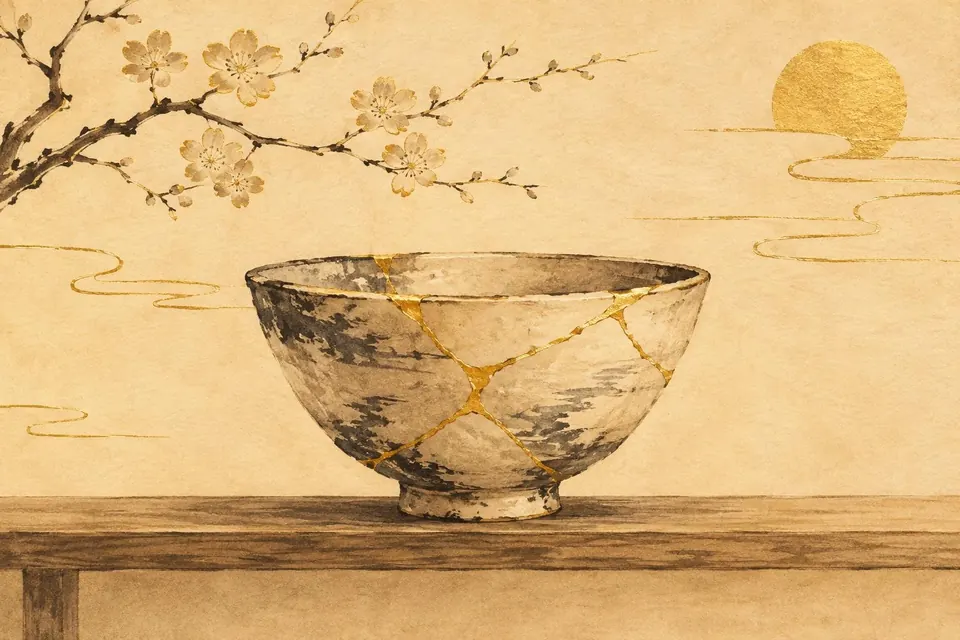
When suffering or any other event disrupts the course of our lives, it is like a drop of ink falling into the peaceful flow of life. There is a mystery contained in that drop; God did not send it for no reason.
What should we do? If we try to erase the drop—if the child tries to erase the drop that fell on the beautiful picture—it will only smear further and ruin the picture completely. If we try to “erase” the drop, our suffering, we will only spoil the whole picture. Instead of trying to get rid of suffering, we need to try to make it part of our lives. We must take it and realize its true meaning, the meaning for which God sent it. We must create “life” from it: flourishing and deeds that will endure forever.
Then our whole life will take on a completely different quality. It will become more wonderful than it was without this suffering.
The Danger in Suffering#
Although suffering offers a wonderful opportunity for a close connection with God, it also carries the danger of becoming separated from Him, God forbid.
When suffering strikes, a person may say, “I don't have the strength to pray now, or the strength to study.” Suffering is like a car: it can easily and quickly take us to distant places. But if we do not know how to drive, it can cause harm, God forbid.
Some sensitive people, when something troubles them or weighs on their hearts, go to the refrigerator and start eating. That is indeed one way to deal with emotional problems. But in doing so, we lose a wonderful treasure. We lose a unique opportunity to draw closer to God. We have been given a wonderful gift: emotional pain. Instead of using it to strengthen our connection with God, we strengthen our connection with cream pastries.
Pain Is Not Sadness or Despair#
The word “pain” is not a synonym for “sadness.” There is joy, and there is sadness. Joy expresses hope, building, and aspiration. Sadness expresses despair.
The Sages say (Bava Kamma 92a), “Poverty follows the poor.” Nothing brings a person wealth more than wealth itself, and nothing brings a person poverty more than poverty itself. When people conduct themselves as important and wealthy people do, that in itself will bring them wealth and importance.
Similarly, we can say that nothing brings a person joy more than joy itself. The best way to awaken joy is to create it artificially, and genuine joy will follow.
When a person is immersed in pain, they should not try to run away from it. By growing accustomed to it and overcoming themselves, they can learn to live with pain. But we must do one thing: learn the lesson pain teaches us. We must take the force that awakens in us the desire to live and grow, and use it for true life: to pray with greater inspiration and concentration, draw closer to the Creator, and become His partner in Creation.
Then suffering becomes a wonderful gift that God gives us.
Suffering is a force that awakens in us the desire for life and the desire to strengthen our spiritual growth. We should use it to grow and rise spiritually.
By Rabbi Shimshon Pincus
Keep reading
More →Do Segulot and Red Strings Really Work in Judaism?
Why Did God Create the World? A Reflection on Eikev
A reading from Isaiah and a teaching of Nachmanides explore the purpose of creation and the role of the Jewish people.
Jewish BeliefsWhat Does God’s Image Mean for Human Power?
Being created in God’s image gives human actions consequences that can reach far beyond what we can see.








