Why Is This World Called Darkness?
The darkness of this world conceals truths that are already before our eyes.
In brief
- The Sages compare this world to darkness and the World to Come to light.
- Darkness does not remove what is there; it keeps us from seeing it.
- The truth of God's unity is present in this world, but its darkness conceals it from us.
- The effort to earn a living is necessary, but livelihood ultimately comes from God.
The Sages use the idea of darkness to describe this world: “You bring darkness”—this is our world, which is like night [Psalms 104:20; Bava Metzia 83b]. Let us think about what darkness means.
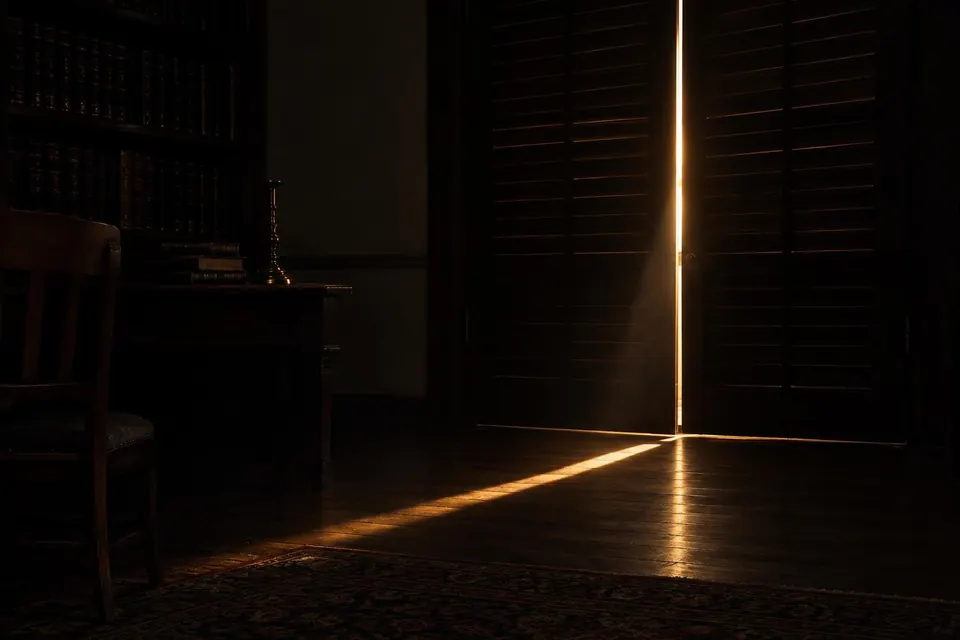
Someone enters a beit midrash (study hall) in the middle of the night, looking for a book. The lights are off, and no moonlight shines through the windows. It is completely dark inside. They feel their way along the walls but cannot find the book they need.
Would it be right to say that because the room is completely dark, all the books have flown out the window and are no longer there? Of course not. The books are in their places, right before the person's eyes, just as they are during the day. The person simply cannot see them. In fact, they are right there.
We can conclude that the difference between darkness and light is not whether something exists. Everything that is there in the light is also there in the dark. The only difference is in the person: In the dark, they cannot see anything.
This world is “darkness,” and the World to Come is “light.” The truth is that the World to Come is already here, revealed before us. The difference between this world and the World to Come is that in the World to Come a person sees the truth, while here, in this world, darkness conceals it.
The whole essence of the World to Come is the unity of God, and in fact, His unity is already “revealed” before our eyes. The reality of the Creator, blessed be He, “whose glory fills the whole earth” [Isaiah 6:3], is the most obvious thing a person can see.
When we see an enormous, magnificent chandelier hanging in the center of a synagogue, common sense tells us that someone hung it there. What is more, we understand that the person was not disabled or paralyzed, because hanging a chandelier requires strength and certain abilities. We can also conclude that the person had some electrical training.
If that is true of a single chandelier, how much clearer are things when we look at this world and try to understand who created the sun and who “hung” the stars. The same is true when we look at the human body and marvel at the complexity of the eye, the brain, and so on. This reality demonstrates the Creator's extraordinary greatness and compels us to recognize how small we are before Him.
Yet even though the reality of the Creator is so clear and proven, there are still people immersed in “darkness.” They do not feel that the Creator watches over them personally, or that their sustenance and livelihood come only from Him, and so on.
I saw with my own eyes a Jewish man who, as soon as he had finished his morning prayer—immediately after Kedushah, the sanctification recited during the prayer leader's repetition—rushed out of the synagogue, grabbed a toolbox, got into his car, and raced off to earn a living...
But this is very strange behavior! The world has a Creator who governs all creatures. A person simply cannot earn anything without God. And they will not receive more than He has decided to give them, whether they work hard or not. The effort to earn a living is only a “penalty” imposed by God after the sin of the first human being. Although we must fulfill the terms of that “penalty,” why run around like a madman?
Yet in the darkness of our world, even this simple truth is hidden from people's eyes!
Chovot HaLevavot (Duties of the Heart) tells the story of a righteous Jew who set sail to earn a living. When he arrived in a foreign country, a local resident asked him which god he worshipped. The Jew began to describe the greatness of the Creator, in whom he believed and whom he served. The man looked at him and said, “Your actions contradict your words. You said that your God is great and all-powerful. Then why did you travel so far to earn a living? Couldn't your God have given you a livelihood where you live?” The Jew felt terrible shame at the question and immediately set off for home to find a livelihood there.
What had been happening to this Jew before that? He was immersed in the “darkness” of this world, the darkness that conceals the Creator's unity throughout creation. The non-Jew's question allowed him to see the light of truth.
By Rabbi Shimshon Pincus
Keep reading
More →Do Segulot and Red Strings Really Work in Judaism?
Why Did God Create the World? A Reflection on Eikev
A reading from Isaiah and a teaching of Nachmanides explore the purpose of creation and the role of the Jewish people.
Jewish BeliefsWhat Does God’s Image Mean for Human Power?
Being created in God’s image gives human actions consequences that can reach far beyond what we can see.