Lech Lecha: Where Is God When We Suffer?
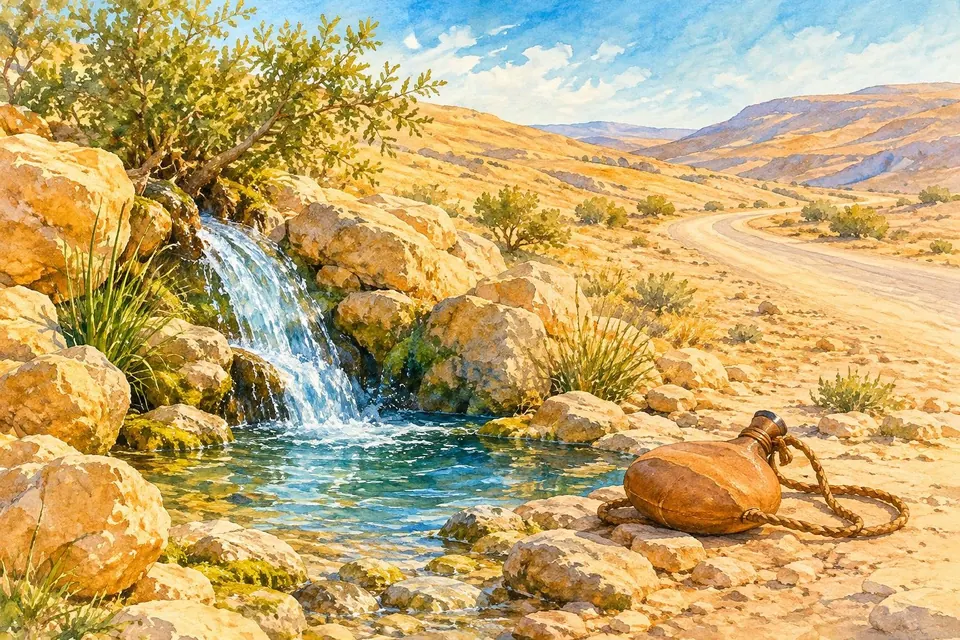
Hagar’s encounter in the wilderness reveals God’s closeness to those in distress.
In brief
- Abraham and Sarah’s home was filled with holiness and miracles.
- Hagar discovered that God was also close to her in the wilderness.
- God is present with a person in distress.
- A time of suffering is a time to turn to God in prayer.
Parashat Lech Lecha#
She called out to God, who had spoken to her: “You are the God who sees.” And she said, “Have I really seen a vision here too?” (Genesis 16:13).
“You are the God who sees” means “the One who sees the suffering of the afflicted.” “Here too” expresses her amazement: Even here, in the middle of the wilderness, I have seen a messenger of the Almighty, after seeing them in Abraham’s home, where I was accustomed to seeing angels (Rashi on Genesis 16:13).
Sforno comments: “You are the God who sees in every place, not only in the home of our forefather Abraham,” as the Sages said: “All the heavenly gates are locked, except the gates of the oppressed” [Bava Metzia 59a].
Let us explain. The home of Abraham and Sarah was entirely like the Beit HaMikdash, the Holy Temple. It was a place filled with holiness, where the Shechinah (God’s Divine Presence) was always present. The miracles of the Temple also occurred constantly in their home. As Rashi explains in his commentary on the portion of Chayei Sarah, a candle burned in our matriarch Sarah’s tent from one Shabbat eve to the next, like the continually burning lights of the Temple. There was always a blessing in her dough, just as there was in the Temple’s lechem hapanim (showbread): If a person ate even a small piece of this bread, they would feel completely satisfied. And a cloud remained over the tent, a sign of the Shechinah’s presence [Rashi on Genesis 24:67].
Angels were constantly present there, and everyone who entered our forefathers’ Holy Temple was privileged to draw as close as possible to the Shechinah.
So Hagar thought that when she fled Abraham and Sarah’s home and wandered through the wilderness, she had left the Temple behind. She believed she had distanced herself from the profound connection to the Creator and the holiness that filled our holy forefathers’ home.
Then, suddenly, she was granted a wondrous revelation: There is another kind of Temple. It is the presence of the Shechinah and the Almighty’s closeness to a person in distress. When a person is in trouble, the Almighty is right there with them and shares in their sorrow, as it says:
For thus says the One who is high and exalted, who dwells forever and whose name is holy: “I dwell in a high and holy place, and also with the crushed and humble in spirit, to revive the spirit of the humble and the heart of the crushed” (Isaiah 57:15).
It also says in Psalms: “When he calls to Me, I will answer him; I am with him in distress” (Psalms 91:15).
How close this is to us. We are not accustomed to seeing angels in our forefather Abraham’s home. If we saw an angel, our souls would leave our bodies from sheer fear and terror. When Manoah saw an angel, he thought he would die at once—and how much more so would we. Yet if our eyes were permitted to see, we would see the Shechinah, together with a chariot of holy angels, the seraphim, coming to a person in sorrow.
And what about us? When even a little trouble comes, we immediately lose our bearings and do not know what to do or whom to turn to.
In fact, at such a time, the words of the prophet Ezekiel are fulfilled for us. He too lived after the destruction of the Temple:
He stretched out what looked like a hand and took me by a lock of hair on my head. A wind lifted me between earth and heaven and brought me to Jerusalem [Ezekiel 8:3].
Whenever someone hurts or insults a person, or some other sorrow befalls them, the Almighty immediately, as it were, runs to them with His entire entourage. In these wondrous moments, a person should intensify their prayers and requests before their Creator. This is a time of divine favor, and the place where they stand is like the Holy Temple. Their prayer is desired and accepted by the Creator, as it says:
For He did not despise or reject the suffering of the afflicted, nor did He hide His face from him. When he cried out to Him, He listened (Psalms 22:25).
By Rabbi Shimshon Pincus
Keep reading
More →Do Segulot and Red Strings Really Work in Judaism?
Why Did God Create the World? A Reflection on Eikev
A reading from Isaiah and a teaching of Nachmanides explore the purpose of creation and the role of the Jewish people.
Jewish BeliefsWhat Does God’s Image Mean for Human Power?
Being created in God’s image gives human actions consequences that can reach far beyond what we can see.








