Can Jews Visit the Temple Mount?
A halachic guide to the holiness of the Temple Mount and the restrictions on entering it today.
In brief
- The Temple Mount retains its holiness even after the destruction of the Temple.
- Different areas have different restrictions based on their degree of holiness and a person's ritual status.
- The authorities cited prohibit visiting the Temple Mount today, including because its historic boundaries are uncertain.
- When a life is in danger, entering the Temple Mount is permitted and necessary.
Visiting the Temple Mount has recently become a widely advertised and popular attraction for tourists arriving in Israel. Both Jerusalem Temples once stood there, making it the holiest place in the world. The first person, Adam, was created from earth taken from this place. Here, he and his sons Cain and Abel brought offerings to the Creator. From here, Noah began to restore life on earth after the floodwaters receded and he left the ark. And here, our forefather Abraham built an altar and prepared to offer his son Isaac on it (Maimonides, Laws of the Chosen House 2:2).
The Israeli authorities permit visits to the site. But are they also permitted under Torah law?
To answer, we will first review some facts about the site, then turn to the views of halachic authorities.
The Temple Mount and Its Layout#
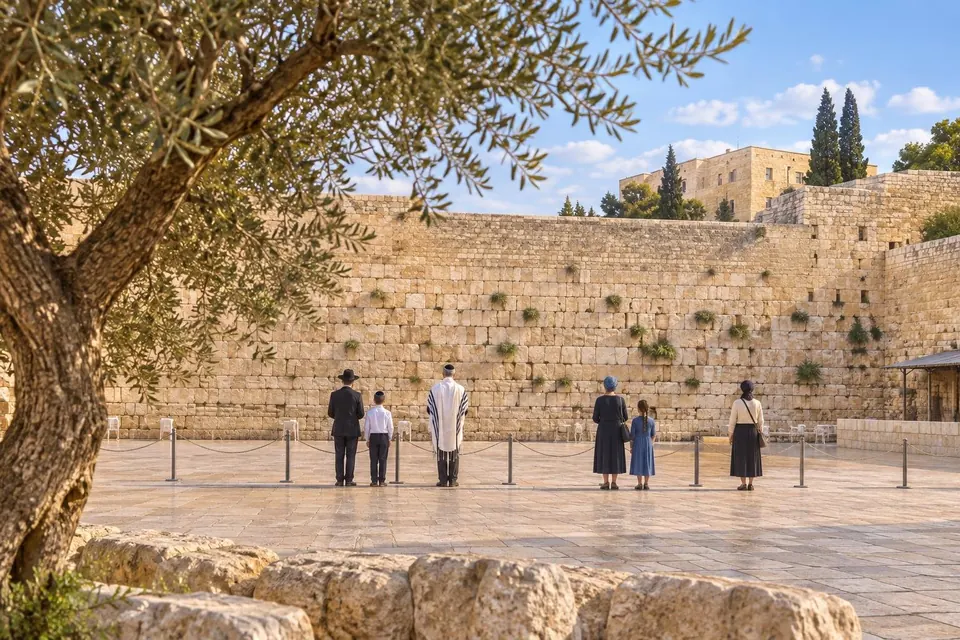
The Temple Mount is a hill in Jerusalem on which the Temple once stood. At the time, the hill was surrounded by a fortified wall. A small portion remains standing today, known as the Western Wall or the Wailing Wall. According to Jewish tradition, the Temple Mount measured 500 by 500 amot. An amah is a cubit, equivalent according to some opinions to 48 cm (about 19 inches) and according to others to 57.6 cm (about 23 inches). The Temple stood in the northwestern part of the mount.
After passing through the fortified wall, a pilgrim traveling from east to west toward the Temple would pass through a gate in a fence called the sorag. It was about 10 tefachim high. A tefach, or handbreadth, is equivalent according to some opinions to 8 cm (about 3 inches) and according to others to 9.6 cm (about 3.8 inches). The fence was made of branches woven in an X pattern.
Beyond the fence, the pilgrim would see a narrow area called the chill, which surrounded the Temple at a distance of 10 amot. Because the Temple stood on high ground, the pilgrim would continue to climb. From the sorag to the Temple complex, which began with the Ezrat Nashim, or Women's Court, there were 12 steps. From the Women's Court to the Ezrat Yisrael, the court for male Israelite pilgrims, there were another 15 steps.
Beyond that point, only kohanim, priests who performed the Temple service, could enter. This area was called the Ezrat Kohanim, the Priests' Court. Three steps led into it from the Ezrat Yisrael, and the altar stood there.
Climbing another 12 steps, a kohen would enter a roofed area called the ulam, or entrance hall. From there, he would enter the Sanctuary, or heichal. It contained the golden altar for burning incense, the seven-branched menorah, and the table on which special loaves called lechem hapanim (showbread) were placed.
At the far end of the Sanctuary, behind a curtain, was the holiest place in the Temple: the Holy of Holies, or Kodesh Hakodashim, where the Ark of the Covenant stood. It was in the western part of the Temple, closest to what is now the Western Wall. The layout of the Temple and the dimensions of its individual parts are described in great detail by Maimonides (the Rambam) in his Mishneh Torah (Laws of the Chosen House, chapters 5–6).
Degrees of Holiness and Ritual Impurity#
Different places on the Temple Mount have different degrees of holiness and, accordingly, different restrictions. There are 10 degrees in all. The Land of Israel is the first; cities in Israel that were surrounded by fortified walls in the time of Joshua son of Nun are the second. Jerusalem within its fortified walls, when they stood, is the third. The area of the Temple Mount up to the sorag is the fourth, and the chill is the fifth. The degree of holiness increased with each area as one approached the Holy of Holies (Mishnah Kelim).
Among the laws that depended on an area's degree of holiness were those governing who could enter. There were distinctions between Levites and Jews who did not belong to the tribe of Levi, between Levites and kohanim, and between the High Priest and other kohanim.
More directly relevant to our subject are the Torah's severe prohibitions against entering these places while ritually impure, regardless of one's lineage. The Torah recognizes several kinds of ritual impurity. Here are those directly relevant to visiting the Temple Mount today:
- Tamei met (one who has contracted impurity from a dead body): A man or woman who has acquired this impurity, for example by being in the same room as a corpse, remains impure until sprinkled with water containing the ashes of a red heifer. This is not possible today.
- Zav (a man with certain bodily discharges): He remains impure until the discharge has ceased, he has counted seven clean days, immersed in a spring of flowing water, and waited for the appearance of the stars, marking the beginning of the next day.
- Zavah (a woman with certain bodily discharges): She remains impure until the discharge has ceased, she has counted seven clean days, immersed in a mikveh, and waited for the appearance of the stars, marking the beginning of the next day.
- Niddah (a woman during her menstrual cycle): She remains impure until the cycle has ended and, after a prescribed interval, she has immersed in a mikveh.
- Boel niddah (a man who has had intimate relations with a woman who is a niddah, in violation of a Torah prohibition): He remains impure until seven days have passed after the relations and he has immersed in a mikveh.
- Baal keri (a man who has had a seminal emission): He remains impure until he immerses in a mikveh. A woman after marital relations is considered impure for three days and thereafter until she immerses in a mikveh.
- Yoledet (a woman who has given birth): From the onset of labor, she remains impure until the bleeding has stopped and, after a prescribed interval, she has immersed in a mikveh.
- Tamei maga (one who has become impure through contact), and similar cases: A man or woman who has touched, carried, or moved objects that have acquired certain kinds of impurity.
Purification requires a thorough knowledge of the many details of these laws. Also, people can have the status of zav or zavah today, as many authoritative works state and as the author of the Mishnah Berurah rules (457:100).
In keeping with the degree of holiness of the Temple Mount up to the sorag, a zav, zavah, niddah, baal keri, or yoledet may not enter that area. In addition to these people, a boel niddah and those with tumat met (impurity from a dead body) may not enter the chill (Mishnah Kelim).
Some of these prohibitions carry the most severe punishment, karet (the soul's being cut off from the Jewish people; Numbers 19:20). Others carry a penalty of 39 lashes, and some, according to a number of opinions, were added by the Sages.
Does the Holiness Remain Today?#
Do these laws apply today, when, to our great sorrow, we no longer have the Temple and very different structures stand where it once stood? Perhaps these rules will apply only after the Third Temple is built, an event we eagerly await. In other words, we must determine the status of the place where the Temple stood.
The Torah says: “Keep My Shabbat days and revere My sanctuary; I am the Lord” (Leviticus 26:2). The Sages teach that the Torah placed reverence for the Creator's sanctuaries alongside Shabbat observance for a reason: just as we are commanded to observe Shabbat forever and under all circumstances, we are commanded to revere the Creator's sanctuaries forever and under all circumstances (Devarim Rabbah, Vaetchanan).
Maimonides writes that the sanctification of the Temple and Jerusalem, which King Solomon carried out after completing the First Temple, applies for all time (Laws of the Chosen House 6:14). Why does the sanctification from Solomon's time no longer apply to many laws, such as mitzvot connected with the holiness of the Land of Israel, while it still applies to the Temple and Jerusalem?
Maimonides explains that the sanctification of the Temple and Jerusalem is connected to the Creator's presence. His presence is eternal, and therefore the holiness of the place where His glory dwells cannot be annulled. He supports his position with the words of the Mishnah: “'I will lay waste your sanctuaries' (Leviticus 26:31)—they retain their holiness even when they are desolate” (Mishnah Megillah 3:3). The mitzvot connected with the holiness of the Land of Israel, by contrast, depend on Jewish possession of the land, which will occur only with the coming of the Messiah. A number of passages in the Talmud support Maimonides' statement that the accepted law is that the holiness of the Temple and Jerusalem remains forever (see, for example, Shevuot 16a and Zevachim 107b).
Other great halachic authorities agree with Maimonides (Sefer Mitzvot Gadol, Positive Commandments 163; Sefer Haterumah, Laws 11; Agudah; the Rosh on Sheviit 6:1; Tosafot on Yoma 44a and Shevuot 14b; Tosafot HaRosh on Yevamot 82b; Sefer Yereim 277; Tashbetz 3:201; and others). Among other sources, they quote the Midrash: “The presence of the Almighty has never departed from the Western Wall (the Wailing Wall), as it is said, 'There He stands behind our wall' (Song of Songs 2:9), and it is said, 'The Lord is in His holy Temple'” (Habakkuk 2:20; Midrash Tanchuma, Shemot 51).
The law follows this view, and anyone who ascends the Temple Mount today violates a Torah prohibition carrying a very severe punishment (Magen Avraham, Orach Chaim 561:2; Mishnah Berurah 561:5). Accordingly, a zav, zavah, baal keri, niddah, or yoledet may not enter the Temple Mount; in addition, a boel niddah and anyone with tumat met may not enter the chill. Everyone today has tumat met, and purification from it is impossible until the ashes of a red heifer become available.
It is important to note that the law that the Temple Mount retains its holiness establishes only a universal obligation to treat the place with proper reverence. But halachic authorities have unanimously rejected the idea that it obligates Jews to bring offerings or perform the mitzvah of guarding the Temple while the Temple has yet to be rebuilt. Moreover, for a number of reasons, anyone who performs these acts today commits several grave sins.
Why Visiting Is Prohibited Today#
At first glance, it might seem that someone who takes steps to purify themselves from the kinds of impurity that do not require the ashes of a red heifer may ascend the Temple Mount as far as the former location of the sorag. Is that really the case?
Rabbi Yitzchak Weiss, one of the great halachic authorities of the previous generation, devoted a thorough responsum to this question (Minchat Yitzchak 5:1). We will try to present its main points.
Rabbi Weiss begins by writing that even if it were possible to meet every requirement for entering the Temple Mount, it should never be permitted. Many uninformed people, hearing that someone had received rabbinic permission to ascend, might begin doing so without observing all the necessary conditions. Someone might mistakenly cross the boundary of the permitted area, beyond which no such measures would help. This concern would apply even if we knew the exact boundaries, all the more so since we do not.
Besides causing terrible violations and severe punishments, such permission would, through its disregard for holy places, delay the complete redemption. After that redemption, we will be able to visit not empty sites but the Temple itself, fulfilling God's mitzvah.
In fact, ascending the Temple Mount today is strictly forbidden not only as a precaution but also under the law itself. The author of Kaftor Vaferach demonstrates this extensively from the Talmud (Kaftor Vaferach, chapter 6; Yevamot 7b). He writes that the Western Wall is the closest point to the Temple Mount that one may approach. For many generations Jews have opened their hearts before God in prayer at the Western Wall, and it is a particularly favorable place for our requests to be accepted. Many Torah authorities cite the author of Kaftor Vaferach as the definitive ruling (see, for example, Responsa of Rama MiPano 25; Peat Hashulchan 3:12, Beit Yisrael 26; and others).
Rabbi Weiss goes on to give a number of objective reasons, based on the laws of impurity, why it is impossible today to become sufficiently pure to enter even a place with the third degree of holiness. He also demonstrates from many sources that we cannot determine the boundaries of the former sorag, the chill, and other areas of the Temple Mount that are strictly forbidden to all of us until we can be purified with the ashes of a red heifer.
To our great sorrow, the entire Temple Mount was excavated many centuries ago, and on more than one occasion enemies of God deliberately tried to level the site. Because of our sins, they largely succeeded. The Temple Mount, whose sides should each measure approximately 250 m (about 820 feet), has very different dimensions today: its eastern and western sides extend approximately 480 m (about 1,575 feet), its northern side 321 m (about 1,053 feet), and its southern side 223 m (about 732 feet). In the past it was indeed a mountain, with the Temple rising at its summit; today the site is fairly level.
Rabbi Ovadia Yosef likewise demonstrates in detail that the boundaries of the Temple Mount's various areas are unknown today. He concludes that it is now strictly forbidden not only to enter the Temple Mount but also to fly over it in a plane or helicopter (Chazon Ovadia, Arba Taaniyot, pp. 454–458). Other Torah authorities take a similar view (see, for example, Tzitz Eliezer 10:1; Shemesh U'Magen, Yoreh De'ah 25; and others).
The prohibition is so strict that even partial entry into the area is forbidden. According to many authoritative opinions, a person visiting the Western Wall may not put their fingers into the cracks between its stones, since this is already considered, to some degree, an intrusion into the Temple Mount. There are also a number of areas adjoining the fortified wall around the Temple Mount whose status is uncertain. Most are in areas of Jerusalem's Old City where Arab residents live.
The prohibition against entering the Temple Mount also applies fully to non-Jews. A Jew who helps a non-Jew commit a violation therefore transgresses the Torah's command: “Do not place a stumbling block before the blind” (Leviticus 19:14).
Saving a Life and Revering the Sanctuary#
Even when there is only a small chance that a person's life is in danger, it is not only permitted but a great mitzvah to take any action that might save them. The Torah says: “A person shall perform these laws and live by them” (Leviticus 18:5). The Sages teach: “Live by them, and not die by them” (Yoma 85b).
In other words, when a person's life is in danger, it is permitted to take any action to save them, including actions normally forbidden by the Torah, with the exceptions of idolatry, murder, forbidden sexual relations, and public desecration of the Creator's name. Therefore, when the public or an individual is in danger, it is permitted and necessary to enter any part of the Temple Mount. If time allows, one must first do everything possible to minimize the desecration of God's sanctuary.
The great sage of the Mishnah, Rabbi Shimon bar Yochai, called simply Rabbi Shimon in the Mishnah, taught:
Violating the laws concerning the holiness of the Temple and all that is connected to it is more severe than violating all the other prohibitions of the Torah. Violations of all the other prohibitions are atoned for by one goat brought as a sin offering, while 32 goats are needed to atone for violations of the laws concerning the holiness of the Temple and all that is connected to it. Violations of all the other prohibitions are atoned for once a year, while atonement for violations of the laws concerning the holiness of the Temple and all that is connected to it must take place every month. As it is said: “Because you defiled My sanctuary with all your detestable things and all your abominations, I too will diminish you. My eye will not pity you, nor will I spare you” (Ezekiel 5:11). All the detestable things and abominations you have done are abhorrent, but defiling the Temple and all that is connected to it is the most abhorrent of all (Tosefta Shevuot 1:2).
To fulfill the great mitzvah of fearing to act disrespectfully toward the Creator's sanctuary, we must first take every precaution not to desecrate it. If someone feels the need for spiritual elevation by drawing on the holiness that fills the place where the Divine presence is manifest, it is enough to stand at a distance from which they can see it clearly, and no closer. This is written in the wonderful Torah commentary Kli Yakar (on Genesis 13:17). We must also remember our teachers' words that the holiness of a synagogue is even greater than that of certain places in the Temple (see Machatzit Hashekel, Orach Chaim 151:4, 17; and Mishnah Berurah 151:40).
Instead of ascending the Temple Mount and committing a violation, we should turn our desire to draw close to God into sorrow that we cannot do so there today. That sorrow will move us to hope for the final redemption, which will bring the rebuilding of the Temple, the return of its service—which encompasses most of the Torah's mitzvot—and the presence of the Shechinah (the Divine presence) in its fullness.
Scripture says: “The Lord tears down the house of the proud, but He secures the widow's boundary” (Proverbs 15:25). May God gather His people from every corner of the world in love and peace in the Holy Land, where all the laws of the Torah will be observed in purity and joy, with the Temple and an anointed king from the house of David. Then all will see the Creator's glory, and the whole earth will be filled with wisdom.
“Give us joy for as many days as You afflicted us, for as many years as we saw hardship. Let Your deeds be seen by Your servants, and Your splendor by their children” (Psalms 90:15–16).
By Rabbi Leib Nachman Zlotnik
Practical law. This page reports a ruling given for a specific question. For your own situation, ask a rabbi who knows you.
Keep reading
More →Why Is Jerusalem So Important to Jews?
Jerusalem’s history and holiness have made it central to Jewish life and longing for generations.
CharacterLashon Hara and Free Speech: Life and Death in the Tongue
Jewish teachings on the power of speech challenge us to consider how we use our words.
CharacterKorach and Disagreement for the Sake of Heaven
What distinguishes Korach’s dispute from the disagreements of Hillel and Shammai?







