What Blessing Do You Say on Crackers, Croutons, and Matzah?
The blessing depends on how the food is made, how it is eaten, and, in the case of matzah, family tradition.
In brief
- Thin, brittle baked goods are generally treated as pat habaah bekisnin and require the Mezonot blessing.
- When eaten in large quantities or as part of a filling meal, they are treated as bread.
- Ashkenazi and Sephardi customs differ regarding the blessing on matzah during the year.
- The blessing on croutons depends on how they were made.
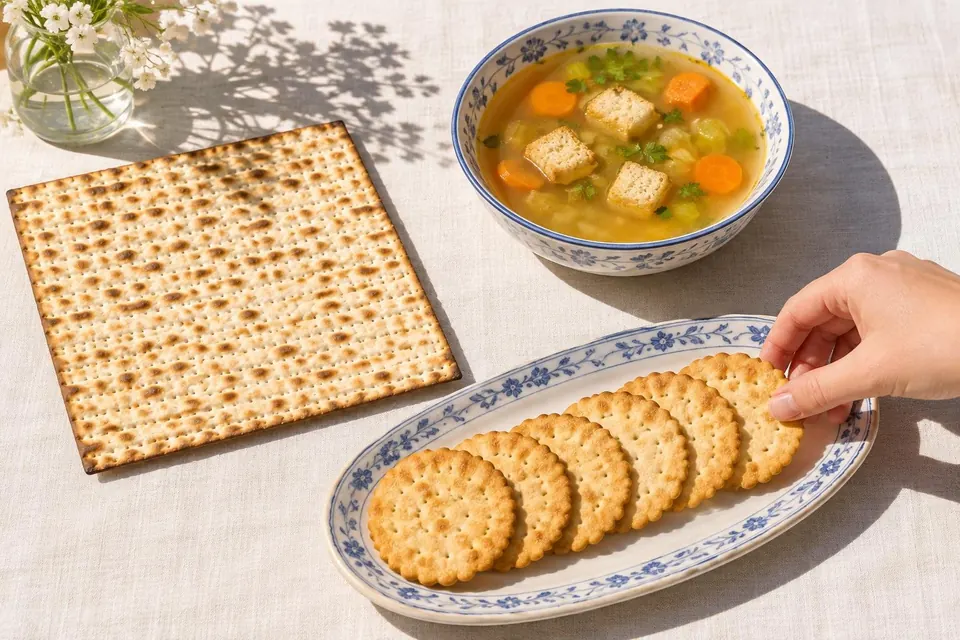
Several kinds of baked goods fall into the category of pat habaah bekisnin (certain baked goods that are not generally treated as bread). The third type is made from ordinary dough but baked in thin, brittle sheets. Such products are often not baked to be eaten as part of a full meal. They are also not eaten like bread but gnawed. For these reasons, they are not considered bread, and the blessing over them is borei minei mezonot (“who creates various kinds of nourishment”).
As mentioned earlier, if they are nevertheless eaten in large quantities or as part of a meal and provide a feeling of fullness, they should be treated as bread. Before eating them, wash your hands with the appropriate blessing, then say hamotzi lechem min haaretz (“who brings forth bread from the earth”). After the meal, say Grace After Meals (Birkat Hamazon).
Crackers made from sweet dough or dough kneaded with oil and the like fall into the category of pat habaah bekisnin for two reasons: the type of dough and the way they are baked. But even crackers made from flour and water, called matziyot (thin crackers), require the blessing borei minei mezonot, because they are not intended to be eaten as bread.
There are different customs regarding matzah. The Ashkenazi custom is always to say hamotzi lechem min haaretz over matzah. The Sephardi custom is to say borei minei mezonot over matzah throughout the year, except on Passover. Some Sephardi sages, however, questioned this custom and recommended eating matzah either in large quantities, or as part of a meal with other foods, or with bread. In all these cases, according to all opinions, one must wash one’s hands and say hamotzi.
Rusks made from ordinary bread are treated as bread. Rusks made directly from raw dough, without first baking it as bread, have the status of pat habaah bekisnin. The Sages disagree about the status of rusks made from bread baked specifically to be turned into rusks.
Nevertheless, Rabbi Isaac Mordechai Rubin writes that the blessing over croutons—small pieces of bread often added to salads and soups—is borei minei mezonot. They are baked specifically to be cut into small pieces, and no one makes a meal of them. If croutons were made from ordinary bread that was cut into small pieces and cooked in oil, the blessing is borei minei mezonot. If the bread was dried or fried, however, it does not lose its status as bread. Even for a small piece, one must wash one’s hands and say hamotzi lechem min haaretz.
Based on Shulchan Aruch, Orach Chaim 168:6; Mishnah Berurah 168:35; Dirshu; and an article by Rabbi Isaac Mordechai Rubin in the 5760 volume of Tzohar.
Practical law. This page reports a ruling given for a specific question. For your own situation, ask a rabbi who knows you.
Keep reading
More →What Blessing Do You Say on an Ice Cream Cone?
The blessing depends on how the cone is treated in relation to the ice cream.
KosherCan You Eat Meat and Milk Outside Israel?
A teaching on Parashat Mishpatim explains why the prohibition applies both in Israel and beyond.
ParashaToldot: Finding Holiness in Eating
A meal can be a moment of closeness to God when we recognize the life and pleasure He gives us through food.
KosherWhat If I Can't Remember Saying Birkat Hamazon?
A story about the Chatam Sofer asks what our attention reveals about the way we bless after eating.







