What Is the Blessing on Blossoming Trees?
The blessing on fruit trees celebrates the beauty and bounty of God’s creation.
In brief
- The blessing on blossoming fruit trees is said once a year, preferably in Nisan.
- The trees must bear fruit fit for human consumption.
- Both men and women are obligated to say the blessing.
- The blessing expresses gratitude for the Creator’s beautiful world.
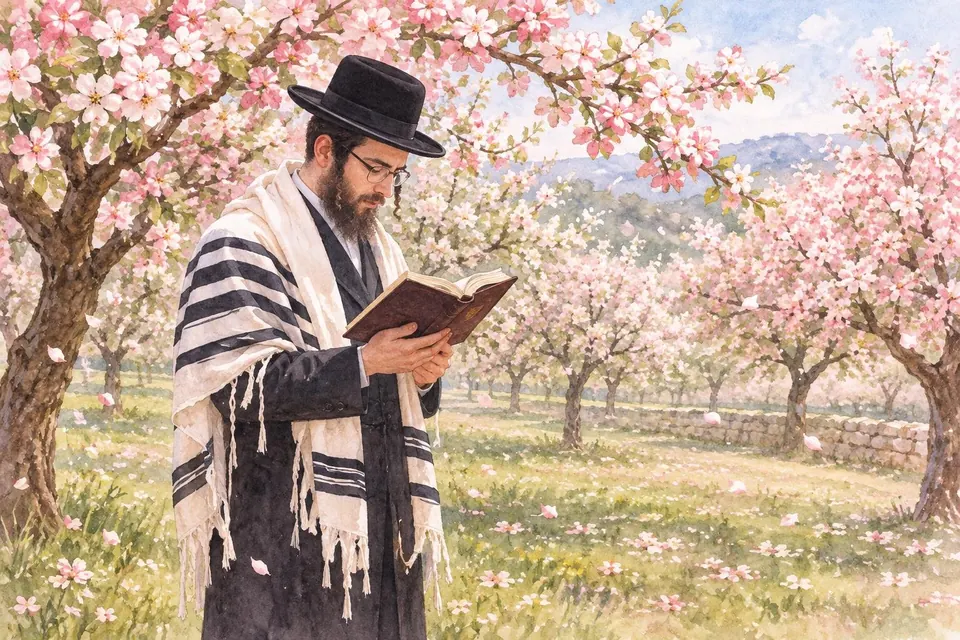
During the spring blossoming season, beginning with the new month of Nisan, the Jewish people go to places where fruit trees grow and bless God for the kindness He shows them, giving them beautiful creatures and wonderful trees to enjoy.
In Ashkenazi communities, the blessing is:
“Blessed are You, Lord our God, King of the universe, who has left nothing lacking in His world and created in it good creatures and good trees for people to enjoy.” [Berakhot 43b]
בָּרוּךְ אַתָּה ה’ אֱלֹקֵינוּ מֶלֶךְ הָעוֹלָם, שֶׁלֹּא חִסַּר בְּעוֹלָמוֹ כְּלוּם, וּבָרָא בוֹ בְּרִיּוֹת טוֹבוֹת וְאִילָנוֹת טוֹבוֹת, לְהָנּוֹת בָּהֶם בְּנֵי אָדָם
“Blessed are You, Lord our God, King of the universe, who has left nothing lacking in His world and created in it good creatures and good trees for people to enjoy.”
Sephardi communities introduce the blessing with beautiful prayers, following the custom of each place. Some also arrange a special session of study of the Written and Oral Torah and say Kaddish. In some communities, the blessing is the same as the Ashkenazi version, with the addition of “and beautiful” after “good trees.” In others, Sephardim omit the phrase “good creatures.”
בָּרוּךְ אַתָּה ה’ אֱלֹקֵינוּ מֶלֶךְ הָעוֹלָם, שֶׁלֹּא חִסֵּר בְּעוֹלָמוֹ כְּלוּם, וּבָרָא בוֹ בְּרִיּוֹת טוֹבוֹת וְאִילָנוֹת טוֹבוֹת וְנָאוֹת, לִיהָנוֹת בָּהֶן בְּנֵי הָאָדָם
“Blessed are You, Lord our God, King of the universe, who has left nothing lacking in His world and created in it good creatures and good and beautiful trees for people to enjoy.”
בָּרוּךְ אַתָּה ה’ אֱלֹקֵינוּ מֶלֶךְ הָעוֹלָם, שֶׁלֹּא חִסֵּר בְּעוֹלָמוֹ כְּלוּם, וּבָרָא בוֹ אִילָנוֹת טוֹבוֹת, לִיהָנוֹת בָּהֶן בְּנֵי אָדָם
“Blessed are You, Lord our God, King of the universe, who has left nothing lacking in His world and created in it good trees for people to enjoy.”
When to Say the Blessing#
The blessing on beautiful creatures and trees is said once a year. In Israel, trees generally blossom in the spring. According to halacha, the blessing may be said as early as the month of Adar, but the custom is to say it specifically in Nisan. This applies even in leap years, when there are two months of Adar and blossoming begins before Nisan.
The general rule is that mitzvot should be performed at the first opportunity. Accordingly, it is desirable to say this blessing on the morning of the new month of Nisan.
If Nisan has ended and you have not yet said the blessing, you may still say it in Iyar, including the Creator’s name, provided that new fruit has not yet grown. Even someone who said the blessing in Iyar should say it in Nisan the following year. The time for the blessing is not tied to an annual or 12-month cycle, but to its designated time, the month of Nisan.
In countries where trees blossom at a different time of year, the blessing is said during the blossoming season. Someone who said the blessing in Nisan and later that year travels to a country where blossoming takes place later does not say it again. The reverse also applies: Someone who said the blessing outside the Land of Israel and returned to Israel after the beginning of Tishrei does not say it in Nisan, since the blessing is said only once a year and they have already said it that year.
It is desirable to say the blessing as soon as one sees blossoming trees. If one did not do so, the blessing may be said the next time one sees the blossoms.
According to halacha, the blessing may be said on Shabbat and Yom Tov (a festival), although some communities try not to do so. If the only way to say it in Nisan is to say it on Shabbat, then it is said on Shabbat according to all customs.
Which Trees Qualify?#
The blessing is said specifically over trees, not other kinds of plants. A tree is a plant whose leaves grow from its branches, rather than from its roots or trunk. In the case of fruit-bearing plants, a tree is distinguished by the fact that it bears fruit year after year and does not need to be replanted annually. Trees are usually fairly tall and do not begin to bear fruit in the year they are planted. As a rule, they grow, develop, and become stronger from year to year. Plants that die less than three years after being planted are not considered trees.
It is preferable to say the blessing over trees growing in fields and gardens, but the law also permits saying it over trees within a city. The blessing is said over growing trees. It should not be said over uprooted or cut-down plants, even if they are still fresh and blossoming. The blessing may be said over a tree growing in a container. However, if the container is indoors, one should not say the blessing over it in the first instance.
The blessing is said only over trees that bear fruit fit for human consumption, even if they were planted for other purposes and their fruit will not be used. It is not said over non-fruit-bearing trees or trees whose fruit is not fit for food, even if the fruit is used for other purposes, such as making medicine or dye, or feeding animals.
In the first instance, one should choose especially beautiful trees with bright blossoms. For this reason, some prefer to say the blessing over almond and pomegranate trees, whose blossoms are particularly beautiful. It is desirable to say the blessing before the blossoms fall. Afterward, the blessing may still be said with the Creator’s name as long as the fruit has not ripened and become fit to eat. If the fruit has ripened and no other trees are available for the blessing, it is said without mentioning God’s name.
Seeing the Blossoms#
The blessing may be said by day or at night, provided the place is lit and the trees are clearly visible. It may also be said on a cloudy or foggy day if the trees can be seen clearly.
The blessing is said after seeing the blossoms. The Sages did not set a specific distance from which the trees must be seen. It depends on how clearly the person can see the blossoms. They need to be visible only before the blessing. While saying the blessing and prayers, one may turn away, close one’s eyes, or look in a prayer book.
The blessing may be said over trees seen through binoculars or a telescope, but not over a reflection in a mirror. Someone who can see only with glasses says the blessing. A person who is blind in both eyes may listen to a sighted person say the blessing and answer “amen.”
Ideally, one should see the whole tree. If that is not possible, the blessing may be said even if only one blossoming branch is visible. One may say the blessing from inside a building, a car, a ship, or a similar place if the trees are clearly visible from a balcony, window, or deck. There is no obligation to leave the building or car to get closer to the trees. Ideally, the blessing should be said while standing.
Who Says the Blessing?#
Both men and women are obligated to fulfill the mitzvah of saying the blessing over trees. It is customary to teach children to perform this mitzvah.
A boy who will turn 13 in Nisan, and will then become obligated in mitzvot, should try not to encounter blossoming trees before his birthday. If he does see them, however, he should say the blessing and not wait until he reaches that age. The same applies to a girl who will turn 12 in Nisan.
Someone who is allergic to tree blossoms also says the blessing, because they benefit from the fruit the trees produce.
The blessing may be said alone, although it is desirable to say it with a community. The more people who say it together, the better.
According to the law, the blessing may be said over a single tree, but it is preferable to have two or more. It is desirable for the trees to be of different species. According to Kabbalah, the trees should belong specifically to a Jew.
Because this blessing is said outdoors, one must make sure the place is clean and suitable for reciting sacred texts. Check for nearby sewage, garbage, a restroom, excrement, manure, and the like. The other conditions for saying blessings must also be met: Clothing, body, and hands must be clean, and the person saying the blessing and those nearby must be properly dressed.
Trees That May Be Problematic#
The Torah contains a number of laws about planting trees. In some cases, it is forbidden to say the blessing over trees planted or grown in violation of these laws. Among the prohibitions are:
- Kilayim: prohibited combinations of two or more kinds of plants.
- Trees used for worship, meaning idolatrous trees.
- Trees growing on the Temple Mount or in a cemetery, whether Jewish or non-Jewish.
There are other, less common prohibitions as well. In each case, a rabbi should be consulted to determine whether the blessing may be said over a particular tree.
The blessing may be said over trees belonging to other people or to the municipality without asking permission, provided one does not enter someone else’s property.
Seeing the Creator#
In Michtav MeEliyahu (“Letter from Elijah”), Rabbi Eliyahu Dessler writes that God created pleasures so that a person, filled with gratitude, would bless the Creator wholeheartedly. To bless is to see the Creator with the heart.
Rabbi Chaim Friedlander, the spiritual mentor of several yeshivas and of our entire generation, says that blessings of praise and thanks to the Creator can be said only when they come from the heart, not merely from reason and cold calculation. This may help us understand why the great Steipler, Rabbi Yaakov Yisrael Kanievsky, said that the blessing over trees is a powerful way to cultivate fear of God.
The Chazon Ish writes in Emunah UBitachon (“Faith and Trust”):
“Human life is sustained by food, which constantly refreshes the blood in the body. For this purpose, grain, the fruit of the vine, olive oil, plants, and trees bearing countless kinds of fruit were created. Each is filled with varied life-giving energies, specifically intended to nourish human beings, give them health, strengthen their bones, and revive their inner powers on earth. Humanity continually deepens its knowledge of the wondrous wisdom built into the structure of every plant, which testifies to its Creator, whose intellect is beyond our understanding.”
Maimonides (the Rambam) writes:
“When a person reflects on His wondrous deeds and creations and sees in them His boundless wisdom, they immediately come to love, praise, and glorify the Creator, and are filled with a great desire to know the great Creator” (Maimonides, Laws of the Foundations of the Torah 2:2).
Practical law. This page reports a ruling given for a specific question. For your own situation, ask a rabbi who knows you.
Keep reading
More →Hebrew Words for Prayer in the Haggadah
Three Hebrew words describe cries that rise to God when ordinary words fail.
ParashaKorach: The Power of Prayer
Why did Moses pray that God would not hear the prayers of Korach and his followers?
ParashaPinchas: The Trap of Routine
The daily offering teaches us to bring fresh attention and inspiration to familiar mitzvot.
PrayerCleansing the Soul Before Sleep
A bedtime prayer and other practices can help us release resentment and begin again.







