Lech Lecha: The Prayer of Someone With No Other Hope
Lot's plea for Zoar reveals the power of prayer when a person feels there is no other way out.
In brief
- According to Nachmanides, Zoar was spared because Lot needed it as a refuge.
- Lot prayed with all his strength because he feared for his life.
- Other stories show the power of prayer offered when no other help seems possible.
- The 15th of Av teaches that wholehearted prayer can overturn a heavenly decree.
Parashat Lech Lecha#
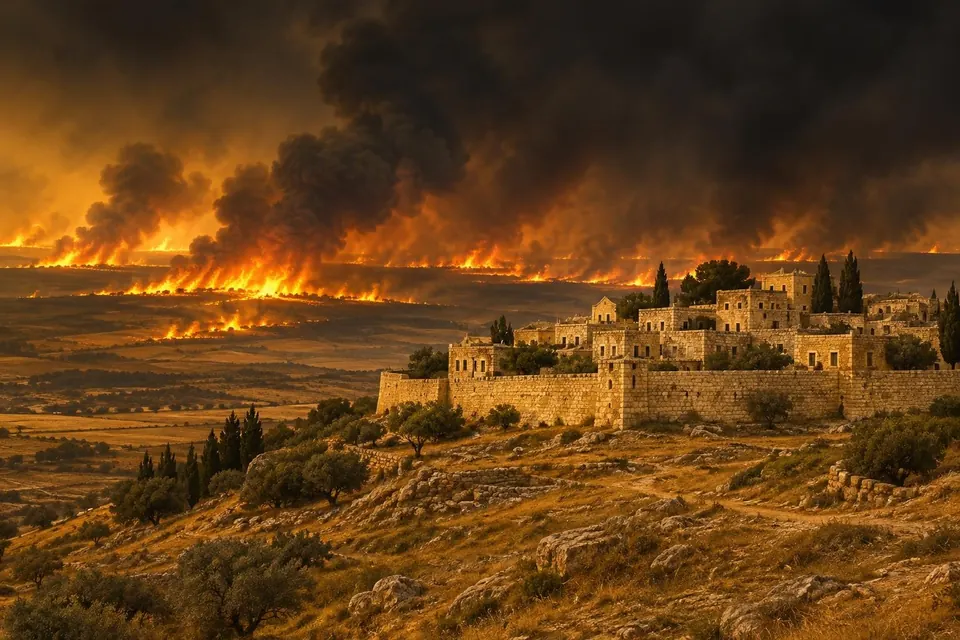
When they had brought them outside, one of them said, “Flee for your life. Do not look behind you or stop anywhere in the plain. Flee to the mountain, or you will perish.” But Lot said to them, “Please, no, my Lord. Your servant has found favor in Your eyes, and You have shown me great kindness by saving my life. But I cannot flee to the mountain, lest disaster overtake me and I die. Look, this town is close enough to flee to, and it is small. Let me escape there—is it not small?—and my life will be saved” (Genesis 19:17–20).
Why was the city of Zoar spared from destruction? Rashi offers two explanations. First, the city had been built only shortly before these events, so its inhabitants' sins had not yet exhausted God's patience. Second, the city was small and was therefore spared.
Nachmanides (the Ramban), however, understands that Zoar was originally included in the decree of destruction. It was spared only because Lot could not climb the mountain and had to stop in Zoar.
According to Nachmanides, Lot's prayer for rescue helped the inhabitants of the wicked city of Zoar survive as well. This is astonishing.
We have just seen Abraham fail to secure the rescue of many cities and their inhabitants through prayer. Yet here Lot's prayer was answered. Although he was not as wicked as the inhabitants of Sodom, he was far from being considered righteous.
The explanation may lie in the fact that Abraham did not need to pray for himself. His life did not depend on the survival of the people of that land. Lot, however, was not at all sure that he would survive the punishment. His own words show this: “and my life will be saved.” Fearing for his life, Lot prayed with all his strength. That prayer was accepted and brought salvation to him, his family, and all the inhabitants of Zoar.
When a person feels that prayer is their only chance of survival, such a prayer cannot go unanswered. The prayer of someone facing certain doom was able to overturn even the heavenly decree against the cities of Sodom and Gomorrah.
What does this example show us? When a person feels that prayer is the only means left to avoid disaster, that prayer has the power to bring deliverance or overturn a decree from Heaven. King David spoke of this: “The Lord is close to all who call on Him, to all who call on Him in truth” (Psalms 145:18).
There is no “and” connecting the two parts of the verse. One might have understood it to mean that God is close to all who call on Him and also close to those who truly call on Him. But that is not what it says. The verse teaches that God is close only to those who genuinely put their strength into prayer. An essential condition of every prayer is always to feel that, without Heaven's help, we cannot escape our troubles.
Examples of Prayer in Desperate Situations#
The Talmud (Ketubot 62b) tells us that Rabbi Yehuda HaNasi, known as Rabbi, arranged for his son to marry the daughter of Rabbi Yosei ben Zimra. After the wedding, the young husband left for a yeshiva to study Torah. During his 12-year absence, his wife became unable to have children.
What was to be done? Rabbi saw no way out. If the couple divorced, people would say that the young wife's sacrifice had not been worth it. Taking another wife was also unacceptable: people would say that the second wife was the son’s real wife and that he had married the first only for his own pleasure. What did Rabbi do? He prayed fervently for his daughter-in-law, and she regained the ability to have children.
The commentators explain that the account emphasizes how hopeless the situation was for a reason. It shows that Rabbi's prayer was accepted when he offered it with all his heart, in a situation with no other acceptable solution.
The Talmud (Megillah 15b) records Rabbi Nehemiah's view that Esther had a reason for inviting Ahasuerus and Haman to her banquet. She wanted to impress upon the Jews that they needed to pray more fervently to God for salvation, rather than rely on having “one of their own” at court who would solve all their problems.
How did this unfold? Before the second banquet was arranged, Esther had already instructed the Jews to fast for three days. At the first banquet, King Ahasuerus was in a good mood and offered Esther half his kingdom. But she did not take advantage of his favor to reveal who she was and ask for mercy for herself and her people.
This was strange. The temper of an arbitrary king could change, and who could say whether he would come to the second banquet the next day? Perhaps this was her last chance. Yet Esther paused and continued to wait until the next day. What was she planning?
The Alshich explains that Esther was not sure how strong the Jews' prayers were at that point. They had someone besides God to “rely on”: their Jewish queen Esther would not allow a catastrophe and would surely solve all their problems.
To dispel the people's illusions about who could truly solve their problems, Esther did not reveal who she was until the day of the second banquet.
Haman left the first banquet visibly delighted. The Jews then thought that perhaps Esther was not concerned about them at all. Perhaps she was sure that, as queen, she could escape the terrible fate awaiting them. Seeing this and suspecting that Esther was allied with Ahasuerus and Haman, the Jews began to pray fervently to God for salvation. It was the third day of the fast, and their physical strength was nearly exhausted. Queen Esther knew that God would be ready to overturn His decree when the Jews repented of their sins with all their hearts and turned in desperate prayer to their Father in Heaven.
The commentators explain that the verse in Psalms, “They cried out to the Lord in their distress, and He saved them from their troubles” (Psalms 107:6), speaks of people traveling by sea and through the wilderness. Another verse, “They called to the Lord in their distress, and He delivered them from their troubles” (Psalms 107:13), speaks of the sick and those held captive.
The Malbim explains that the prayer of someone who cries out is stronger than that of someone who calls. Why, then, do the sick and imprisoned not also use the stronger prayer? Because they simply cannot pray on that level. A person whose illness is not hopeless has a doctor in whom to place their hopes. A prisoner has the hope of amnesty. As soon as people place their hopes in powers other than the Creator, their prayers lose strength.
But who besides God can save sailors from a storm or a caravan in the wilderness from robbers? That is why their prayers have greater power.
Rabbi Shimon ben Gamliel said (Taanit 26b): “There were no days as joyous for Israel as the 15th of Av and Yom Kippur.”
The Talmud asks: Yom Kippur is the day when our sins are forgiven, so its joy is easy enough to understand. But what made the 15th of Av so special? The Talmud gives several reasons. One is Rabbi Yochanan's view that on that day, those who had left Egypt stopped dying (Taanit 30b).
After the sin of the spies, God punished all the men of that generation, except Joshua and Caleb: they would not enter the Holy Land but would die in the wilderness. Every Tisha B'Av—the day of the spies' sin—15,000 Jews went to sleep and did not wake up. Dividing 600,000 Jews by 40 years gives 15,000 each year.
Then Tisha B'Av of the 40th year in the wilderness arrived. The last 15,000 Jews prepared for the final night of their lives. But in the morning, they all woke up alive. There were no calendars then, and at first they thought they had miscalculated the date of the new moon. But when the 15th of Av arrived and a full moon appeared in the night sky, they understood that there had been no mistake.
Why was that last group of Jews able to survive?
It is also unclear why the 15th of Av became a day that, though only a minor festival, was no less joyous than Yom Kippur. After all, the miracle concerned only a relatively small group of Jews, not the entire people.
Here is a possible answer. Each time the Jews went to sleep on the night of Tisha B'Av, each person could hope that their time had not yet come. But when the time came for the last 15,000, there was no doubt about who would not rise the next morning from the graves they had dug in advance. Their “final” prayer was offered with the passion and fervor of people facing certain death. They put their whole hearts and all their spiritual strength into it. Such a prayer was able to overturn God's terrible decree (Rashbam and Tosafot on Bava Batra 121a).
The 15th of Av became a day of great joy for the entire people because it was then that everyone learned this vital principle: when a person gives up all other hopes and places their trust only in the Creator, such a prayer does not go unanswered.
The Sages of the Talmud brought together the seemingly different days of the 15th of Av and Yom Kippur so that Jews would approach prayer on the Day of Judgment as though it were the last prayer of their lives.
By Rabbi Nachum Shatkhin
Keep reading
More →Hebrew Words for Prayer in the Haggadah
Three Hebrew words describe cries that rise to God when ordinary words fail.
ParashaKorach: The Power of Prayer
Why did Moses pray that God would not hear the prayers of Korach and his followers?
ParashaPinchas: The Trap of Routine
The daily offering teaches us to bring fresh attention and inspiration to familiar mitzvot.
PrayerCleansing the Soul Before Sleep
A bedtime prayer and other practices can help us release resentment and begin again.







