How Can I Pray With Focus and Avoid Routine?
Practical advice and stories about bringing attention, sincerity, and a sense of closeness to God into prayer.
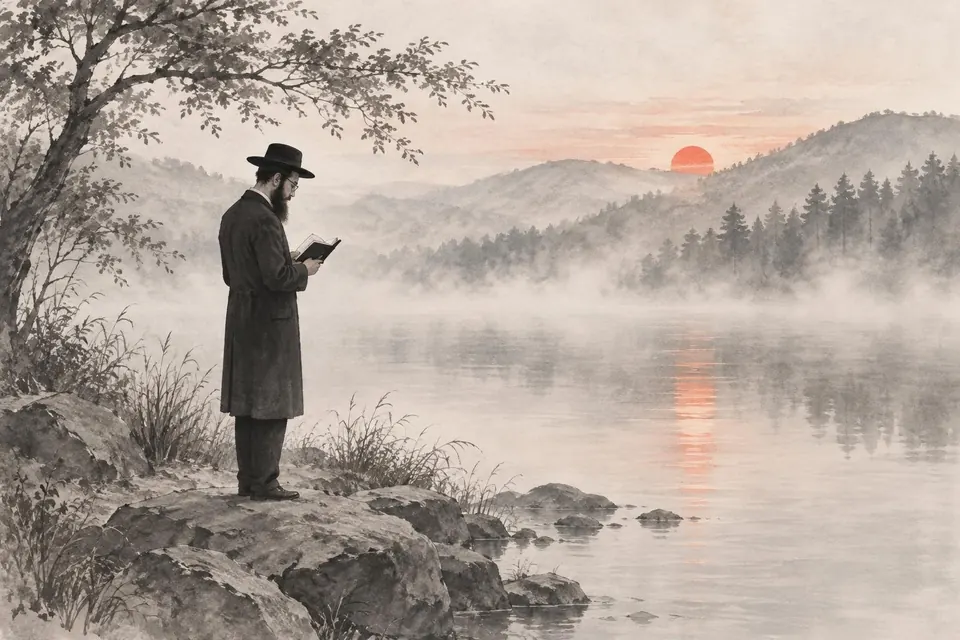
In brief
- Prayer can become routine, but pausing before we begin can help us remember whom we are addressing.
- A quiet place, a prayer book, and personal requests can help us concentrate.
- If our attention wanders, we can begin again from the moment we notice.
- Even a small effort in prayer can bring us closer to God.
Closeness to the Creator, Not Routine#
One of my younger sons was studying Psalms in cheder (a Jewish elementary school). He was learning Psalm 119, which has eight verses for each letter of the Hebrew alphabet. It was hard for the boys: they were not yet fluent readers, and the text itself is difficult. At the end, their teacher held a festive morning celebration to reward them for their hard work.
That Friday, I took my son with me to the Western Wall. Remember, we spoke about how important it is for a mother to show her child that she values his studies. I prayed Mincha, the afternoon prayer, while my son sat reading his Psalm 119 with deep concentration. We went into the Western Wall tunnels, where there are fewer people and it is quieter.
It was astonishing to watch him read without being distracted or noticing anything around him. When we adults read Psalms, we cannot do it for 40 minutes without losing focus. Why is it so hard for us to be as absorbed in Psalms or prayer as a child? He reads several times more slowly than we do, so it is harder for him, yet he does not give up. He is immersed in his reading, and nothing can pull him away from the book.
The reason is simple: mitzvat anashim melumadah, a commandment performed by rote. We can grow accustomed even to something wonderful. A favorite food can lose its appeal, and a close friend can become tiresome. What draws us powerfully when it is new can become stale and even repel us when it is repeated every day, especially if it is an obligation.
At some point, the process begins to resemble taking bitter medicine. We know we “have to,” so we wrinkle our noses and swallow, hoping to get it over with. Is that what our prayer should look like? Not at all. Our goal is to keep it from becoming that way.
God created the world so that we do not see His presence openly. The Hebrew word for world, olam, comes from neelam, meaning hidden. God hides from us behind natural phenomena and processes. Becoming accustomed to things is natural, and here we need to go against nature. The test of our faith is to see Him where we must look not with our eyes, but with our hearts. He is with us and hears our prayers.
Ways to Avoid Routine#
- Before praying, stop and think for a few moments: What am I about to do? I am going to stand before the King of kings, the Ruler more powerful than any other. At this audience, I can ask for what matters most to me and my loved ones, for health and a speedy recovery. The King graciously allows me to stand before Him and ask. He invites me, giving me the chance to address Him directly, as we do when we say Baruch Atah, “Blessed are You.”
- We need to wage war against our yetzer hara (the evil inclination). “For with wise strategies you wage your war, and victory comes through many advisers” (Proverbs 24:6). Many commentators understand this verse to speak about the war against the yetzer hara. With a well-thought-out strategy, we can defeat it. Who are the advisers who help us in that war? Books of mussar, Jewish ethical teaching. And what methods can we use to resist the distractions of the evil inclination? We can pray with feeling. For example, if we are distracted when praying in the living room at home because the children are around and it is noisy, we can set up a place to pray in another room and perhaps lock the door.
- Rather than pray at the busiest hour of the day, find a relatively quiet time. The Book of Esther says: “When she came before the king, he ordered by letter that the wicked plan he had devised against the Jews should return upon his own head” (Esther 9:25). The words im hasefer yashuv machashavto haraah can also be read as a suggestion that, with a book, a person can return from their own bad thoughts. Looking at the letters and words in a siddur (prayer book) helps keep a person from being distracted by other thoughts during prayer.
- Our ears should hear the words we whisper. This is neither prayer out loud nor prayer silently in our thoughts. Our ears will help keep us with the text, so that we are not thinking one thing while our lips say another.
It is also helpful to add our own requests, related to the subject of each blessing, in the middle blessings of the Amidah—for example, in Refaeinu (the blessing for healing), Chonen Hadaat (the blessing for understanding), and Hashiveinu LeToratecha (the blessing for return to Torah). When the prayer includes not only the text composed by our Sages but also our own words, it becomes personal, and we are less easily distracted. We can add any requests in Shema Koleinu (the blessing asking God to hear our prayers) and before Yihyu Leratzon (the concluding verse) at the end of the Amidah.
Grab the Mitzvot#
Sometimes a person becomes so absorbed in their thoughts during prayer that they surface only at Barech Aleinu (the blessing for a fruitful year) or even later. What should they do? Is everything lost?
The Chafetz Chaim told a parable. A woman brought a basket of apples to the market to sell. Suddenly, a rampaging troublemaker overturned her basket, and the apples scattered in every direction. Dishonest people began grabbing them.
“My apples! They’ve scattered my apples!” she cried.
A wise man came over and said, “Grab them! They’re grabbing, so you grab too, or there really won’t be anything left!”
The same is true of prayer and every mitzvah: wherever you catch yourself, start grabbing. Grab—don’t just stand there! There is no need to say that everything is lost, that it is too late, or that you have already made too many mistakes. Whatever you manage to grab will be yours. In prayer, this means that from the moment you surface, begin praying with kavanah (focused intention).
The Required Minimum#
The medieval authorities disagreed about whether the Torah commands us to pray every day. Maimonides (the Rambam) held that daily prayer is a Torah commandment and that one prayer a day fulfills it (Maimonides, Sefer HaMitzvot, Positive Commandment 5). He cited the verses: “Serve the Lord your God, and He will bless your bread and your water, and I will remove illness from among you” (Exodus 23:25), and “Fear the Lord your God, serve Him, and swear by His name” (Deuteronomy 6:13).
Our Sages explained that prayer is avodah (service) of the heart. At first, people prayed as they felt moved to pray: some at greater length, others more briefly. Later, the Men of the Great Assembly established a form for prayer.
Nachmanides (the Ramban), in his objections to Maimonides, maintains that the Torah does not require a person to pray every day. Rather, he says, the Men of the Great Assembly established the three daily prayers. Nachmanides suggests that the Torah may require prayer when misfortune strikes or a person faces a difficult period. He cites the verse: “When you go to war in your land against an enemy who oppresses you, sound a blast on the trumpets, and you will be remembered before the Lord your God and saved from your enemies” (Numbers 10:9). Because the verse speaks of turning to God when an enemy attacks, Nachmanides understands the Torah obligation of prayer to mean turning to the Creator when troubles overwhelm us.
Which parts of the morning service should women today recite if they are not overwhelmed with caring for children and the home? Rabbi Yosef Shalom Elyashiv answered: the blessings over Torah study, the morning blessings, and Tamid (the passage about the daily Temple offering); from Pesukei Dezimra (the verses of praise), Baruch Sheamar, Ashrei, and Yishtabach; the Shema and its associated passages Emet Veyatziv and Gaal Yisrael; and the Amidah.
It is told that the Chafetz Chaim exempted his wife from the obligatory prayers during the day for as long as she was caring for their small children, until they grew older. There are several reasons for this. First, a person engaged in one mitzvah is exempt from another. A woman cannot simultaneously watch a crawling baby and stand in the Amidah. Second, “her mind is not at ease”: she is constantly thinking about her responsibilities and what she needs to do, and this distracts her.
Complete Prayer#
The Talmud says that Rabbi Meir described two people who took to their beds with the same illness, and likewise two people who were led to execution under the same sentence. One recovered and the other did not; one was saved and the other was not. Why? Both prayed, but one was answered and the other was not (Rosh Hashanah 17b).
It is a difficult question: one person's fate changed because of prayer, while the other's remained the same. Why? Rabbi Meir and Rabbi Eliezer offered different answers. Rabbi Meir said that although both prayed, only one offered a complete prayer, and that person was answered. Rabbi Eliezer held that the person whose sentence was overturned had not yet received a final verdict, which is why the prayer succeeded. Rashi explains that a complete prayer is one offered with the proper intention of the heart.
The best-known prayer by a woman in the Hebrew Bible is the prayer of Hannah, Samuel's mother. The Sages of the Talmud derive laws about how to pray from her prayer: “Hannah was speaking in her heart; only her lips moved, but her voice could not be heard” (I Samuel 1:13). “In her heart” means not out loud; her moving lips teach us to pronounce the words.
Hannah prayed that God would give her a son, and her prayer came from an attentive heart. It accomplished the impossible and changed nature. According to our Sages, Hannah had not even had a womb, but one was created for her as a result of her prayer. Prayer from the heart can change nature!
Feeling Close to the Creator#
Joy, as well as sorrow, can bring a person closer to God. On Sukkot, during Simchat Beit Hashoeva (the celebration of the pouring of water on the altar), people who came to the Temple drew so close to the Creator through their joy that they merited ruach hakodesh, divine inspiration.
We feel joy and closeness to God during the festivals, but afterward it takes effort to preserve those feelings throughout the year. On Passover, for example, joy is given to us as a gift. Then comes the Counting of the Omer, when we must work on ourselves and improve, drawing closer so that we can receive the Torah with joy on Shavuot.
For children, a sense of God's closeness comes naturally. Recently, as I do every evening, I sat one of my younger sons down to comb his hair. Strangely enough, I could not find the comb—not in its usual place or anywhere else. No matter how hard I looked, I could not find it, and we had to skip the combing.
As soon as my son heard that, he said, “Baruch Hashem”—“Blessed is God.” It was natural for him to thank God for sparing him the combing. Why do we not thank Him or turn to Him as naturally? Only in exceptional moments of joy or sorrow do the words come to our lips on their own. In ordinary life, we have to work on ourselves to turn to God.
Concentration#
Rabbeinu Bachya writes in Chovot HaLevavot (Duties of the Heart) about a righteous man who always prayed: “God, save me from pizur hanefesh”—a scattered mind. Concentration is essential to prayer.
We have spoken about how our Sages compared prayer to the Temple service. If, while offering a sacrifice, a kohen (priest) had machshevot pigul—certain improper intentions about how the sacrifice would be offered—he rendered the offering pasul, invalid. Similarly, unrelated thoughts interfere with prayer and with its being accepted. That is why concentration is so important.
Rabbi Elchanan Wasserman, head of the yeshiva in Baranovichi, was murdered by the Nazis at the Ninth Fort of the Kaunas fortress. On the way to their execution, he explained to his students who were walking with him that they were going to an act of mesirut nefesh, giving up their lives, to sanctify God's name (al kiddush Hashem, the term for the death of a Jew for being Jewish).
Now, he told them, the most important thing was to remember that machshevot pigul spoil an offering. They needed to concentrate on clearing their minds of doubts about faith and the perfection of God's rule. They should stand before God in such a way that this sacrifice would be accepted favorably in Heaven and counted as a merit for the entire people.
The Sick Person's Own Prayer#
Hagar, who had been sent away with Ishmael at Sarah's insistence, carried her son on her shoulders because he was ill and weak. When their water ran out, she laid him beneath a bush and moved away so she would not have to see his suffering. Not far from him, she wept and prayed for him to recover, even as she dreaded seeing him die.
After a time, however, Ishmael prayed for himself, and God answered him “as he was” (Genesis 21:17). God judged Ishmael by his conduct and condition at that moment, without taking into account how Ishmael's descendants would later treat the Jews.
Hagar had seen angels and lived a righteous life in Abraham's home. After Sarah's death, Abraham took her back: as Rashi explains, Keturah was Hagar, and her deeds were pleasing to the Creator like ketoret, incense, a word with the same root as Keturah. Yet God accepted not her tearful prayer but “the voice of the boy.”
Even Rabbi Shimon bar Yochai, a great master of mystical teaching, said that he had not reached Hagar's level. And yet the Creator heard her son's voice rather than her prayer. Why? Because a sick person better understands their own condition. They know exactly what torments and wears them down. God accepted Ishmael's wholehearted prayer for his own life more readily than his mother's prayer.
There is a well-known story about a rabbi who went from house to house collecting money for the poor of his town. The weather was terrible: an icy wind was blowing and snow was falling. The rabbi knocked at the door of a wealthy man. The man himself answered, and the rabbi began telling him about the hardships the poor were facing and their shortage of fuel.
The wealthy man politely interrupted. “Rabbi, let's go inside and close the door. It's very cold out here. In the warmth of the living room, I'll be happy to hear everything you have to tell me.”
But the rabbi answered, “No, I don't want to go inside where it's warm. On the contrary, I need you to experience the cold felt by the people I've come to ask you to help with heating and their other needs.”
A healthy person cannot fully feel what a sick person is going through. That is why the sick person must pray for themselves. This does not replace other people's prayers; rather, the sick person's own prayer will be more effective.
Since we are speaking about praying for someone who is ill, let us look at this in a little more detail. In Nedarim 40a, Rav Dimi teaches that someone who visits a sick person helps that person live. The visitor asks Heaven for mercy so that the sick person will live, because they are nearby and see the person's suffering. This is quite different from praying for a sick person at home.
The Shechinah, God's presence, is beside the sick person. The Talmud says that a visitor should not sit on the sick person's bed, or on a bench or a chair, but should wrap themselves in a tallit (prayer shawl) and sit on the floor, because God's presence is above the bed (Nedarim 40a).
The Chafetz Chaim imagined that he was speaking about the sick person directly before God, facing the Shechinah. He would ask: “You are the great healer. You know how much this person has already gone through, how much they have endured. Heal them.”
The Offerings of Our Lips#
Rabbi Yaakov Galinsky commented on the verse “We will offer the words of our lips in place of bulls” (Hosea 14:3) with a parable.
A counterfeiter had special machines for printing banknotes. What denomination did he choose? A substantial one: say, $100. Why that much? Would such bills not be more likely to be checked? Would it not be easier to counterfeit $10 bills, which pass from hand to hand all the time?
But the man reasoned differently. If he was taking such a risk and incurring such expenses for machines, special paper, and ink, he might as well take a big risk rather than bother with small amounts. After all, the punishment for counterfeiting was the same, whether the bill was for $10 or $100.
Every word of our prayer is a banknote. Who decides its denomination? We do. Will we say each word with proper concentration and kavanah, making it worth $100, or will we mumble something indistinct, making it worth only $10?
“We will offer the words of our lips in place of bulls.” Bulls were the most expensive animals offered as sacrifices. If we are going to bring an offering, let it be a bull—the most costly and the best. So too, let our words of prayer, which today take the place of the Temple service, be like bulls: precious and weighty.
You Need Not Finish the Work#
“It is not your task to finish the work, but neither are you free to withdraw from it” (Mishnah Avot 2:16). Who, then, will finish it? King David wrote in Psalms: “I call to God Most High, to God who completes the work for me” (Psalms 57:3). God Himself will finish the work for me and make my prayer complete.
“Entrust your way to the Lord and rely on Him, and He will act” [Psalms 37:5]. To entrust all our needs to God means to tell Him in prayer what we need: health for ourselves and our children, well-being in our families, financial security, and more. “Cast your burden on the Lord, and He will sustain you” (Psalms 55:23).
A parable is told about this. A man was looking for a cornerstone for a building he was constructing in a valley. He climbed a mountain and found a suitable stone, but it was an enormous boulder, too heavy to lift. He rocked it until it came partly loose from the ground, then pushed it down the mountain. The stone rolled into the valley on its own.
If the man had needed to drag the stone uphill, he would hardly have managed. But pushing it took only a small effort. King David tells us: Entrust, gol, your needs to God. The word gol resembles golel, to roll or turn, and megalgel, rolling or turning. All that is required of us is a small effort in prayer, and God will roll the stone of our heavy burden for us.
Does Prayer Require Enormous Effort?#
Prayer does not actually require physical exertion. Even a physically weak person can move mountains through prayer, as we see from the example of our great teachers. Our task is to want it. “One who comes to purify themselves is helped” (Yoma 38b). A person needs to begin by opening a hole the size of the eye of a needle, and help will come immediately.
Isaiah says: “Do not fear, worm of Jacob, people of Israel; I will help you, declares the Lord” (Isaiah 41:14). The Mechilta of Rabbi Yishmael explains: Just as a worm can attack a cedar only with its mouth, so Israel has nothing but prayer.
A worm is soft and weak. All its strength is in its mouth, with which it grinds through hard, coarse material—trees, houses, and earth. Gnawing through an entire cedar would seem an enormous task, yet a little worm can do it. So too, the people of Israel are strong not through physical power, but through their ability to move mountains with prayer and Torah study.
And Still, Prayer Was Needed#
During the reign of Ahab, Elijah brought a drought upon Israel because of its idolatry. The Northern Kingdom, home to the ten tribes, went without rain for more than three years. Elijah held the key to rain. But when he needed the key to the resurrection of the dead to revive the son of the widow who had sheltered him, he had to return the key to rain.
God saw the famine in Israel and told Elijah: “Go, appear before Ahab, and I will send rain upon the earth” (I Kings 18:1). Elijah proposed a test to the people: “I alone remain here of the prophets of the Lord, while the prophets of Baal are 450 men. Let two bulls be given to us. Let them choose one, cut it up, and lay it on the wood, but put no fire to it. I will lay the other bull on the wood and put no fire to it. Let them call on the name of their god, and I will call on the name of the Lord. The One who answers with fire is God.”
And so it was. The prophets of Baal called on their god all day without success. Elijah dug a trench around the altar and poured water over it until the trench was full. Then he called to God: “Answer me, Lord, answer me, so that this people may know that You are God.”
In response to his prayer, fire fell from Heaven upon the altar and consumed not only the bull and the wood but also the altar and all the water around it. The people acknowledged that God is one, and Elijah executed all the priests of Baal.
Even then, the rain did not begin immediately. Elijah put his head between his knees and prayed to God for rain with great concentration and fervor. Seven times he sent his servant to see whether there was a cloud over the sea. Only on the seventh time did a small cloud appear. Elijah then warned Ahab to have his horses harnessed and go home, or the downpour would delay him.
It is remarkable that after such a miracle the rain did not come on its own. The priests of Baal had been executed. The people had recognized God's greatness and oneness, crying, “The Lord is God, the Lord is God.” Yet Elijah's focused prayer was still needed before the rain came on the seventh attempt. Prayer from the depths of the heart, then, accomplishes more than miracles.
Where You Are#
Rabbi Yaakov Galinsky told this story. In Germany there was a medical specialist who combined Torah with worldly life, following the teachings of Rabbi Samson Raphael Hirsch. He was satisfied with himself and his spiritual level, but one day he heard about the yeshivas in Lithuania and decided to visit them.
What he saw made such an impression on him that he could not stop thinking about it. Later, he asked to meet the Chafetz Chaim.
“I thought I was a good Jew, but these young men study in such conditions—or rather, with no proper conditions at all! I'm nowhere near their level. How do they do it?” he asked.
The Chafetz Chaim thought for a moment and answered: “Perhaps your portion in paradise is not so bad. Perhaps it is next to mine. You grew up in Germany and received that upbringing. And you do everything you can in your circumstances, with all your strength. You are a God-fearing person and set aside regular time to study Torah.
“I grew up in Lithuania and received a different upbringing. I studied according to the Lithuanian system. I too do everything I can in my circumstances, with all my strength. The main thing is to do what you can, with all your strength.”
We can give ourselves the same advice: the main thing is to do what we can, with all our strength, wherever we are.
By Rebbetzin Leah Gans
Keep reading
More →Hebrew Words for Prayer in the Haggadah
Three Hebrew words describe cries that rise to God when ordinary words fail.
ParashaKorach: The Power of Prayer
Why did Moses pray that God would not hear the prayers of Korach and his followers?
ParashaPinchas: The Trap of Routine
The daily offering teaches us to bring fresh attention and inspiration to familiar mitzvot.
PrayerCleansing the Soul Before Sleep
A bedtime prayer and other practices can help us release resentment and begin again.







