Why Is Receiving the Priestly Blessing a Mitzvah?
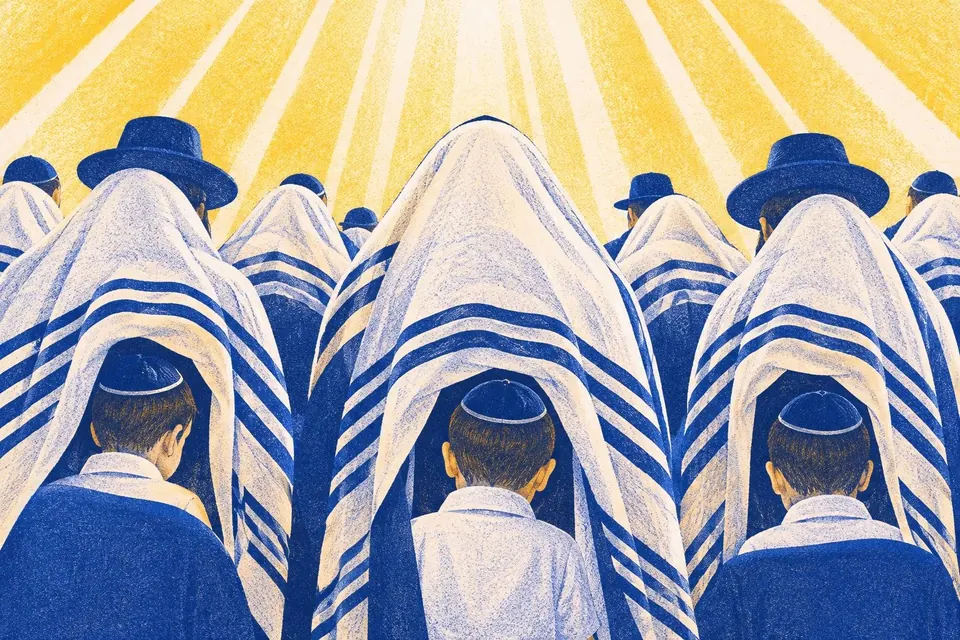
The priestly blessing continues a service from the Temple—and the people who receive it have a part in its mitzvah.
In brief
- The priestly blessing continues today in synagogues, as it was performed in the Temple.
- Nachmanides also sees Hanukkah candles as a continuation of the Temple menorah.
- According to Sefer Charedim, those who receive the priestly blessing participate in the mitzvah.
- The priests are channels for God’s blessing of His people.
Parashat Naso#
“May the Lord bless you and protect you. May the Lord shine His face upon you and be gracious to you. May the Lord turn His face toward you and grant you peace.” (Numbers 6:24–26)
Nachmanides (the Ramban), in his commentary on Parashat Behaalotecha, reveals the importance of the blessing given by the kohanim (priests descended from Aaron).
Aaron was deeply distressed that he had not taken part in the offerings brought by the leaders of all the tribes. To comfort him, God told him that his portion was far greater than theirs. The sacrificial offerings they began would continue as long as the Temple stood, but Aaron’s descendants would receive a much greater portion. The lighting of the menorah by the kohanim would continue even after the Temple’s destruction, finding expression in the Hanukkah candles.
The blessing of the people by the kohanim in the Temple would also continue in synagogues after its destruction.
From Nachmanides’ words, we can understand that we have two practices today that are not merely reminders of the Temple service. They are direct continuations of two forms of that service. Hanukkah candles are a direct continuation of the lighting of the candles by the kohanim in the Temple, and the blessing of the people by the kohanim in the Temple continues today during synagogue prayers. Both services retain the same power and influence today that they had in the days of the Temple.
The Vilna Gaon says that the priestly blessing includes every blessing that exists in the world.
Just as surprising, however, is that the kohanim are not the only ones who take part in fulfilling this mitzvah. What does that mean?
In the laws of Nesiat Kapayim (the priestly blessing), section 128, the Biur Halacha writes in its first comment: “Sefer Charedim says that the blessing of the people by the kohanim is a positive commandment, as it says: ‘Speak to Aaron and his sons, saying: This is how you shall bless the children of Israel’ (Numbers 6:23). The Jews stand silently before the kohanim, wishing with their whole being to receive God’s blessing. In this way, they take part in fulfilling the mitzvah…”
According to Sefer Charedim, it follows that not only do the kohanim have a mitzvah to bless the people, but the people also have a mitzvah to receive the blessing.
This is unprecedented and calls for an explanation. For example, there is a mitzvah to give tzedakah, but does a poor person have an obligation to accept it? What makes the priestly blessing different from other mitzvot?
The Talmud asks (Sotah 38b): How do we know that God greatly desires the priestly blessing? It is learned from the verse: “Let them place My name upon the children of Israel, and I will bless them” (Numbers 6:27). In other words, the kohanim do not bless the people on their own. They are merely channels for the blessing of God Himself, who wants to bless His people. If so, how can a Jew stand aside when given the opportunity, so to speak, to fulfill the desire of the Creator Himself?
By Rabbi Nachum Shatkhin
Keep reading
More →Hebrew Words for Prayer in the Haggadah
Three Hebrew words describe cries that rise to God when ordinary words fail.
ParashaKorach: The Power of Prayer
Why did Moses pray that God would not hear the prayers of Korach and his followers?
ParashaPinchas: The Trap of Routine
The daily offering teaches us to bring fresh attention and inspiration to familiar mitzvot.
PrayerCleansing the Soul Before Sleep
A bedtime prayer and other practices can help us release resentment and begin again.







