Is Cremation Permitted in Judaism?
A rabbi explains Jewish burial, the prohibition on cremation, and a daughter's responsibility when her mother requests it.
My close friend was recently found to have a serious illness. She won't tell me what it is, but I understood that it is a death sentence. She has made a will asking that her body be cremated and her ashes scattered over the Mediterranean Sea, where she loves to swim. Her religious daughter is upset and wants to persuade her otherwise. Why is this a problem? The body dies anyway. Does the Torah require her daughter to carry out her mother's wishes?
Jewish law prohibits cremation and requires burial. A daughter should care for and honor her mother, but she may not carry out a request that conflicts with Jewish law.
In brief
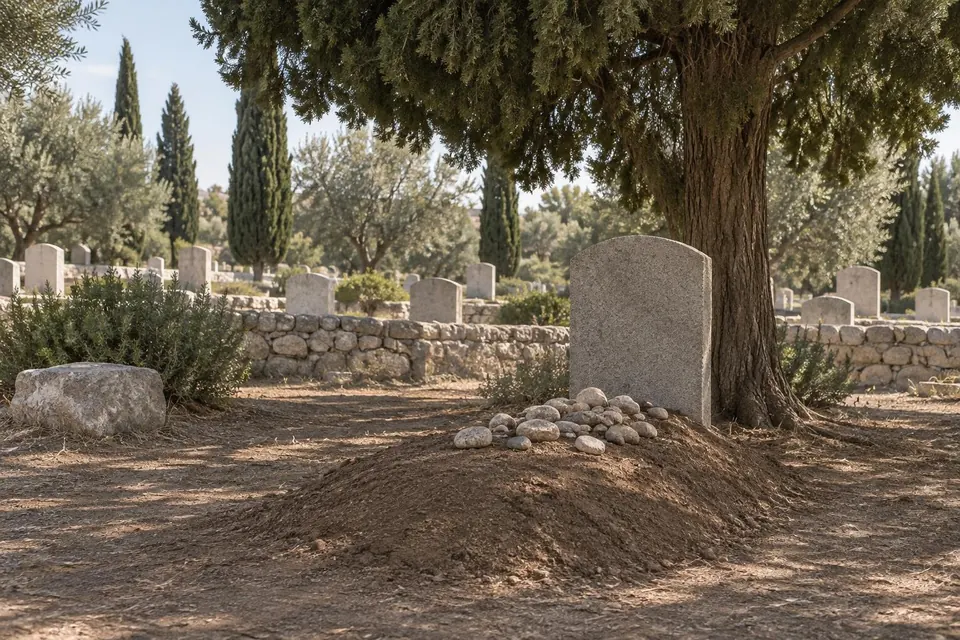
- Jewish law requires burial and prohibits cremation.
- The body is treated with respect because of its connection to the soul.
- If a Jewish person has been cremated, the ashes or other remains must be buried.
- A daughter should care for and honor her mother, but may not carry out a request that violates Jewish law.
First, in this difficult situation, the most important thing is to support your friend emotionally. Remind her that doctors are often mistaken. People given a “death sentence” can live for many years and die at a very old age. It is important for her to feel the care and concern of the people close to her at all times.
Her daughter obviously bears the primary responsibility for her well-being. One of the Torah's most important commandments is to honor one's parents. The Sages write that it is also one of the most difficult mitzvot. We are required to observe it always, with all parents, however difficult it may be. In this case, when an elderly mother is in a difficult situation and truly needs support and help, her daughter has an opportunity to fulfill this mitzvah fully.
With that introduction, let us turn directly to your question.
The Holiness of the Human Body#
The Torah sees the human body not simply as a piece of meat, but as something holy that must be treated with respect. Rabbi Yechiel Michel Tukachinsky writes in Gesher HaChaim, volume 1, chapter 5, section 1:
Anyone who attends to a dead body must be aware that they are dealing with something holy.
The human body is not merely a container for something holy, the exalted and holy human soul. It possesses holiness of its own, like a Torah scroll. That is why Jewish law permits worn covers of Torah scrolls to be made into burial garments for the dead. Just as a physical scroll, made of leather and wood, acquires holiness through the spiritual words of Torah written on it, the human body acquires holiness of its own through the soul that dwells within it ...
The Sages call a living person who has studied Torah a “living Torah scroll.” And they say that someone who witnesses a person's death has seen a Torah scroll being burned ...
We must therefore conclude that when attending to the dead, we should show them the greatest possible honor. Most of the laws and customs concerning the dead body are based on this principle ...
The Body as the Soul's Home#
While a person is alive, the soul dwells in the body. At death, body and soul part, but the separation is not immediate. Their long time together leaves its mark on both. As we have explained, the body acquires holiness through the presence of the soul, like a Torah scroll. The soul, for its part, grows accustomed to the body and does not want to leave it.
The Sages teach that death is a process with seven stages of separation between body and soul, as described in Gesher HaChaim, volume 2, 27:1:
- Thirty days before death, the soul begins gradually to withdraw from the body. The Zohar describes two aspects, or images, of the soul's inner essence: one “large” and one “small.” Both begin gradually to leave the body.
- In the final hours before death, these images leave the body completely.
- The nefesh, the aspect of the soul that dwells in the body and gives it life, leaves the body. This is the body's physical death. The Zohar relates that at the moment of death a person sees the Divine Presence. The soul feels a powerful attraction to its Divine source, and this draws it out of the body to reunite with its spiritual root. At this time, the soul of the deceased is judged.
- For three days after death, the soul hovers over the body. The Jerusalem Talmud relates that during the first three days the soul thinks it can return to the body. Only when it sees that irreversible changes have taken place in the body does it begin to move away. These three days are also the period of the most intense mourning for the deceased.
- Until the seventh day after death, the soul continues to visit the deceased person's home, return to the grave, and come back to the home, trying to adjust to its new state. Separation from material life is still difficult for the soul. At the end of seven days, it ascends to its higher source.
- The Zohar relates that for 30 days after death, the soul and body are judged together. Afterward, the soul ascends to a higher level, while the body decomposes in the earth.
- Only a year after death does the soul finally relinquish the material world and fully recognize the insignificance of everything that happens to matter. It then ascends to a higher level and loses its connection to the body and to its former material life. [Nevertheless, at the resurrection of the dead, the soul will return to the body.]
The Zohar relates that even after the soul ascends to the higher spiritual realms, the aspect of the soul called nefesh remains connected to the body and continues to be present at the burial place.
Burial and the Soul#
The Sages teach that the funeral procession, burial, and eulogies show respect both for the deceased and for the family (Sanhedrin 46b–47a). This is puzzling: What meaning can the respect shown by the living in this world have for a person who has died?
Michtav MeEliyahu, volume 2, page 62, explains:
The death of the body does not change a person's inner nature. A wicked person who lived in fantasies during life continues to cling to those fantasies after leaving the body. But because they cannot satisfy their desires, they will crave pleasure even more, and a powerful appetite will overcome them. In Berakhot 18b, the Talmud tells of two spirits who were interested in what was happening “behind the scenes” of the world and what events would soon occur in the material world. [This shows that the material world continues to interest the soul after the body's death.] Moreover, the soul that had been buried in a reed mat was ashamed of it. In other words, its ideas and feelings about honor remained the same as they had been before her death.
What happens in this world therefore matters to the soul. But the soul is especially concerned with how its own funeral takes place. As the passage below makes clear, even very righteous people care about receiving a proper burial.
Rashi's commentary on Sanhedrin 44b recounts the following incident:
In one town, a tax collector who had been a wicked man died, and on the same day a great Torah scholar died. All the townspeople went out to accompany the scholar's bier, while the tax collector's family also went out of the town to bury their relative. On the way, enemies attacked the funeral procession. The people abandoned the biers and fled. Only one of the scholar's students remained, sitting beside his teacher's bier.
After a while, the town's respected citizens returned to bury the scholar. But they confused his bier with the tax collector's. The scholar's student cried out that a mistake had been made, but no one listened. And so the scholar was buried only by the tax collector's relatives, while the tax collector was buried with honor by the town's leading citizens.
The student suffered greatly over this injustice. What sins had caused the Torah scholar to be buried in disgrace, and what merits had earned the wicked man an honorable burial?
The teacher came to him in a dream and said, “Don't suffer. Come, and I'll show you the great honor I am receiving in the Garden of Eden. I'll also show you that the pivot on which the door of Gehinnom turns is turning in the ears of this sinner, [who was buried alongside me. Why was he honored at the funeral instead of me?] Once I heard people speaking disrespectfully about Torah scholars, and I didn't object. That is what I was punished for. This man, on the other hand, once prepared a feast for the town's ruler, who did not come. He then gave the food to the poor, and this [honor at his funeral] was his reward.”
This passage makes clear that the soul is not indifferent to the honor shown at a funeral. The Sages teach that the respect shown to a person after death is called “true kindness”—kindness done without expecting anything in return.
Burial and the Family#
The funeral procession, burial, eulogies, and other laws and traditions associated with a funeral also show honor and respect to the deceased person's family, provided, of course, that they are carried out properly. The soul of a person who, for any reason, could not be buried properly and according to Jewish law suffers because of this. The family should feel a responsibility toward the deceased and do everything possible to provide a proper burial. If the family fails to do so, it brings disgrace upon itself.
Tragically, during the Holocaust, the perpetrators not only murdered millions of innocent Jews but also deprived most of their victims of a humane burial. We cannot know why the souls of these people suffered such a difficult fate. We believe that everything that happens to a person, both during life and after death, is allotted by the Almighty for particular reasons and is measured specifically for that person in accordance with Divine justice.
Burial and Resurrection#
The Sages tell us that burial is intended not only to honor the soul of the deceased and ease its passage to another world. It is also a vital step in preparation for the future resurrection of the dead.
Belief in the resurrection is widely discussed in Jewish literature and is one of the 13 principles of faith formulated by Maimonides (the Rambam). Here I will quote just two short passages from Daat Tevunot by Rabbi Moshe Chaim Luzzatto (the Ramchal):
The general idea of the resurrection of the dead is, briefly, quite simple. God created a person with a soul and a body so that they would serve and bear their burden together as one, carrying out all the holy work, the Torah and the commandments He gave them. It follows that they should also receive their eternal reward together. It would make no sense for the body to labor for someone else and receive no reward, for God does not withhold reward from any creature ...
Only by returning to dust will the body finally be rid of the impurity introduced by the serpent. And when the body rises from the dust, the soul will descend into it once more, with the full power of its good deeds, filled with the light it enjoyed in the Garden of Eden as a reward for those deeds. This light will finally purify the body, healing it of all the evil to which it was originally subject.
The Sages connect the resurrection of the body with its burial. They say that burying a body is like planting a seed in the ground: the seed begins to decay, but then a whole tree grows from it, surpassing in every way the seed from which it grew.
The Talmud relates a conversation between a Jewish sage and Queen Cleopatra (Sanhedrin 90b):
Queen Cleopatra asked Rabbi Meir, “I know that the dead will come to life, as it says, ‘May people flourish in the city like grass of the earth’ (Psalms 72:16). But how will they rise: naked or clothed?”
He replied, “Look at wheat. If grains of wheat that are ‘buried’—sown—without clothing come out of the ground clothed, then surely the righteous, who are buried in clothing, will rise clothed.”
Burying the dead affirms our belief in their future resurrection.
Torah Law#
Having considered the beliefs underlying your question, let us turn to its practical aspect under halacha, Jewish law.
The Torah requires us to bury the dead, as it says, “You must bury him” (Deuteronomy 21:23). Although this verse speaks of a person who has been executed, the Sages demonstrate that the commandment to bury the dead applies to everyone. There is also a commandment to bury the body so that it touches the earth, as it says, “You are dust, and to dust you shall return” (Genesis 3:19).
The Sages explain that someone who does not bury a dead person in the earth on time also violates the prohibition against letting the body remain overnight. Ideally, it is best to bury the deceased on the day of death. But a funeral may be delayed to show the deceased greater honor, to transport the body to the Land of Israel, or for similar reasons.
The question of whether Jews may be cremated arose in ancient times. The Jerusalem Talmud (Ketubot 11:2) tells of a man who requested that his body be burned after death. The Sages write that this is forbidden.
Closer to our own time, in the second half of the 19th century, the question was put to the great Torah scholar Rabbi Yitzchak Yehuda Schmelkes. A Jew in Italy wrote to him that a group had formed in Livorno to cremate dead bodies. After cremation, the ashes were placed in a special vessel, which the family kept as a remembrance of their deceased relative. Could Jews be buried this way?
Rabbi Schmelkes replied (Beit Yitzchak, Yoreh De'ah, volume 2, chapter 155) that it is unquestionably forbidden for several reasons. First, anything the Torah commands us to bury may not be burned. Burning a body is therefore itself a violation of Jewish law. Moreover, if a body is burned, God forbid, it can no longer be buried properly. Cremation thus conflicts with the laws of burial, especially if the ashes are not buried in the earth but kept in a special vessel. Someone who does not place the body in the earth violates the prohibition against leaving a body unburied.
A similar question was also put to Rabbi Chaim Ozer Grodzinski, one of the foremost authorities of the first half of the 20th century. He confirms that cremation is strictly forbidden by Jewish law. He adds that if a Jewish person's body has been burned, the ashes or any other remains must be buried. See Achiezer, volume 3, chapter 72.
Burial According to Jewish Law#
Burning a dead body is a great insult to the deceased. The prophet Amos says (Amos 2:1): “Thus said the Lord: For three offenses of Moab, and for four, I will not turn away its punishment, because it burned the bones of the king of Edom to lime.”
All the more so, what your friend wants done to her body is a profound desecration. The Talmud (Gittin 56b) mentions similar treatment in connection with one of the greatest villains in Jewish history: Titus, the Roman general and later emperor who destroyed the Second Temple. After his victory over Judea, his arrogance grew so great that he challenged the Almighty.
The Talmud relates that, as punishment, God brought on him a disease of the brain that caused him terrible suffering. Titus feared that his punishment would continue after death. He therefore instructed that his body be burned and his ashes scattered over the seven seas.
The Talmud goes on to tell of Titus's nephew Onkelos bar Kalonymus, who later converted to Judaism and became a great Torah scholar; his works remain widely used today. Onkelos summoned the spirit of his uncle Titus. Among other things, Titus told him that his punishment was that every day his ashes were gathered from the seven seas, he was judged anew, and then he was burned again and scattered over the seven seas.
This passage makes clear that cremation and the scattering of ashes cause the soul of the deceased the most severe suffering. We are therefore obligated to oppose such treatment of the bodies of the dead with all our strength.
Rabbi Yitzchak Zilberstein relates an instructive story about a man (Chashukei Chemed on Yoma 35b):
A Jewish man married a Jewish woman, and they had a boy. Soon after they married, World War II began, and the young wife was killed by the Nazis. Her husband was saved by a non-Jewish woman who managed to have him listed as her husband in her passport. He did go on to live with her, and they had a non-Jewish son.
His first son survived the Holocaust but lost all contact with his father. As a result of the upheavals of war, father and son ended up in different countries and remained there.
One day, the Jewish son unexpectedly received a letter from a law firm. It informed him that his father had died and left a vast estate of $50 million. Half of it—$25 million—rightfully belonged to the first son.
The older son immediately set out for the country where his father had lived. When he arrived, his father had not yet been buried. A dispute arose between the deceased man's two sons over where to bury him. The Jewish son wanted to bury his father in a Jewish cemetery, near the fence. The non-Jewish son believed their father should be buried in a non-Jewish cemetery beside the grave of his wife, the second son's mother.
The case went to court. The judge found what he considered the best solution: cremate the father's body and divide the ashes equally between the sons.
The Jewish son was horrified by the decision and fell into despair, not knowing what he could do. But his lawyer did not lose heart. He advised him, “You've just come into a huge sum of money. Offer your ‘brother’ $50,000 for his half of your father's body. He'll surely agree—after all, what difference does it make to him where his father is buried?”
The Jewish son was delighted with the idea and acted on it at once. But the non-Jewish son immediately sensed an opportunity for profit and refused such a modest offer. He said, “If your father's honor is so important to you, give up your entire share of the inheritance. I'll take all $50 million, and you can have your father's body.”
The Jewish son realized that the only way to bury his father according to Jewish law and custom was to part with his share of the inheritance. He passed this difficult test, gave the second son the entire sum he had just acquired, and received his father's body in return. He then buried him according to Jewish law.
Fortunately, most of us do not face such tests. For many Jews living in Israel or in large cities outside Israel, a proper Jewish funeral observing all the traditions can be arranged with a single call to the local chevra kadisha (burial society). The main obstacle to observing our laws and customs may be the wishes the deceased expressed before death. This brings us to your question.
What Should the Daughter Do?#
First and foremost, the daughter should care for her mother, look after her, help her, and honor her. She should visit her mother with her children as often as possible and bring her joy. But what should she do about her mother's will if her mother, God forbid, dies?
It might seem that by carrying out a mother's wishes, a son or daughter fulfills two mitzvot at once. First, they honor their parent. Second, they carry out the wishes of the deceased, which is also a mitzvah.
But this applies only when a parent's wishes do not conflict with Jewish law. It is forbidden to obey a parent's instructions or wishes when they contradict halacha. As for carrying out the wishes of the dead, there is no doubt that for a soul that has entered the World of Truth, there is no greater joy than a funeral conducted according to our holy laws and centuries-old traditions.
We must not forget that by burying a body according to Jewish law, we affirm our belief in the resurrection of the dead. Let us recall the words of Maimonides (Mishneh Torah, Laws of Repentance 3:6):
There are sins for which a person loses a share in the World to Come and meets eternal destruction and punishment for a great sin and wrongdoing. This applies ... to those who do not believe in the resurrection of the dead.
If you can persuade your friend to abandon the idea of cremation, you will bring her at least a little closer to belief in the resurrection of the dead, and in doing so give her a great gift.
Practical law. This page reports a ruling given for a specific question. For your own situation, ask a rabbi who knows you.
Keep reading
More →How Can You Help a Loved One's Soul After Death?
Jewish sources and traditions describe ways to bring merit to the souls of departed loved ones.
Yitro: A Representative of the Dead
Death and MourningWhat Happens to the Soul After Death in Judaism?
Jewish teachings describe the separation of body and soul, the meaning of burial, and the eventual resurrection of the dead.
Death and MourningWhy Does the Torah First Describe Burial With Sarah?
Sarah’s burial marks a change in how the Torah describes death and the human body.







