Why Does the Torah First Describe Burial With Sarah?
Sarah’s burial marks a change in how the Torah describes death and the human body.
In brief
- The Torah first describes a burial after Sarah’s death, although it earlier tells Abraham that he will be buried.
- The Hittites already had graves, so burial was not new.
- The essay connects a change in the meaning of burial to the era of Torah that began with Abraham.
- It compares the burial of a person who studied Torah to the respectful storage of a worn Torah scroll.
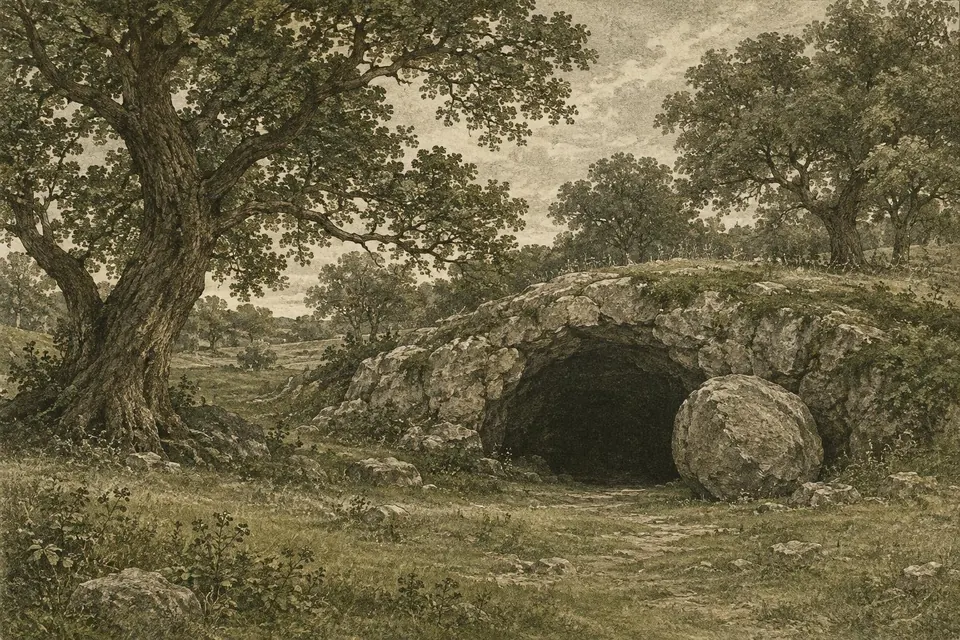
Abraham rose from beside his dead and spoke to the Hittites: “I am a stranger and a resident among you. Give me a burial property among you, so that I may bury my dead out of my sight.” The Hittites answered Abraham: “Listen to us, my lord. You are a prince of God among us. Bury your dead in the finest of our graves. None of us will refuse you his grave for the burial of your dead.” (Genesis 23:3–6)
Of all the deaths described in the Torah before this point, not one mentions burial. Throughout the 10 generations from Adam to Noah, the Torah tells us repeatedly that people died, but it never describes a burial. The same is true of the 10 generations from Noah to Abraham. Only after Sarah’s death does the Torah describe the circumstances surrounding a death and burial.
There is one earlier mention: at the covenant between the pieces (brit bein habetarim), the Almighty promises Abraham, “You will go to your ancestors in peace; you will be buried at a good old age” (Genesis 15:15). But apart from this promise to Abraham, we find no mention of burial before Abraham and Sarah.
From this point onward, however, the Hebrew Bible mentions burial along with death, with two exceptions: the deaths of Bat Shua, Judah’s wife, and Ishmael.
What changed in the world with the arrival of Abraham and Sarah? We cannot simply suggest that people had not buried their dead before then. The Hittites told Abraham, “Listen to us, my lord. You are a prince of God among us. Bury your dead in the finest of our graves.” Rashbam explains that the Hittite elders were offering Abraham a ready grave, in the place where they buried the distinguished members of their people [Rashbam on Genesis 23:6]. So they did bury their dead, and they had burial ceremonies. What, then, distinguished the world before Abraham and Sarah from the world after their deaths?
One possible answer is that although funerals and burial existed before, they meant something entirely different. People regarded burial not as a way of parting from someone important, but as a way of disposing of waste. A burial place was not a memorial cemetery, but a waste disposal site.
The Talmud divides the days of our world into three periods (Avodah Zarah 9a). The first 2,000 years are compared to chaos. The second 2,000 years are called the era of Torah. The last 2,000 years are called the era of the Messiah. When do the 2,000 years of Torah begin? With Abraham. Because Abraham began to study and teach God’s word in the world, the era of Torah began, as the verse says, “the souls they made in Haran” [Genesis 12:5]. Onkelos explains: “the souls they brought under the Torah” [Onkelos on Genesis 12:5].
The way people regard the human body changes as well. The body of a person who studied Torah and fulfilled God’s mitzvot is now like a box filled with precious jewels. A worn Torah scroll must be placed in a genizah, a place for the respectful storage of sacred items. Even when a Torah scroll is no longer fit for use, it retains its holiness. It is not enough simply to bury it in the ground; it must be respectfully laid away in a genizah. Likewise, the body of a person who studied Torah was a dwelling place for holiness. Its burial is therefore like placing something in a genizah, not like disposing of waste.
This sheds light on why Abraham did not want to bury Sarah in the Hittites’ cemetery. It was not a genizah, but a place where unwanted remains were buried.
Keep reading
More →How Can You Help a Loved One's Soul After Death?
Jewish sources and traditions describe ways to bring merit to the souls of departed loved ones.
Yitro: A Representative of the Dead
Death and MourningWhat Happens to the Soul After Death in Judaism?
Jewish teachings describe the separation of body and soul, the meaning of burial, and the eventual resurrection of the dead.
ParashaChukat: The Consolation of Fools
A story of grieving sages opens an exploration of the emotional and rational sides of consolation.







