Chukat: The Consolation of Fools
A story of grieving sages opens an exploration of the emotional and rational sides of consolation.
In brief
- Rabbi Yochanan ben Zakkai’s students tried different ways to comfort him after his son died.
- Rabbi Yechezkel Abramsky saw in his response the Sages’ extraordinary compassion.
- The author argues that consolation must address both emotion and reason.
- He suggests comparing ourselves with others to find contentment materially, while striving for more spiritually.
Parashat Chukat#
“Take Aaron and his son Elazar and bring them up Mount Hor. Remove Aaron’s garments and dress his son Elazar in them” (Numbers 20:25–26).
Rabbi Yechezkel Abramsky once said of a story from the Talmud: “We find stories that show us the minds of our Sages: their extraordinary brilliance, their instant grasp of a situation, and their phenomenal memory. This story shows us their hearts—the depth of their feeling, empathy, and compassion for others.”
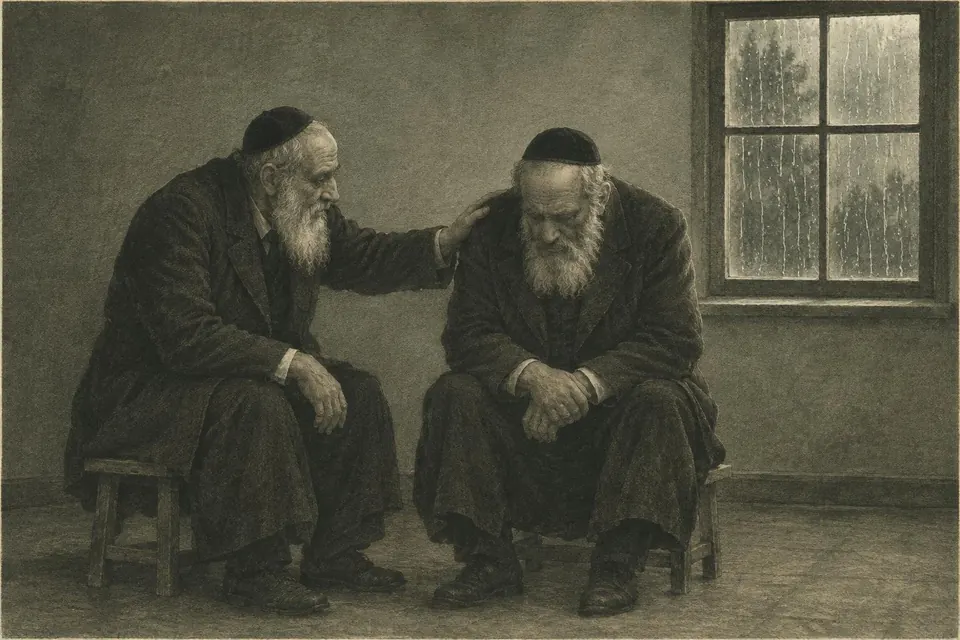
Here is the story (Avot deRabbi Natan 14): When the son of Rabbi Yochanan ben Zakkai died, his students came to fulfill the mitzvah of comforting mourners.
Rabbi Eliezer ben Hyrcanus entered first, sat before him, and said, “Rabbi, may I say something to you?”
“Speak,” he replied.
Rabbi Eliezer said, “Adam, the first man, had a son who died, and Adam was comforted after his death. As it says, ‘Adam knew his wife again’ (Genesis 4:25). You, too, should accept consolation.”
Rabbi Yochanan answered, “Is it not enough that I am grieving for my son? Must you also remind me of the grief of the first man?”
Rabbi Yehoshua entered, sat before him, and said, “Rabbi, may I say something to you?”
“Speak,” he replied.
Rabbi Yehoshua said, “Job had sons and daughters, and they all died on the same day, yet he was comforted. As it says, ‘God gave, and God took away; may His name be blessed’ (Job 1:21). You, too, should accept consolation.”
Rabbi Yochanan answered, “Is it not enough that I am grieving for my son? Must you also remind me of Job’s grief?”
Rabbi Yosei entered, sat before him, and said, “Rabbi, may I say something to you?”
“Speak,” he replied.
Rabbi Yosei said, “Aaron had two great sons, and both died on the same day. Yet he was comforted, as it says, ‘Aaron remained silent’ (Leviticus 10:3). You, too, should accept consolation.”
Rabbi Yochanan answered, “Is it not enough that I am grieving for my son? Must you also remind me of Aaron’s grief?”
Rabbi Shimon entered, sat before him, and said, “Rabbi, may I say something to you?”
“Speak,” he replied.
Rabbi Shimon said, “King David had a son and a daughter who died, yet he was comforted, as it says, ‘David comforted his wife Bathsheba’ (2 Samuel 12:24). You, too, should accept consolation.”
Rabbi Yochanan answered, “Is it not enough that I am grieving for my son? Must you also remind me of David’s grief?”
Rabbi Elazar ben Azariah—or, according to other sources, Elazar ben Arach—entered and sat before him. “Let me offer you a comparison, Rabbi,” he said. “Imagine that a king entrusted a man with a precious object. Every day the man groaned and sighed: ‘When will I finally be able to return this treasure to the king, so that nothing happens to it?’
“So it is with you, Rabbi. You had a son who studied Torah, the Prophets, the Writings, Mishnah, laws, and aggadot—rabbinic teachings and stories—and left this world without sin. You should accept consolation, for you returned this treasure in perfect condition, without a flaw.”
Rabbi Yochanan answered, “Rabbi Elazar, my son, you have comforted me as one should comfort.”
Rabbi Abramsky explained: Usually, a person in mourning is immersed in their own grief, and their heart is closed to the suffering of others. A simple example makes the point. When does a person have more money: when they are hosting a celebration—a wedding, a bar mitzvah, or the like—and spending a great deal, sometimes even borrowing to pay for it? Or when, God forbid, their parents have died and they have received an inheritance? Yet we see that in times of joy, people give tzedakah generously, without holding back, while in mourning the opposite is often true.
Rabbi Yochanan’s heart was so heavy that his students, one after another, tried to persuade him to accept consolation. Yet when they reminded him of King David’s grief, a thousand years earlier, Aaron’s grief, fifteen hundred years earlier, and Adam’s grief, four thousand years earlier, he grieved with them and was distressed to be reminded of their suffering.
How remarkable were the hearts of our Sages, how alive their feelings, how deeply they shared in every tragedy they heard about. Each year we read in the Torah about the deaths of Abel and Aaron’s sons. How many of us feel compassion for their fathers?
All this is true, but now I have a question. When the students saw that their teacher did not accept the words of the great Rabbi Eliezer—and, moreover, was distressed by the grief of the first man—why did they go on mentioning the grief of Job, Aaron, and King David, causing Rabbi Yochanan even more distress?
And if Rabbi Elazar’s consolation was “as one should comfort,” why did it not occur to them?
The answer is profound, and we must understand it.
A person is made up of reason and emotion, and neither can be ignored. Even the greatest sages have both, and both must be taken into account.
I heard from Rabbi Moshe Feinstein that this was precisely Cain’s mistake and the beginning of his downfall. Cain was a great man: he was the first to understand the secret of sacrifices (see Genesis 4:3 and Nachmanides’ commentary there). More than that, he persuaded Abel to bring an offering. So why did he offer inferior produce? Was he unwilling to give God a good carrot, so that he brought a rotten one instead? All the produce in the world was his, and he could not possibly eat it all. Why did he not bring the best, as it says, “All the fat belongs to God” (Leviticus 3:16), meaning the choicest part?
The answer is that Cain made a simple calculation: All the produce is a gift from Heaven, and if I offer the best of it, I will appear ungrateful to the Creator. Besides, it matters to me whether the produce is the best or not, but what difference does it make to God? He does not eat it anyway.
This is explained in Shevuot 15a. There the Sages ask about the words of the prophet Nehemiah (12:31): “I will bring there two large thanksgiving offerings.” Why does he say “large”? If they were large in size, what difference would that make to God? It does not matter to Him whether a person brings more or less; what matters is that the person’s heart is directed toward Heaven.
The commentary of Tosafot—the medieval Talmud commentators—on Yoma 34b says that one should offer the best animal in the flock. And Shevuot 11a says that if a person consecrated a red cow and then found another, better than the first, they have a mitzvah to redeem it. Tosafot explain that Nehemiah should not have boasted about offering large animals, since the mitzvah is fulfilled either way if a person acts for the sake of Heaven.
Cain, too, thought: If I offer God the very best, it will seem that this matters to Him, while I do not care what I bring, as though I do not value His gifts. So I will bring inferior produce, to show, first, how much I value and enjoy the good harvest and, second, that to the Creator, blessed be He, there is no difference between good and inferior produce.
These were the calculations of a great man, a prophet who understood the secret meaning of sacrifices.
Where did he go wrong? He thought that a person is governed by reason alone, and he acted according to pure logic. He did not understand that a person also has feelings. When he offered inferior produce, even in his own eyes he had shown disrespect for the glory of Heaven, and God was angry with him for it.
Our Sages, the students of Rabbi Yochanan ben Zakkai, knew this secret: Before appealing to reason, one must appeal to emotion and feeling. And feelings are helped by the saying, “A trouble shared by many is half a consolation.” Of course, this is completely illogical. The Pele Yoetz, a work of ethical guidance, says, “A trouble shared by many is the consolation of fools.” If I know that many people have toothaches, will my tooth hurt any less?
Indeed, Rabbi Yochanan rejected these empty consolations, which appeal to emotion but in fact have nothing in them. Yet they paved the way. When Rabbi Elazar ben Azariah came and comforted Rabbi Yochanan with words that appealed to reason, he accepted them.
What can we do? That is how we are. All the children of the great Rebbe of Gur, author of the Chidushei Harim, died during his lifetime. The last was his eldest son, Rabbi Avraham Mordechai, father of the brilliant author of the Sefat Emet. When the Rebbe returned from the funeral, he said, “One thing comforts me. When, God forbid, another Jew suffers a tragedy and loses a child, he will say, ‘Well, what can we do? Itche Meir lost thirteen children.’”
The author of the Chidushei Harim himself makes a related point. A well-known Midrash says that the sun and moon were originally created the same size. The moon said, “Two kings cannot share one crown.” God then told her, “Go and make yourself smaller,” and to comfort her, He increased the number of stars.
But what sort of comfort is that? She wanted to be larger than the sun, and in the end she had to become smaller. Besides, does she rule over the stars? Do they belong to her? The answer is simple: She will see that there are others smaller than she is, and she will be soothed.
Yes, this applies even to great people. We learn it from our weekly portion. God tells Moses: “Take Aaron and his son Elazar and bring them up Mount Hor. Remove Aaron’s garments and dress his son Elazar in them. Aaron will be gathered to his people and die there” (Numbers 20:25–26).
Everywhere the Torah says to “take” a person, it means to persuade them gently. Here, too, Rashi explains: “Take Aaron”—comfort him. Tell him, “Fortunate are you to see your crown pass to your son. I did not merit that.” Moses our teacher also very much wanted this, but did not merit it; see Rashi on Numbers 27:16.
Of course, this was very important to Aaron and was genuine consolation, for the Talmud says that a person who leaves behind a son like himself is as though he has not died (Bava Batra 116a). But why did Moses have to add, “I did not merit that”? At first glance, the consolation was that Aaron saw his son continuing in his path, becoming high priest. Why should it matter to him? Let the same happen for Moses, too.
But we see that this, too, was part of the consolation: I merited it, and he did not.
Oh, how can we say such a thing about Aaron, who loved everyone and sincerely rejoiced in others’ good fortune?
And all the more so when it came to him and Moses, who were like one soul in two bodies: “Each rejoiced in the other’s greatness. Aaron rejoiced in Moses’ greatness, as it says, ‘He will see you and rejoice in his heart’ (Exodus 4:14). And Moses rejoiced in Aaron’s greatness, as it says, ‘Like the precious oil running down the beard, the beard of Aaron’ (Psalms 133:2). Did Aaron have two beards? No. When Moses saw the anointing oil running down Aaron’s beard, it seemed to him as though it were running down his own beard, so happy was he for his brother” (Song of Songs Rabbah 1:52).
And, as the verse says, “As water reflects face to face, so one person’s heart reflects another’s” [Proverbs 27:19]. Yet despite all this, it was a consolation to Aaron.
Why? Because it is one of the powers of the soul, a feeling imprinted in every person—an emotion for which there is no logical explanation.
Why Did God Give Us This Feeling?#
Rabbi Moshe Rosenstein, the mashgiach, or spiritual mentor, of the Lomza yeshiva, taught in the name of his teacher, the Elder of Kelm: Just as there is no physical power in a person that is useless, so there is no useless power of the soul. We simply need to know how and for what purpose to use each one.
This quality—taking pleasure in having more than others—was surely placed in us so that we could learn to be content with little and rejoice in our lot. Nedarim 50a tells us that Kalba Savua, one of the wealthiest men in Jerusalem, refused to support his daughter Rachel because she married a simple, uneducated shepherd who was already forty years old: Rabbi Akiva.
The young couple settled in a barn. The hay stored there served as their bed and blanket. The prophet Elijah came to encourage them. Disguised as a poor man, he asked them for a little hay, saying that his wife had given birth and he did not even have hay to put under her and the baby.
Rabbi Akiva said to his wife, “Look, there are people worse off than we are. They don’t even have hay.” We see that this really does comfort people.
In material matters, we should take comfort in the fact that others have less than we do. In spiritual matters, we should strive to have as much as possible.
Taanit 25a tells of Rabbi Chanina ben Dosa. He was destitute, and life was so hard that one day his wife could bear it no longer. She asked him to pray to God to send them relief. Rabbi Chanina prayed, and a golden table leg came down from Heaven.
That night, his wife dreamed that they were sitting at a table in the Garden of Eden. All the righteous had tables with three legs, but theirs had only two.
“Well,” Rabbi Chanina said, “do you want everyone else to eat at a whole table while we sit at one with a leg missing?”
His wife did not want that. She agreed that he should pray to God again, and the leg was taken back.
The story is puzzling. A table cannot stand on two legs, especially if it bears the entire reward of Rabbi Chanina ben Dosa in the World to Come. Someone would have to sit beside it and hold it up forever. Of course she would ask to return the leg. What was the question?
But it is not so simple. If Rabbi Chanina’s wife had seen all the righteous sitting and holding up their tables, she surely would have agreed to sit forever holding theirs so that it would not fall.
What bothered her was that all the righteous were eating at steady tables, and only theirs was missing a leg.
This is what the Talmud means when it says that in the Garden of Eden “each person is burned by the chuppah, or canopy, of another. Woe to him for that shame” (Bava Batra 75a).
Let us recall the well-known Midrash (Bamidbar Rabbah 23:9) in which the prophet Elijah proposed that the worshippers of Baal offer a bull and that he, too, would offer a sacrifice to God. They would then see upon whose altar fire came down from Heaven.
The Midrash says that the bull designated as a sacrifice to Baal did not want to go with them. “My companion and I were born to the same mother and raised in the same pasture. Why is he being offered to God, while I am being offered to Baal, arousing my Creator’s anger?” Four hundred worshippers of Baal could not move him from the spot.
Elijah explained to the bull that when fire did not descend upon Baal’s altar, the name of Heaven would be sanctified no less than when fire descended upon God’s altar. Elijah himself then led the bull to the worshippers of Baal.
But how had the idolaters managed to offer sacrifices before? If a bull refuses to move, four hundred men cannot budge him. We see, then, that the bull did not object to being offered to Baal. What really bothered him was that his companion was being offered to God. He was “burned by the chuppah of another.”
But at least it was something. God tells us, “Learn from Elijah’s bull,” as Job says: “[God] teaches us through the behavior of animals” (Job 35:11).
And what about us? Woe to us, for we have it the other way around. In spiritual matters, we take comfort in knowing that others are worse than we are. In material matters, we are “burned” by our neighbors’ achievements.
In the book Minchat Eliyahu, the author of Shevet Mussar relates that in the month of Av 5442, he was freeing a young man from a dybbuk, another person’s spirit that had entered him.
“I knew this man,” the rabbi writes. “He was a chicken seller, a hot-tempered man whose deeds were repulsive. I asked him what had happened to him, and he replied, ‘I had many debts, and I could not bear it. I realized that I would have to ask others for help, and I preferred death. I took poison and died.’”
A person who dies by suicide receives no share in the World to Come, and their soul wanders without finding rest. The rabbi asked him various questions, and he answered according to the knowledge and understanding he had possessed in life. “I asked him how large his soul was, and he replied that it all depends on a person’s spiritual stature. His soul was the size of a small nut, and there were souls even smaller.”
The Hebrew Bible uses descriptions such as “the greatest among the giants” (Joshua 14:15), said of our forefather Abraham, and “a great woman” in Shunem, a God-fearing woman (2 Kings 4:8). We usually understand these figuratively, as referring to great people. But this story gives us a new perspective: These people are actually large—their souls are large. And sin makes the soul smaller.
A person goes through life proud of being tall, not realizing that they will leave that height in the grave. And what size will they be when they ascend to Heaven? A grain? A crumb of tobacco?
But what a consolation: “There are souls even smaller,” so there is nothing to fear.
By Rabbi Yaakov Galinsky
Keep reading
More →How Can You Help a Loved One's Soul After Death?
Jewish sources and traditions describe ways to bring merit to the souls of departed loved ones.

Yitro: A Representative of the Dead
Death and MourningWhat Happens to the Soul After Death in Judaism?
Jewish teachings describe the separation of body and soul, the meaning of burial, and the eventual resurrection of the dead.
Death and MourningWhy Does the Torah First Describe Burial With Sarah?
Sarah’s burial marks a change in how the Torah describes death and the human body.







