Eikev: Silent Witnesses
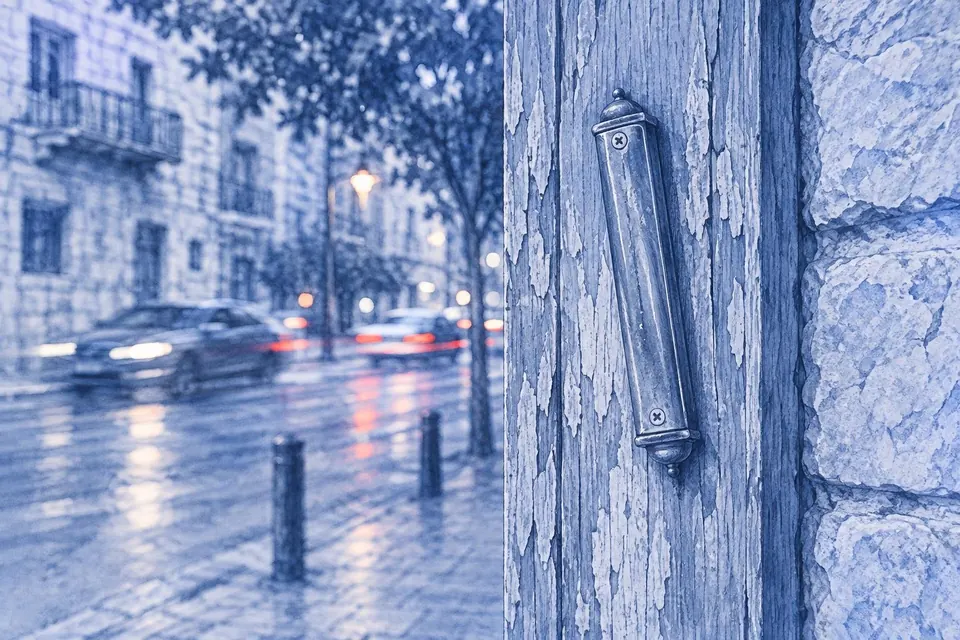
The mezuzah at the door reminds us what endures amid a changing world.
In brief
- Maimonides says that seeing a mezuzah should awaken us to God’s unity.
- A mezuzah is a silent witness to generations, empires, and ideas coming and going.
- The story of Nobah’s city offers another lesson about the pursuit of immortality.
- God and His Torah endure through every change.
Weekly Torah Portion: Eikev#
“Write them on the doorposts of your house and on your gates” (Deuteronomy 11:20).
The mezuzahs on our doors are like guards. We pass them as we leave a room and as we enter it. When we look at a mezuzah, what do we think about? What comes to mind when we see the letter shin on the case and remember the sacred texts inside it?
At the end of his discussion of the laws of mezuzah, Maimonides (the Rambam) advises us to reflect on God’s unity. This should prompt us to shake off the routine of daily life and remember that nothing in life is eternal except God and His Torah [Maimonides, Laws of Tefillin, Mezuzah, and the Torah Scroll 6:13].
But one thing is unclear: Why should the mezuzah be what reminds us of this?
One possible answer is that the mezuzah is a silent witness to world history and to the events of people’s lives. Think of a mezuzah attached to the doorway of an old synagogue or another historic building. It has hung there for decades, if not hundreds of years. It has seen babies brought into the synagogue for their circumcisions. Thirteen years later, it has watched those same babies return as young men to read from the Torah at their bar mitzvahs. Then, many years later, those same people were carried into the synagogue for a eulogy before being taken to the cemetery.
The mezuzah has seen generations come and go. Empires have risen and fallen; ideologies have gained popularity and faded away.
Imagine a mezuzah over the past hundred years. It has witnessed humanism, capitalism, materialism, and existentialism. Each of these movements became the one true philosophy of life, only to be shattered. The Soviet Union, carrying the ideas of communism, threatened to take over the whole world—and where is it now? The mezuzah saw the rise of the Third Reich, the Thousand-Year Reich, and the terrible Holocaust.
It is human nature to seek immortality in everything. This invention, this idea, this building, this book—this creation will achieve immortality, stand the test of time, last for ages, and make its creator immortal. But everything comes and goes, and nothing eternal remains.
The Torah tells us: “Nobah went and captured Kenath and its surrounding villages, and he called it Nobah after his own name” (Numbers 32:42). The Hebrew word for “it” here is la; it refers to the city, a feminine noun in Hebrew. According to the rules of the holy language, the word should end with a pronounced heh, marked to show that it is sounded. Instead, it ends with an ordinary heh, which is silent at the end of a word. The Midrash tells us that this spelling hints that the city would not last long—and indeed, it was soon destroyed.
Why does the Torah, which contains not a single extra letter, see fit to share this information with us? Apparently, we need another lesson in how fleeting the pursuit of immortality is. Nobah wanted to achieve immortality by creating something lasting—nothing less than an entire city—and he named it after himself. But he did not succeed. The city was destroyed, and its name was forgotten, as though it had never been mentioned at all.
Everything changes; nothing lasts forever. The only things that always were, are, and will be are God and His Torah. The mezuzah can bear witness to that.
By Rabbi Yissocher Frand
Keep reading
More →Why Are Tattoos Forbidden in Judaism?
Rabbi Shlomo Wolbe’s comparison of the body to a spacesuit helps explain the Torah’s prohibition.
Guide · MitzvotThe Laws of Separating Challah From Dough
- General Principles
- Who Is Obligated to Separate Challah?
- Separating Challah on Shabbat and Festivals
You Do What You Can, and I Will Add My Glory
Our efforts to perform mitzvot are only one part of the story.







