You Do What You Can, and I Will Add My Glory
Our efforts to perform mitzvot are only one part of the story.
In brief
- God told Moses to build the Tabernacle as best he could, and God would bring His presence into it.
- The same principle applies to every area of our lives.
- When we do all we can to perform mitzvot, God brings our actions to perfection and gives them holiness.
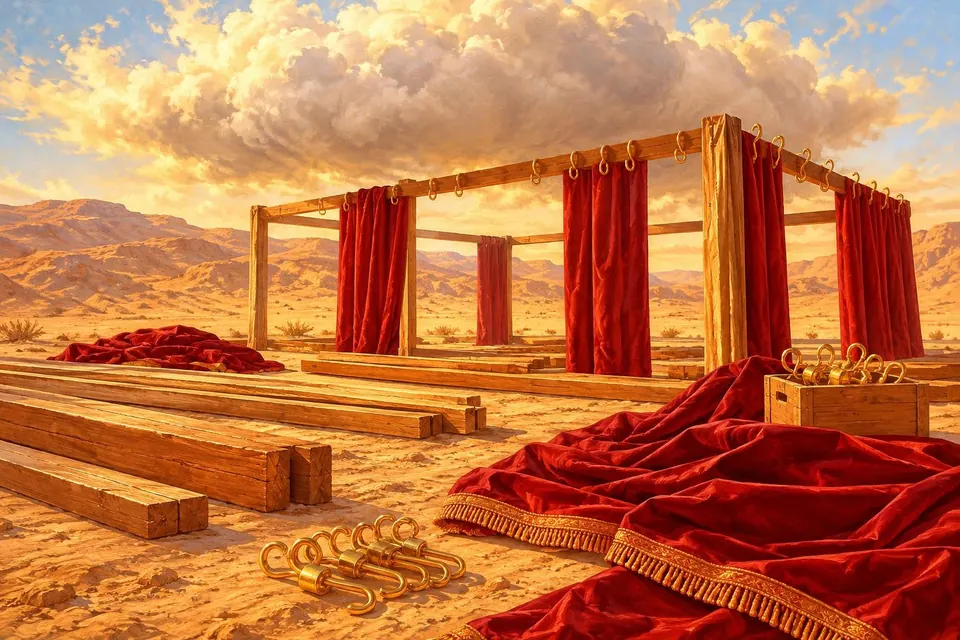
“Moses erected the Tabernacle: he laid its bases, set up its planks, put its bars in place, and erected its pillars” (Exodus 40:18).
Rabbi Avin said: “This is like a king who had a beautiful portrait. He said to a member of his household, ‘Make me one just like it.’” The man replied, “Your Majesty, how can I make anything like it?” The king said, “You do it with your own resources, and I will add my glory.”
In the same way, God said to Moses, “Look and make it.” Moses said, “Master of the universe, am I God, that I can create something like this?” God replied, “In the form of the blue, purple, and scarlet that you see above, make it below … If you make below what you saw above, I will leave the heavens and bring the Shechinah (Divine Presence) to dwell among you below” (Shemot Rabbah 35:6).
The Midrash explains that God told Moses he had to do only what was within his power, just as the king in the parable said: “You do it with your own resources, and I will add my glory.” Once you do what you have been tasked with and build the Tabernacle according to the plan I gave you, I will do My part and bring My Shechinah to dwell in the house you build. That was God's answer to Moses, and that is what happened: Moses our teacher built the Tabernacle from physical materials, and God brought His Shechinah and His glory to dwell in it.
We can apply this principle, this answer God gave Moses, to every area of our lives.
When we begin to perform a mitzvah, we recite a blessing: “... who sanctified us with His mitzvot ...” We thank God for sanctifying us with His mitzvot. But why do we call them God's mitzvot? Aren't they ours? Shouldn't we say, “who sanctified us with our mitzvot”?
The answer is that when we perform mitzvot, God brings them to perfection. He gives them additional holiness, a special grandeur, and a power beyond our understanding.
Psalms says: “I call to God Most High, to God who fulfills His purpose for me” (Psalms 57:2). When we perform mitzvot as well as we can and study Torah at our own level, God brings our actions to absolute perfection and grants our mitzvot a special holiness. He completes what we, with our own limited strength, cannot complete.
That is the meaning of the blessing “who sanctified us with His mitzvot.” The value of our mitzvot does not depend on our actions alone. If it did, they would be full of flaws and shortcomings. But God Himself completes and perfects what we cannot, and the mitzvot reach a level of holiness worthy of God's mitzvot.
When we recite a blessing before performing a mitzvah, it is as though we are saying to God: “Master of the universe, we have done everything You commanded us. We have finished our part; we can do no more. And now, our Father in Heaven, we ask You: Sanctify us with Your mitzvot. Complete everything necessary so that the mitzvot we performed with our limited strength receive their value and dignity, the value and grandeur that only You can give them.”
And indeed, God hears our request and examines our actions. If we have truly done everything within our power, He brings our mitzvot to perfection and sanctifies them with His holiness, the exalted holiness with which the Creator's mitzvot are sanctified.
By Rabbi Shimshon Pincus
Keep reading
More →Why Are Tattoos Forbidden in Judaism?
Rabbi Shlomo Wolbe’s comparison of the body to a spacesuit helps explain the Torah’s prohibition.
ParashaEikev: Silent Witnesses
The mezuzah at the door reminds us what endures amid a changing world.
Guide · MitzvotThe Laws of Separating Challah From Dough
- General Principles
- Who Is Obligated to Separate Challah?
- Separating Challah on Shabbat and Festivals







