Lag BaOmer: Meaning and Customs
The 33rd day of the Omer is a day of joy associated with Rabbi Akiva’s students and Rabbi Shimon bar Yochai.
In brief
- Lag BaOmer falls on 18 Iyar, the 33rd day of the Omer count.
- Mourning practices are suspended because Rabbi Akiva’s students did not die on this day.
- Rabbi Shimon bar Yochai died on Lag BaOmer and asked that it be a day of joy.
- Customs include visiting his grave in Meron, lighting bonfires, singing, and dancing.
The 33rd day of the Omer count—the counting of days between Passover and Shavuot—is called Lag BaOmer. Each letter of Hebrew, the Holy Language, has a numerical value, and numbers are represented by letters in sacred books. “Lag” combines ל, the letter lamed, which has a value of 30, and ג, the letter gimel, which has a value of three. Together they make 33. This day always falls on 18 Iyar.
On this day, Rabbi Akiva’s students stopped dying. It is because of their deaths that mourning is observed between Passover and Shavuot. According to one opinion cited in the Shulchan Aruch, they did not die again after this day. According to another, they continued to die afterward, but none of them died on Lag BaOmer itself. In either case, because Rabbi Akiva’s students did not die on Lag BaOmer, the laws of mourning are not observed that day.
Another great student of Rabbi Akiva, Rabbi Shimon bar Yochai, a sage of the Mishnah, died on this day. Before his death, however, he asked that Lag BaOmer be made a day of joy and celebration. Unlike the first generation of Rabbi Akiva’s students, Rabbi Shimon bar Yochai died at an advanced age, surrounded by his students and followers. Because of the tremendous effort he devoted to Torah study, God revealed great secrets to him that had not previously been known to the Sages. On the day of his death, he was granted the greatest revelation of the Torah’s deepest secrets. For this reason, Kabbalists consider this day a celebration of the giving of the hidden Torah.
There is an ancient custom to visit the graves of Rabbi Shimon bar Yochai and his son Rabbi Elazar on this day. The graves are in the village of Meron, near the city of Safed. There, people customarily share a meal and celebrate. There is also a tradition of giving boys who turn three around this time their first haircut there, a ceremony known as chalakah. Their peyot (sidelocks) are left in place, as required by halacha and tradition. Before this age, it is customary not to cut boys’ hair, although there is no prohibition against doing so.
Kohanim (priests descended from Aaron) who travel to Meron to visit the graves of Rabbi Shimon bar Yochai and his son must take care to avoid the ritual impurity present at graves and cemeteries. They may not enter the building constructed over the graves of these righteous men.
Large numbers of people have visited Meron for many centuries. If a trip to Meron poses a physical danger or leads to immodest behavior, it should, of course, be avoided.
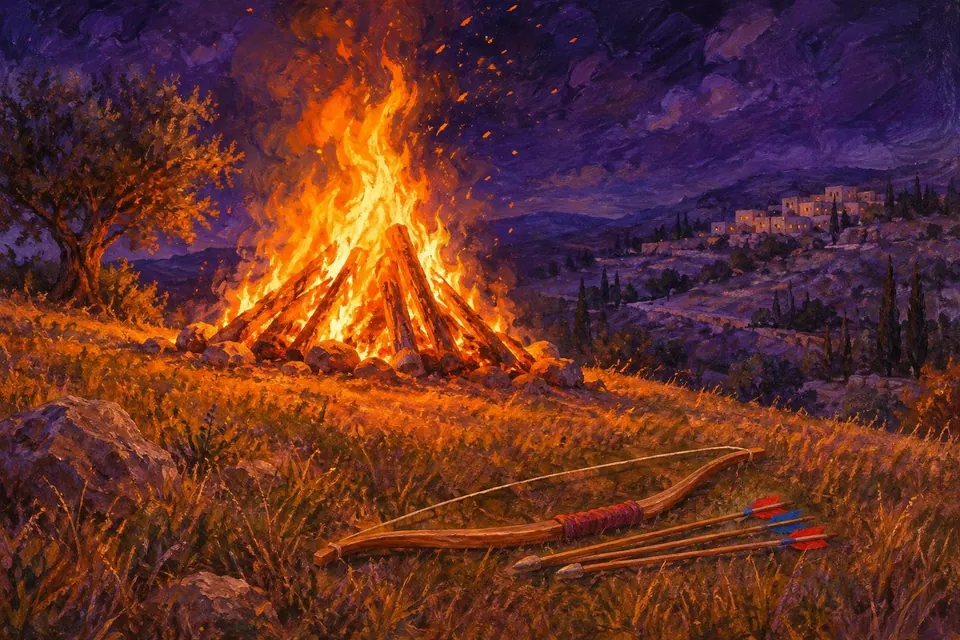
There is also a tradition of lighting bonfires, dancing around them, and singing songs about the holy sage Rabbi Shimon bar Yochai.
In any case, we should not forget what enabled Rabbi Shimon to become such an important link in the transmission of Torah and a teacher to all who study its secrets. The Talmud says that Rabbi Shimon stood apart even from the other sages of the Mishnah of his time because he studied Torah constantly, without interruption. His fulfillment of this mitzvah even exempted him from the obligation to pray (Shabbat 11a). The same tractate tells how Rabbi Shimon and his son were forced to flee from civilization and live in a cave (Shabbat 33b). Even under those difficult conditions, these great righteous men continued to study Torah without interruption. It was through this that God revealed to them aspects of wisdom inaccessible to others.
Based on Rabbi Yehuda Chesner, Shaarei Yemei HaPesach 11:5.
Practical law. This page reports a ruling given for a specific question. For your own situation, ask a rabbi who knows you.
Keep reading
More →Why Do We Celebrate Lag BaOmer?
Lag BaOmer marks the survival of Rabbi Akiva’s Torah and is closely associated with Rabbi Shimon bar Yochai.
HolidaysRabbi Shimon Bar Yochai and the Myrtle Branches
After years in a cave, Rabbi Shimon and his son encountered a man whose myrtle branches revealed a lesson about holiness.
HolidaysWhat Is Tu B'Av and Why Is It a Holiday?
The fifteenth of Av is a day of joy whose history reveals a recurring theme of wholeness and reunion.
HolidaysWhat Is Tu BiShvat and Why Is It the New Year of Trees?
Tu BiShvat marks a turning point for the laws of fruit trees and offers lessons about human growth.







