What Is Tu BiShvat and Why Is It the New Year of Trees?
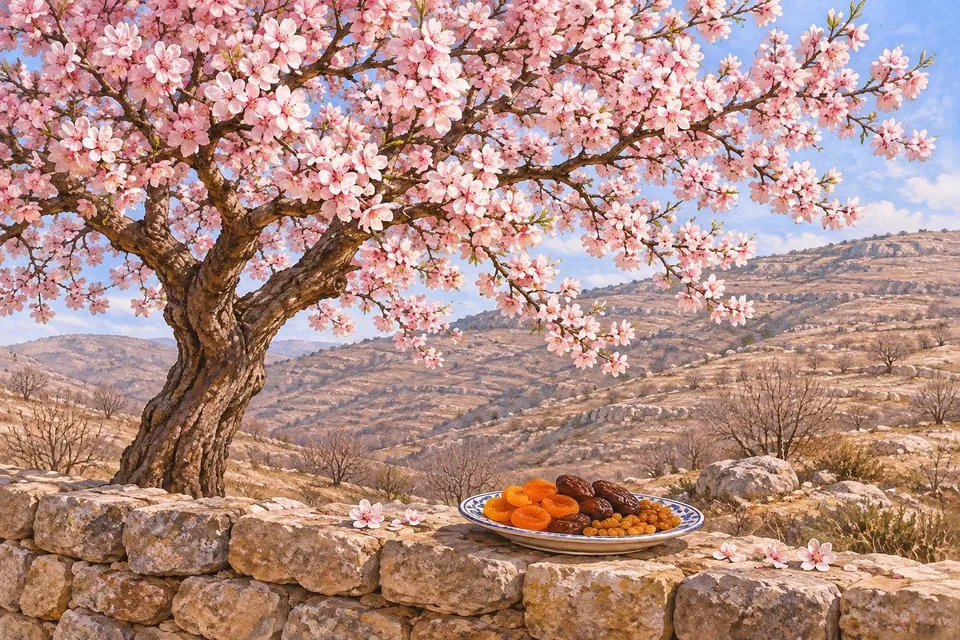
Tu BiShvat marks a turning point for the laws of fruit trees and offers lessons about human growth.
In brief
- Tu BiShvat means the 15th of the Hebrew month of Shvat.
- The date has significance for laws concerning young trees, agricultural gifts, and the Sabbatical year.
- In the Land of Israel, most annual rain has fallen by this time, and trees begin a new cycle of growth.
- The Torah compares people to trees, whose fruits can be understood as Torah, mitzvot, good deeds, and children.
Author’s note: This article discusses several important laws that apply today. The laws of terumot, maasrot, and the Sabbatical year apply primarily to those who live in the Holy Land, while the laws of orlah also apply, to a certain extent, outside it. The author hopes that all the information presented here is correct. Nevertheless, it is not detailed enough to be relied upon for practical decisions in halacha, Jewish law. Anyone with a question about these laws should consult the appropriate guides or a competent rabbi.
What Does “Tu” Mean?#
Every letter of Hebrew, the holy language, has a numerical value. Traditionally, numbers in sacred books are represented by letters. To write the number 15, one might use two letters: י (yod), which has the value 10, and ה (heh), which has the value five. But because this combination is one of God’s names, which must be treated with respect, the custom is to represent 15 with ט (tet), nine, and ו (vav), six.
This number might be read as “tet-vav,” but for brevity the letters are pronounced as one word: טוּ, “tu.” Thus, “Tu BiShvat” means “the 15th of the Hebrew month of Shvat.”
What Is Tu BiShvat?#
The Mishnah at the beginning of tractate Rosh Hashanah says:
There are four new years. The first of Nisan is the new year for kings and pilgrimage festivals. The first of Elul is the new year for the tithe of livestock; Rabbi Elazar and Rabbi Shimon say it is the first of Tishrei. The first of Tishrei is the new year for counting years, Sabbatical and Jubilee years, plantings, and vegetables. The first of Shvat is the new year for the tree, according to the school of Shammai; the school of Hillel says it is the 15th of that month. [Mishnah Rosh Hashanah 1:1]
The familiar name “New Year of Trees” sounds strange. Do trees celebrate the new year?
The Talmud explains that this date, the 15th of Shvat, matters for three groups of laws concerning trees. The first concerns fruit that grows on young trees during the first four years after planting: orlah and neta revai. The second concerns gifts to the poor, and the third concerns the Sabbatical year.
Let us briefly explain these laws and see how Tu BiShvat relates to them. To do so, we will turn to Maimonides (the Rambam), who explains the foundations of Jewish law clearly and concisely.
Orlah and Neta Revai#
The Torah prohibits using the fruit of a young tree during its first three years after planting. Such fruit is called orlah. During the fourth year, the fruit has the status of neta revai, or fourth-year fruit. It may be eaten only in Jerusalem and only in a state of ritual purity, like the second tithe, maaser sheni.
Under certain conditions, neta revai and maaser sheni can be redeemed. Afterward, they may be eaten like any other food, as is our practice today. Orlah, however, cannot be redeemed.
The three years of orlah and the year of neta revai do not correspond to the tree’s actual age; they are counted by calendar years. Here we find our first example of the significance of Tu BiShvat. Maimonides explains (Laws of Second Tithes and Fourth-Year Fruit 9:8–10):
The first of Tishrei is the new year for orlah and revai. From when is the year counted? From the time of planting. We do not count from the beginning of one year to the beginning of the next—that is, we do not require a full year from Rosh Hashanah to Rosh Hashanah. Rather, we count 30 days of a year as a whole year. But this applies only if the sapling has taken root in the soil. How long does that take? For a tree, two weeks. Thus, if one planted a tree 44 days before Rosh Hashanah, those days count as a year. Nevertheless, the fruit of that tree may not be eaten until the 15th of Shvat, the New Year of Trees in its fourth year. How does this work? For example, if a tree was planted in the 10th year after the Jubilee, it is considered orlah until the 15th of Shvat in the 13th year. Everything that grows on the tree during that time is orlah, even fruit that ripens after Tu BiShvat. And everything that grows from Tu BiShvat of the 13th year until Tu BiShvat of the 14th year is considered neta revai …
In this example, the tree had the status of orlah for two and a half years from planting: a month and a half of the 10th year, the 11th and 12th years, and four and a half months of the 13th year. This is what the Talmud means when it says of the laws of orlah: “The Torah was lenient at the beginning, but strict at the end.” At the beginning of the count, we counted one month of growth as a whole year. But at the end, we cannot begin using the fruit as soon as the fourth year begins. We must wait for fruit that set after the 15th of Shvat of the fourth year.
Separating Agricultural Gifts#
Another important group of laws for which Tu BiShvat matters concerns the separation of gifts from tree fruit. Gifts must be separated from fruit, vegetables, and grain grown in the Holy Land: bikkurim (first fruits), terumot (portions given to priests), maasrot (tithes), challah (a portion of dough), leket (fallen stalks), shikhecha (forgotten produce), peah (the corner of a field), peret (fallen grapes), and olelot (imperfect grape clusters).
Terumot and maasrot are separated by taking a quantity of produce and setting aside gifts in the proportion prescribed by halacha. The law says that separating produce from one year on behalf of produce from another year is invalid.
Here is a simple example. A basket contains 25 olives from one year and 25 from another. One olive is taken from the basket with the intention of separating terumah for all of them. Only the olives that grew in the same year as the separated olive are now considered fit for use. For the remaining olives, the separation does not count at all. They retain the status of tevel: produce that is forbidden to eat because the required portions have not been separated.
For this law to work, there must be a point at which one year ends and another begins. Under Torah law, that point for trees is Tu BiShvat. Maimonides writes (Laws of Terumot 5:11):
If someone picked an etrog—a citron—before sunset on the day before Tu BiShvat and then picked another etrog after sunset, they cannot separate terumah from one etrog to count for the other. For the first of Tishrei is the new year for tithes of grain, legumes, and vegetables, while Tu BiShvat is the new year for the tithe of the tree.
The etrog has a special status. Unlike other fruit, the year to which it belongs is determined by when it is picked, not when the fruit sets.
The “birth year” of produce also matters because it determines which tithe we must separate. In the third and sixth years of the Sabbatical cycle, maaser ani, the tithe for the poor, is separated instead of maaser sheni.
The Sabbatical Year#
The third major group of laws for which Tu BiShvat is significant concerns the seventh, or Sabbatical, year. The Jewish calendar divides time into seven- and 50-year cycles. Produce that grows in the Sabbatical year has a very different status and is subject to different laws from produce of the six “ordinary” years.
To determine which year produce belongs to, we need a date marking the end of one year and the beginning of the next. For tree fruit, that date is Tu BiShvat. As with other laws concerning trees, we look at when the fruit set to determine its “birth year.” Only the etrog is associated with the year in which it was picked. This is because, unlike other trees, the etrog is not a seasonal plant. Its fruit can remain on the tree and continue growing for several years.
Why Tu BiShvat?#
The Talmud says that by Tu BiShvat most of the year’s rain has fallen (Rosh Hashanah 14a). What did the Sages mean?
Trees do not grow at a uniform rate. We can see this from the rings that form in a tree trunk, which are easy to find in a cross-section. In winter, the tree becomes dormant. In spring, a period of vigorous growth begins, slowing somewhat over the year and almost stopping by the following winter.
In the Land of Israel, where rain falls only in the cold season, most precipitation usually falls before Tu BiShvat. It is during this period that trees awaken from their winter rest and begin actively drawing in the water God has sent them that year. Tu BiShvat begins a new cycle in the life of the tree, which is why it is considered a turning point for laws concerning its fruit.
The Meaning of the Day#
The Torah compares a person to a tree, as it says: “For the tree of the field is a person” (Deuteronomy 20:19). How is a person like a tree? The Midrash says that just as a tree exists to produce fruit, a person’s purpose is to bear fruit. What fruit can a person produce? Torah, mitzvot, good deeds, and good children are a person’s fruit.
It is no coincidence that the prophet calls a childless person “a dry tree” (Isaiah 56:3). Immediately afterward, however, he says that a person has other fruit besides children: keeping Shabbat in particular, and observing the covenant—the Torah—more generally. A person who does not care for their fruit leads a purposeless existence.
The author of Chidushei HaRim, Rabbi Yitzchak Meir Alter of Gur, writes that in the month of Shvat a special abundance of Torah knowledge and understanding descends into the world. As the Torah says: “In the 40th year, in the 11th month, on the first day of the month … Moses began to explain this teaching” (Deuteronomy 1:3–5). The 11th month is Shvat, since the months are counted from Nisan.
At the beginning of the month, only the greatest sages and righteous people feel this abundance. By the middle of the month, the flow of Torah knowledge reaches ordinary people as well. Bnei Yissachar, by Rabbi Tzvi Elimelech Shapira of Dinov, explains that the view of the school of Shammai—that the New Year of Trees falls on the first of Shvat, as we saw in the Mishnah above—reflects its exacting, strict approach. The beginning of the Jewish month, when the moon is hidden from view, corresponds to this quality.
In this light, we can understand the teaching of Chidushei HaRim: At the beginning of the month, the abundance of Torah knowledge reaches only those who have truly earned it through tireless work to understand Torah, constant self-improvement, and purification.
The Talmud also says that the students of Shammai had sharper minds than the students of Hillel [Eruvin 13b]. Chidushei HaRim says that because of their keen perception, the students of Shammai sensed the abundance of Torah earlier than the students of Hillel.
The middle of the month, the 15th, is the full moon. Its bright light symbolizes the abundant revelation of Torah to everyone, even those who are not entirely worthy of it. This approach is characteristic of the school of Hillel. That is why, in their view, the New Year of Trees falls on the 15th of the month.
The Sages of the Talmud said that water symbolizes Torah (Bava Kamma 17a and 82a; Avodah Zarah 5b). We can now see striking parallels between a tree and a person. Moses explained the Torah in the month of Shvat because it is especially favorable for receiving Torah. And knowledge of Torah is the main source of a person’s spiritual growth.
In the same month, the trees of the Holy Land awaken from their winter dormancy and begin to grow vigorously, drawing in water, which symbolizes Torah. Of course, these parallels are not accidental. Chidushei HaRim says that the spiritual abundance—the flow of Torah understanding—comes first. It begins in the spiritual realms and brings a flow of abundance into the physical world as well, since everything that happens in the material world is a reflection of spiritual processes.
This helps us understand why the Torah calls a person a tree, and what significance the month of Shvat has even for those who do not work in agriculture.
A Person Is a Tree of the Field#
The similarities between people and trees do not end there. All the mitzvot connected with Tu BiShvat show us, in one way or another, how a person should behave.
The prohibition against using the fruit of a young tree—orlah—shows how important it is to protect a young child from all kinds of outside influences and raise the child in an atmosphere of holiness.
The custom not to cut a boy’s hair until he is three years old is directly connected to the laws of orlah.
We can also draw an important lesson about proper conduct from the laws of separating gifts.
Produce harvested in the Holy Land has the status of tevel and is forbidden to eat. To make it fit for use under Torah law, we must separate gifts from it: terumah, maaser (the tithe), and either maaser sheni or maaser ani.
We should take the same approach to all our income. First, we should determine how much money will go toward mitzvot, such as buying a mezuzah, as well as children’s education and charity. Only then should we use the remaining resources for our own needs.
The same applies to our daily schedule. Even if we must spend most of our time on everyday activities—work, caring for children and the home, and the like—we should first make sure we have a fixed time for daily Torah study.
Finally, let us consider the third group of mitzvot connected with Tu BiShvat: the laws of the Sabbatical year, or Shemitah.
It is not hard to see what we should learn from reflecting on these laws. God commanded us to sit idle for an entire year, refraining from agriculture and relying only on His help. This is a vital lesson in trust in God. The laws of Shemitah show us that the only factor that truly affects our prosperity is divine providence.
Therefore, when we seek to provide for ourselves and our families, we must be guided first by the laws of the Torah and only afterward by considerations of profit. Only God decides how much prosperity will come to us and by what means. We cannot expect to gain more than He has decided to give us by violating His will.
The setting of fruit—its very first appearance, immediately after the flower dies—determines which year it belongs to. This law teaches us an important principle in raising children: The beginning matters most. The early stages of development depend on parents more than later stages do. That is why it is so important for parents to give young children water to drink only from a pure source of knowledge. This remains extremely important at a later age as well.
Guided by these laws, we can, with God’s help, make the New Year of Trees a new year for people too—a new year for us.
I hope that this Tu BiShvat we will merit to drink from the pure springs of the holy Torah that God will open for us, and that with its help we will produce abundant and pleasing fruit throughout the year!
Practical law. This page reports a ruling given for a specific question. For your own situation, ask a rabbi who knows you.
Keep reading
More →Lag BaOmer: Meaning and Customs
The 33rd day of the Omer is a day of joy associated with Rabbi Akiva’s students and Rabbi Shimon bar Yochai.
HolidaysWhy Do We Celebrate Lag BaOmer?
Lag BaOmer marks the survival of Rabbi Akiva’s Torah and is closely associated with Rabbi Shimon bar Yochai.
HolidaysRabbi Shimon Bar Yochai and the Myrtle Branches
After years in a cave, Rabbi Shimon and his son encountered a man whose myrtle branches revealed a lesson about holiness.
HolidaysWhat Is Tu B'Av and Why Is It a Holiday?
The fifteenth of Av is a day of joy whose history reveals a recurring theme of wholeness and reunion.







