Purim: Chance or Destiny?
Why the holiday is named for Haman's lot, and how its four mitzvot, down to the wine, express one idea.
In brief
- Purim means "lots," and the name expresses the holiday's idea: what looks like chance is hidden divine providence.
- Haman cast a lot expecting blind chance to serve him, but the Creator turned each of his attempts against him.
- Sending food and giving to the poor aim at the unity of the Jewish people, and the wine reveals what is really in a person's heart.
- The Creator governs the world both by open reward and punishment and by hidden governance, through which even evil serves the good.
We have gone through the basic meaning of Purim, the meaning we should take away at the very least from reading the Scroll of Esther. How can a modern person see the presence of the Creator when He is completely hidden? The Scroll of Esther is full of absurd, unexpected coincidences and strange twists of events. At each moment they seem random on their own, hidden behind natural causes. But when we put them together, it turns out that they were all parts of a single design. What looked like chance was not chance. As someone put it: "Chance is God's pseudonym when He does not want to sign His own name."
Now let's take a closer look at the meaning of the holiday and try to find one view of everything that happens on this day. What, exactly, is supposed to happen? First, from the beginning of the month of Adar, joy and merriment increase: people joke and laugh, and children go around in costumes. Where this custom came from is unclear; the Megillah itself says nothing about it. And on Purim itself there are four mitzvot. There is reading the Megillah. There is mishloach manot (gifts of food), sending treats, that is, bringing your neighbors portions of food as though they were sitting there hungry. There is matanot la'evyonim (gifts to the poor), which is understandable: even the rich do not have enough money, and the poor have it worse. And there is the festive meal, a wine feast, at which for some reason you are supposed to get drunk, and not just on your own initiative but by command. Behind all this there is, of course, a meaning, and we need to understand it.
Why the Holiday Is Called Purim#
Let's start, as we usually do, from a distance, with the name. What would we call a holiday that celebrates the miraculous rescue of an entire people from certain destruction? The Day of Salvation, Victory Day, the Day of the Turnaround. But the Sages called it Purim. The names of holidays are not accidental; they carry the essence. So what does "Purim" mean?
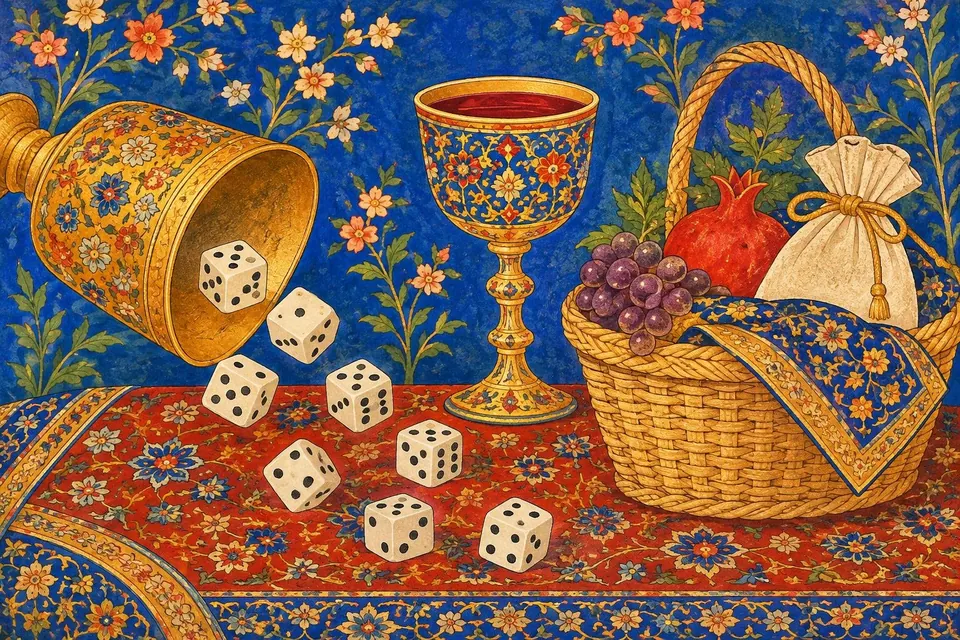
Let's turn to the Scroll of Esther. It says that Haman cast a pur, that is, a lot. When Haman could not decide on which date to set the destruction of the Jews, he cast a lot, so that chance would show him the date. From Haman's point of view, this was a chance lot. True, the Megillah adds that it was a goral, fate, destiny [Esther 3:7; 9:24]. We will come back to that.
If you think about it, it is hard to see why the holiday is named after a lot. It is only one of many details in the Megillah, and far from the most important. Moreover, if the holiday were to be given such a name, it should have been called "Pur," in the singular. Why "Purim," in the plural? To answer, we will have to go deeper into the idea of the lot, and along the way we will understand a good deal about our own lives.
Two Ways of Seeing the Lot#
There are two approaches to understanding a lot. The first is familiar to us. As a rule, a person decides how to act for himself: he understands for himself, he makes his own decisions, he is the master of his life. But sometimes it is hard to decide. There is not enough data and facts to base a choice on. For example, I was driving to see you, and there was a traffic jam on the road. I could have taken a detour, but there was a jam there too, because there were a lot of clever people like me. Where is the real jam, here or there? How do you decide? To go or not to go, to speak or not to speak: a person often ends up in situations where the future is hidden. Then there are various methods: heads or tails, a counting rhyme, a daisy ("she loves me, she loves me not"). It is frightening and unpleasant, but we have to rely on blind chance, because there is no choice. Let the lot decide what we cannot decide ourselves. That is the first approach: people turn to a lot because choosing is impossible, and the lot itself is, for us, random. Maybe we'll get lucky.
The second approach looks similar but is, at bottom, the opposite. The Scroll of Esther gives the lot one more name, goral, fate. A coin is tossed here too, but not so that chance will establish fate. It is the other way around: so that fate will be revealed through the lot. This is an entirely different vision: everything that seems random is, in principle, predetermined. Chance really is blind, but only for the blind. For those who can see, it follows a pattern. Chance is a pattern that has not yet been uncovered or proven; we simply have not found the cause yet, so it is out of sight. And if chance is not chance, then someone is directing it. This Someone we call the Creator, and the result of the lot is His will, His providence, independent of any human choice.
That is why we find lots in the Torah as well. On Yom Kippur, one of two goats, the "scapegoat," was chosen by lot. In the Book of Joshua, the Promised Land was divided among the tribes by lot. Mordechai uses the same word, "chance," when he tells Esther everything that happened to him. The Sages turned to lots to learn the Creator's will, and they still do in our time. They say that Rabbi Moshe Feinstein, finding himself in a completely hopeless situation in the first half of the last century, had to decide whether to go to Palestine or to America, and he turned to a lot. The lot fell on America. And as we know, he became the leading spiritual figure of American Jewry, and it was largely thanks to him that Jewish life there was saved.
So there are two ways of looking at what happens: as random or as intended. For convenience, let's call the first the view of the unbeliever and the second the view of the believer. Haman, the representative of unbelief in the world, casts a lot, wanting chance to decide when to bring catastrophe on the Jews.
A few words about Haman's ancestry, because we need to understand why he, of all people, ended up in this story. Haman the Agagite was a descendant of Agag, king of the Amalekites, and that nation comes from Amalek. Amalek was the illegitimate son of Eliphaz, son of Esau, an excellent family. He carried in himself the quintessence of Esau's evil. And the numerical value (gematria) of the word "Amalek" is the same as that of the word safek, "doubt," or "chance." That is his essence.
When the Jews left Egypt, the descendants of Amalek attacked them out of the blue. Why? People usually go to war over territory, wealth, a woman they both wanted, or "do you respect me?" Here there was nothing of the kind. The only reason was that they had heard of a people that claimed there is a Creator and that He was about to give them the Torah. This was unbearable to them, and for the sake of their idea they were ready to fight hundreds of miles from home. This was the first ideological war in the world, waged by active atheists against the people of God. The very idea of divine providence drove Amalek into a rage. He was ready to give his life just to prove that the world is ruled by chance, not by the Creator. From then until today, Amalek has stood for the ideology of unbelief. But that is a whole topic in itself, and it is better not to touch it.
So the unbelieving Haman casts a lot, counting on a favorable outcome, while the believing Mordechai tells of the details of fate dressed up as chance. It looks alike, but it is the opposite. How can it be that the unbeliever is one hundred percent sure that the choice is random, and the believer that it is not? Haman is easy to understand. But how do we understand Mordechai?
According to Mordechai, the world is arranged differently: it is ruled by divine providence, fate, a plan, an order. To a person, his life looks like an unbroken chain of random events, and nothing makes sense, because he looks at life from the bottom up, from the place and time where he stands now, as if he were sitting deep in a pit and could see only a patch of sky above. But when he lifts himself up and looks down from above, the whole picture opens up and the pattern becomes visible. It is like a soldier in a trench. He finds it hard to understand the general's strange order to retreat when it is perfectly obvious to him that they should advance. Or like an employee who is given foolish instructions at work, while his boss one floor up has the whole work plan spread out in front of him. The general sees the entire front. From above, you see more. As a famous figure in Israeli politics said: "What you can see from the prime minister's chair could not be seen from the opposition's seat."
Fate: Mazal#
The Sages explain: from up there, you can see how carefully planned coincidences come down to us. Let's look more closely. Everything that happens to a person seems to happen for one of two reasons. Either it is the result of his choice and effort: he decided, he did, and it is all clear. Or it happens unexpectedly, against his will: adventures he did not look for but somehow got into. Say Abrasha came to the airport and his flight was canceled. He had to sit there for eight hours, and he got to know another stranded traveler, Aronchik. They became friends, and two years later, through this Aronchik, Abrasha found the job he had dreamed of all his life. That is a true story. Want another? He wanted to propose to her, and she refused. In his grief he went to a bar for a drink and there met his future wife, who had ended up in that place for the first time in her life for roughly the same reason. Or someone overslept, got off at a different stop, and met a friend he had not seen in twenty years. All of these are parts of a life planned from above.
Events imposed from outside like this are called goral, fate. In Hebrew it is mazal, destiny, or, in more elevated language, determinism. The word mazal comes from nozel, "dripping" or "flowing" down upon us from above. It turns out that our lives are predetermined. And not only the coincidences: it is fixed in advance who will be rich and who poor, who will suffer and who will be at peace, who will be sick all the time and who will die healthy.
Here is an example. A midrash tells [Sukkah 53a] that King Solomon once noticed that the angel of death looked a little sad. "What happened?" he asked. "God commanded me to take two of your favorite scribes. It is sad." Hearing this, King Solomon immediately provided the scribes with the fastest means of travel, so that they could escape to the city of Luz. Why there? Because in that city the angel of death has no power. The reason is a separate story; in a few words, the people who lived there were of exceptional honesty, devoted to truth alone, and where there is complete truth there is no death. To die, the residents had to leave the city. The scribes raced to Luz, but before they reached it they were killed in an accident. The next day King Solomon sees the angel of death smiling, pleased. "What's with you?" "Yesterday I was sad. The Creator gave me the task of taking the scribes, but warned me strictly that it could be done only at the walls of the city of Luz. I did not know how they would get there. So thank you for your help."
As people say, "you can't run away from fate." If anything, it is the opposite: your own feet will carry you right to it. One man ran after a bus, but it slammed its doors right in front of his nose and drove off, just his luck. And exactly a minute later it blew up.
The world is full of surprises. One person is chosen, another is dismissed. This one wins the lottery, that one's whole fortune vanishes. This one finds something, that one loses it. A person does not choose any of this; it comes down on his head from somewhere. One is destined to be rich, another poor, and whatever he does, nothing will change. They tell of Ibn Ezra, one of the greatest Jewish sages of the past. He was poor, not just poor but, so to speak, the quintessence of poverty; he had nothing. Once he said about himself that if he opened a business selling shrouds, tachrichim, people would stop dying.
So is everything in life predetermined? It depends on whom you ask. For those who simply live out their days, who squander their lives, it is so: such a person is an extra in this world. But for someone who lives in earnest, predestination is only partial: it is possible to step out from under its influence and earn a higher role in the world.
Discussing this subject does not cancel free choice. Without any doubt, a person has free choice. The whole question is where. As the Sages said: "Everything is in the hands of Heaven except the fear of Heaven" [Berakhot 33b]. At this point, in the spiritual and the material beginning, in the choice between good and evil, truth and falsehood, there is free choice. In everything else, everything is predetermined. This is an excellent question, but it deserves several sessions of its own, so I will limit myself to what I have said.
Much in life happens against our wishes. We very much do not want to be controlled, but even the most ardent atheist understands that his life is not entirely in his own hands: someone above dictates it. That is, there is some kind of fate.
The unbelieving Haman relied on a lot, on a random choice. But somewhere inside he understood that the lot would not always fall in his favor. He knew very well that there is such a thing as fate, destiny, an unknown force that governs chance, and he understood that he was handing the decision over to heaven. He simply did not take into account what heaven wants. He wanted to use fate as he saw fit, to bend it to his desire.
How can both chance and intentional fate coexist in one Haman? He was no fool: he was the king's adviser, and surely he had a diploma from the best university. The answer is simple: a split personality. Suppose a person casts a lot and acts according to the result. Two outcomes are possible. If he succeeds and wins, what will he say? "I am a god, how smart I am! I achieved this! I chose wisely! This is the result of my purposeful efforts!" And if he fails? He turned right, and there was a two-hour traffic jam. What is that? Circumstances. Fate. You can't run from fate, that's how it turned out, it's stronger than me, what can you do, I'm only human.
That is how we live. We credit success to ourselves at once and failure to fate, even though we are unbelievers. As long as everything goes well, we feel we are the complete masters of our fate. But as soon as something goes wrong (bad luck, a black cat, the evil eye, the stars shifted), we remember fate. I am talking about very rational people who flinch at the word "God" but at the end of the week sit down in an armchair, open the newspaper to the horoscope page, and carefully study what is and is not worth undertaking this week. They do not believe in God, of course, but that a ball of burning hydrogen and helium hundreds and thousands of light-years away has something personal against them and affects their lives, that is logical. A person does not feel that his whole life is one contradiction.
It was the same with Haman. He cast a lot so that chance would show him the best time to deal with the Jews. The lot fell on Adar. And all this was happening in Nisan, so he had to wait about a year. But in this result he saw no intervention from above: Adar, so Adar. Everything around him stayed within natural phenomena and the chance course of events. It happens that a king gets drunk in the middle of a feast. It happens that he gets the idea of showing everyone his queen. It happens that in a fit of rage a wife is killed. In just the same way, it happens that the lot falls on Adar.
In his blindness, Haman never allowed for one possibility: that this chance had been arranged for him by someone. After all, the fact that the lot fell on Adar postponed the immediate carrying out of the decree, and that allowed events to unfold that led to his downfall and the rescue of the Jews. He thought that acting precisely in Adar would bring him glory, money, and satisfaction, and it turned out the opposite. The lot for when to destroy the Jews turned into the lot of his own downfall. Not fate? More precisely, it was fate, but not the kind he wanted.
"Purim": Two Purs in Every Event#
Now it is clear how the name of the holiday expresses its essence. In every decision, Haman wanted the heavenly result to fall as he desired, and he wanted to use astrology for his own purposes. But, and this is the essence of the whole Megillah, the Creator turned each of his attempts, each pur, against him. That is Purim: venahafoch hu, "it was turned around," the opposite.
Haman wanted to use chance to set the date of the slaughter, and the Creator carried out his plan in exactly the opposite way: the day turned out to be excellent, but not for destroying the Jews. It was excellent for striking down their enemies. He plotted to ruin Vashti, hoping it would benefit him, and it all turned into the appearance of Esther, who led to his death. He built a gallows for Mordechai, and it turned out to be for himself. And so on.
Now we understand why the holiday is named for the lot, the pur, and why the name is plural. The Megillah itself says: "Pur, that is, the goral." In other words, what seems to us to be chance, pur, is in truth divine providence, goral, fate. That is the essence of Purim. It applies to all the events of the Megillah, and to our lives too. In every event there are two sides, two purs, and hence "Purim": what is right in front of our noses and seems random, and what lies deep down and follows a pattern. A person intends one thing, and the Creator brings about something completely different.
I will give a few examples, though you will remember a hundred like them yourselves, since our whole life is full of them. One man said that by his business plan he had every chance of earning two million. But a baffling chain of random events began, and when he was able to catch his breath and tally the result, it turned out that he had lost exactly two million. Talk to businesspeople and you will hear incredible stories of people who became rich with almost no effort, while others did everything right and ended up in debt.
Let me tell you an amazing story I heard from an acquaintance who lives in America. A young man was studying law at Harvard and was one of the best in his class, a straight-A student. In his senior years, when vacation came, he was one hundred percent sure he would get a part-time job at one of the best law firms in New York or its surroundings. He sent out applications, and to his complete surprise he was turned down everywhere. As a result, he had to stay at the university and spend the entire break in the library and the archive, helping one of the professors. Needless to say, he was very depressed and dissatisfied. A few years later, this professor got a call from the Supreme Court of the United States asking him to recommend a Harvard graduate for a very important and prestigious position. The professor remembered the brilliant student who had worked with him in the archive, and recommended him. The young man was summoned, vetted, and hired. So at the very start of his career he landed one of the most prestigious positions anyone could dream of. And how he got there, you have just heard.
That is why we say: "Everything that is done is done for the good." And everything that happens in the Megillah is a foreshadowing of how salvation will come to the Jews in the future.
Here is another story; I do not know all the details. A certain family lived on the border of Ukraine and Poland during the Second World War. They did not know where to turn. They were afraid of the Germans, decided not to stay where they were, and crossed the border into the USSR. As soon as they crossed, they were sent straight to Siberia. There they nearly died of hunger and cold, and every minute they cursed their decision. When the war ended, they managed to return to their little town, and it turned out that they were the only ones who had survived. Life is hidden from us: Providence can turn even a random decision to our benefit.
And one more story, from a completely different realm. A family from Bnei Brak became acquainted with a nonreligious couple from Tel Aviv. They met once, twice, got to talking, and, as always in such cases, the conversation turned to the religious and the nonreligious. The Tel Aviv couple insisted that, in principle, they were good people, and good people like them don't really need any religion: they don't steal, rob, or kill, and they are polite and cultured. The Bnei Brak family said their piece, and the others said theirs. At some point the Bnei Brak family invited the couple to their home. The hostess decided to put all her culinary talent into a three-layer cake, and she baked it, layered it, and assembled it like a magician. The result was something incredible. The guests came, sat down, tea, coffee, and she cut the cake into beautiful slices and served it. Fortunately, she managed to notice the reaction on the guests' faces and tasted it herself right away. Instead of sugar, she had put in salt. You can imagine her confusion: she turned red and felt faint. All she could force out was: "Salt and sugar look so much alike that it is very easy to mix them up."
Her husband, sitting next to her, did not lose his head. "Do you see this cake? It is not at all clear whether it is made with sugar or with salt, and there is no way to tell until you taste it. It's the same with your claim. At first glance there is no difference between Jewish life and living as we please. You can't see any difference until you try." Jewish life has to be tasted. The guests said afterward that all the lectures, persuasion, and arguments had changed nothing, and only this incident, where everything was turned upside down, made a tremendous impression on them. They understood that to grasp even what Jewish life is about, you have to try it. There are many stories like this.
Two Ways God Runs the World#
It is interesting to understand how the world is governed. The subject is a little more complicated, but let's try. A warning: we are not discussing the existence of the Creator here, but analyzing what Purim is.
Having created the world, the Creator did not leave it to the whims of chance but governs it. How exactly is a question of the utmost importance, because our whole life depends on it. The Sages of the Torah reveal this secret. We will say it very briefly, and do not be surprised if questions remain. They say that there are two parallel ways in which the world is governed.
The first is understandable to our everyday sense of the world: it is governance by the attribute of justice, or governance by punishment and reward. A person is responsible for his deeds; the world is governed according to them, as the result of his free choice. A good deed leads to a good result, both for the person himself and for the whole world; a bad one, accordingly, the opposite. This kind of governance is also called open. It is clear and simple.
But in parallel with it, and this is what muddles history and a person's life and makes it incomprehensible, the Creator governs the world through what is called governance by unity, yichud Hashem (the unity of God), which is also called hidden governance. It has nothing at all to do with a person's deeds. This is an enormous topic, and we will touch on it only lightly.
The Creator created the world and every creature in it exactly according to the role it is meant to fulfill, and gave the creature, that is, the person, the means to reach the goal. That is why we are born to these parents, in this place, with exactly this body and these abilities, and receive the prosperity we need, and so on. In addition, a person is sent a fitting number of tests in the form of random events. All of it together must bring the person and humanity to the final goal. We will not speak about that goal either; it is not the topic of this session. In this gigantic process, each person has his own role, complementing the role of the rest of humanity. When the historical process is complete and the world arrives at its goal, everything that happened in the past will come together into one gigantic picture that will clear up everything that was unclear and mysterious. That is why there must be governance from above that does not take a person's choice into account: if everything depended only on people, on open governance by justice, the world would have ceased to exist long ago. Governance by unity keeps everything within bounds and leads the system to its final outcome.
It is like people sailing on a ship down a river. Anything can happen on board: you can walk, jump, quarrel. But the cabins have been assigned, the roles too, villages known in advance flash by beyond the rail, and the whole ship moves steadily downstream toward its destination. This is what is called governance by unity, hidden governance, governance by mazal, fate. It sets a person's destiny.
From the fact that the world is governed by the Creator and each of us has his own fate, several important practical conclusions follow.
First, when we come across a random occurrence, we understand that it has a cause hidden from us. Even without knowing the cause, a Jew relies on chance, knowing that in doing so he places himself in the hands of the Creator, Who knows better what his role is. That is why you will hear extraordinary stories from religious people about how their lives were full of divine providence. Everything that happens to us is not random.
Second, it is not only not random but also for the good. Nothing bad ever happens to us. This clarifies a great deal about the role of evil in the world: it turns out that evil has no power of its own and is no more than a cog in the gigantic mechanism of history. In the end it becomes clear how this evil served the overall design and the good. In each individual situation it seems to us that evil is winning and everything is happening against the Creator's will, but in fact not only does evil not win; it serves the Creator as a tool in carrying out His universal plan. We only have to wait, and we will see that what seemed undeniable evil, private or public, is in the end transformed into good.
In this sense, it was on Purim that governance of the world by the attribute of unity appeared most clearly. At that time, the darkness of the Creator's concealment did not allow people to see the overall picture, and everything taken separately was perceived as evil. Only with time did it become clear that all the evil and all the random events, "pur, pur, pur," served the plan of awakening the Jews, their unity, and their acceptance of the laws of the Torah: "Purim."
The conclusion is paradoxical: through the villain Haman, God's name was glorified. Evil served good and the overall purpose of creation. That is the greatness of Purim, which will not be abolished in the future. Why? Because it reveals the unity of the Creator, His governance against the natural backdrop of events. This kind of governance will be the main one in the future, and so Purim will not be abolished.
The Mitzvot of Purim and the Unity of the People#
Now we have come to the topic of this session: to understand, on the basis of what has been said, everything that happens on Purim itself, all its mitzvot. This is necessary so that we do not perform them automatically ("that's the way it's done, and that's it") but see what intention stands behind them. The Sages established four mitzvot: reading the Scroll of Esther, sending treats, gifts to the poor, and the festive meal with wine. We spoke about reading the Megillah in the last session: careful reading reveals the hidden presence of the Creator in the world. Incidentally, this is also where the hint of masks and costumes comes from. The Creator has a costume, and it is called "nature," "the news," "events." And there is also a mask, and it is called "chance." On this day we must see the One Who pulls the strings, hiding behind the mask of chance. Let's turn now to the other mitzvot.
First, about the joy of the month of Adar. I cannot resist saying a few words about it. When are we happy? We smile, we laugh. Let's ask a more general question: what makes us laugh? If you think about it, we laugh at unexpected changes in the world that overturn the established order: someone gets a cake in the face, or someone slips on a banana peel. It is funny, especially when we were children and laughed until we dropped. The cause of the laughter is an unexpected change in the situation, and not just any change but one where someone's importance is brought down. That is the central point. When someone is brought low, I am higher. And the more important the person who slipped, the funnier it is. This is the laughter of one's own pride, when the self rises above everything else. It is a cruel laughter.
But there is another kind of laughter in the world: we laugh not out of a sense of our own elevation, but because it becomes clear that the importance of evil has been brought down. In the Jewish understanding, only the Creator is important in the world, and when His will is revealed in the world, it brings a special joy. Haman sought many honors for himself, and the more important he became and the higher he climbed, the more laughter and joy his fall brings. Remember: venahafoch hu, the opposite. This is the special joy of the days of Purim.
Back to the mitzvot. We are commanded to send treats to our neighbors, at least two portions to one person, and to give gifts to the poor: at least one gift, preferably money, to each of two poor people. Where do these commands come from? Let's recall how Haman persuaded the king to destroy the Jews: "There is one people, scattered and dispersed among the peoples" [Esther 3:8]. The answer is already hinted at in these words. "There is one people": a people that is supposed to be one, but they are divided and splintered. And that alone is enough for a tragic fate to overtake them. This is what Haman saw: the Jews do not feel their common destiny. He understood that it is impossible to destroy the Jewish people unless there are spiritual reasons that allow it. Which reasons? Disunity. Unlike other nations, for the Jews unity is a matter of life and death. Moreover, their purpose in being in the world as a people lies in it. The Jewish people is wholly bound to the Creator; it is His representative in this world, and its purpose is to reveal the Creator's presence, that is, His unity. But revealing the unity of the Creator in the world depends entirely on the unity of the Jewish people: only those who are united can reveal unity. Only when there is a single people can it merit the Creator's presence. That is why we proclaim: "Hear, O Israel, Hashem is our God, Hashem is One." And this service of the Creator unites us all. It is the cause of causes.
Incidentally, it is quite possible that, in the subconscious, it is precisely this shared destiny that lies behind the age-old hatred of Jews. When Mordechai did not bow to Haman, it enraged him, and he was ready to finish Mordechai off on the spot. Had it been a member of any other nation, that is what would have happened, and it would not have occurred to anyone to punish all the others, who are innocent, for the crime of one, only because they are of the same nationality. This holds for everyone except the Jews. Rabinovich was caught stealing, so all Jews are guilty, all are thieves. Note that if this happens so consistently in every age and among all peoples, then they, like Haman, have glimpsed a share of the truth. In principle, that is so: the Jews are one organism, and it is impossible to separate the deeds of one from the rest. We are all connected and responsible for one another. And indeed, Rabinovich was caught stealing, and we are all to blame.
Then, in the days of Purim, when real danger awoke, strong feelings of national unity awoke as well. So that they would not pass and evaporate, Mordechai and Esther established two mitzvot meant to join us into a single whole: bringing treats to our neighbors and giving gifts to the poor. The point of the treats is not to feed anyone, since nobody is sitting hungry specifically on Purim, but to strengthen friendship and love. If we want to merit true friendship, then, as the Mishnah says, kne lecha chaver, "acquire a friend for yourself" [Mishnah Avot 1:6]. Bring him a treat, give him attention, become closer. That is why, according to a number of authorities, this mitzvah cannot be fulfilled anonymously by modestly leaving a gift at the door. As long as it is not known who brought the gift, the mitzvah is not considered fulfilled: it is entirely aimed at bringing hearts closer and at the feeling of the people's unity. That is why on this day we bring mishloach manot to everyone, and it does not matter whether the person is religious or not, whether we know him or not. It is a day of unity.
For the same reason, matanot la'evyonim, gifts to the poor, were established. When we help with money, we should feel responsible for another Jew. Not just make a donation and be done with it, but feel responsibility for other Jews. This brings all of us closer. Now it is clear why the law obliges even the poorest of the poor to give a gift to a fellow poor person, even if they simply exchange their last pennies: in this mitzvah, inner empathy for another matters more than the concrete help. Performing it with the proper intention will lead us to still greater unity, and that is the guarantee that the threat of total destruction will no longer hang over us.
The Wine Feast: Why Drink#
There is one more mitzvah, mishteh yayin (the wine feast), a shared meal, and its purpose seems to be the same, the unity of the people: we sit together. But this mitzvah has an interesting addition: it is not just a meal but a wine feast. Why must we drink wine? The Sages explain: measure for measure. The sin was connected with wine. When the Jews went to Ahasuerus's feast (and Mordechai told them, "Do not go"), it was precisely because they enjoyed themselves there that the threat of total destruction hung over them. Since the sin was with wine, the repair must also go through wine. Moreover, the whole salvation came through wine: Esther gave two wine banquets. Fine, we will make it right: now we drink together, not apart, at the command of the Sages and not against it, as at Ahasuerus's feast.
But there is one more strange instruction here: chayav inish levasumei. Every Jew must get drunk on wine until he can no longer tell the difference between "Blessed be Mordechai" and "Cursed be Haman" [Megillah 7b]. For those of us who came from a country where people know a great deal about this, it is fairly easy to understand. You can picture it: a bottle is set in front of you, and nobody tells you what condition to reach. So, you have to get drunk until you do not distinguish "Blessed be Mordechai" from "Cursed be Haman." What lies behind this?
The Vilna Gaon says that it does not mean we should drink to the point of not knowing that Mordechai is a blessed righteous man and Haman a cursed scoundrel; after all, each did good or bad accordingly. The point is that both Mordechai through his good deeds and Haman through his bad ones led equally to the glorification of God's name. As we said, the main meaning of Purim lies in revealing the unity of the Creator, when before Him there is no good separately and no evil on its own, but both serve the single purpose of revealing His unity. That is why we must drink until we no longer distinguish between Mordechai's good and Haman's evil.
But while we are still sober, let's ask: why get drunk at all in order not to distinguish good from evil, Mordechai from Haman? Wouldn't it be simpler to reach this conclusion in a sound, clear mind? Here we come to a very important, inner part of understanding Purim.
Let's make a small digression. The sense of the Creator's unity is a central theme not just of Purim once a year: it should be the essence of every Jew all year long. A popular saying has it that for some people every day is Purim, hinting at a fondness for the bottle. In fact that is how it should be, only not in drinking but in being, in feeling His unity all year, all the time. It might create the impression that Jews are engaged in self-deception and only once a year, on Purim, remember that God is One. But it is the opposite: the Creator's unity must be in a Jew's heart all the time. Only once a year is there a check, an exam for each of us, to see whether this is really so.
How does this happen? The Sages explain that the command to drink wine holds many secrets. They coined the famous expression nichnas yayin, yatza sod, "wine goes in, a secret comes out" [Eruvin 65a]. The numerical value of the word yayin, "wine," is seventy, and that of the word sod, "secret," is also seventy. Wine helps a person open up. In the glass, a person shows himself plainly. Say Abrasha got drunk at Uncle Yasha's birthday party and told all the relatives in front of everyone exactly what he thinks of them, of his wife, of her mother. The next day he came to make peace: "Forgive me, I was drunk, I wasn't thinking straight, I'm a fool." For years he hid his opinion, and now at last he opened up. Wine draws a person's secret out of him.
And what is the secret? What does a person most want to keep hidden, to conceal from everyone? Who he really is, what makes up his essence. That is what a person fears most, which is why he walks around all year in a mask and hides behind it. And then Purim comes, and he has to lift the mask a little. Wine draws the hidden essence out of the heart. Now everything depends on what is in the heart. If there is love of God there, then the Jew will feel only added love and spiritual elevation. But if what is there is love of this world, then wine will also bring out a special love, but not for God: for oneself, for women, for entertainment, for pleasures. It turns out that wine lifts a righteous person to unimaginable spiritual heights, while the sinner it seems to lift too, but only in order to smash him on the floor. Wine has a double effect: good for the righteous and bad for the sinners.
Purim, Purim, masks, masks. All year we walk around in masks. Some hide behind righteousness, because they fear most of all that it will come out what they are really like. Some hide behind refinement: they fear people will think they are uncultured. Some hide behind intellect and intelligence: they fear people will realize they are stupid. Some hide behind religiosity: God forbid anyone should discover who they really are. And then Purim comes. Wine goes in, a secret comes out. Wine drives out the consciousness that covers our self and reveals our true essence, which we sometimes do not know ourselves, do not want to know, or are afraid to know. One more glass, and another, and the mask falls, and on this day, once a year, we appear before people the way we are not ashamed to stand before the Creator all year: naked and barefoot, as our mothers bore us, in a drunken burst putting on display what we so carefully hid. The one who hid behind righteousness, with a red, angry face, starts snarling at everyone who is not righteous. The one who wanted to seem cultured climbs onto the table. The one who wanted to seem clever spouts such high-flown nonsense that he sobers up from shame. The one who disguised himself as religious bursts into tears that in truth he wants to be not religious but a film critic, and that, generally, he has been wronged and underappreciated.
That is us. And the righteous? They also drink until their self is revealed, but something else comes out of them. They say that Rabbi Yisrael Salanter got drunk every Purim like Lot, Russian style, absolutely plastered. And in precisely that state he revealed secrets of the Torah that he would not have dared to speak while sober, lest people think he wanted to puff himself up. Or another example. There was a great Rebbe, and on Purim the Hasidim sit around him. Suddenly he calls one of the Hasidim: "Come here, you." This man, a thoroughly nondescript cobbler who had never been shown any special honor, sat down next to him and looked at the Rebbe in terror. The Rebbe poured him a glass of vodka: "Drink." There was nothing to do, so he drank. The Rebbe looked at him, and looked, and poured another: "Drink." "Rebbe, I can't." "Drink!" He drank the second glass. The Rebbe looked into his eyes again and suddenly said: "Speak!" And this completely silent, nondescript Hasid began to speak, page after page, folio after folio of the Talmud by heart, as though the text were before his eyes. All the Hasidim were struck dumb. The Rebbe wanted to show them what a true person is when nichnas yayin, wine goes in and the secret comes out. What comes out is the secret of what is really in a person's soul and what should be in it.
Yom Kippur is the self-affliction of the body, and Purim is the affliction of the soul: for the mind, intoxication is torture. It is easy to be a righteous Jew on the fast of Yom Kippur, but how hard it is to remain a Jew on the day of drinking and eating on Purim. Purim is the day of testing whether the Creator is in a Jew's soul, in his bones, in his subconscious. It is the day of each Jew's honesty with himself, a day when there is nowhere to hide. A day of testing your own self, your essence without the mask: am I really the person I want to look like? Let us wish that on this extraordinarily joyful day, when we all gather together and reach the necessary condition, we find within ourselves a pure, trembling soul, a soul that seeks the Creator, full of purity and holiness.
From a lesson by Rabbi Asher Kushnir
Keep reading
More →Why Did Mordechai Refuse to Bow to Haman?
Mordechai’s choices in the Purim story reveal his understanding of spiritual and material effort.
PurimPurim, Lots, and the Meaning of Chance
The name Purim invites us to consider the difference between chance and divine providence.
PurimWhy Do Jews Drink on Purim?
The Talmud’s teaching about drinking on Purim has inspired different interpretations and a reflection on closeness to God.
Guide · PurimIs It Permissible to Wear Costumes on Purim?
The reasons for Purim costumes and the boundaries Jewish law places on them.







