Purim Laws and Customs: From Parashat Zachor to the Purim Meal
A week before Purim, Rabbi Bentzion Zilber walks through the laws of the holiday in order and explains what Purim asks of us.
In brief
- Hearing Parashat Zachor is best done in the synagogue on the Shabbat before Purim; the Fast of Esther runs from dawn until the stars come out.
- The mitzvot of Purim are hearing the Megillah at night and by day, sending two portions of food to one friend, and giving a gift to each of two poor people.
- The Purim meal should be mostly during the day, and Al HaNissim is said in the prayer and in Grace After Meals, though both still count if it is omitted.
- Purim is a path of serving God from inside the material world, through eating, drinking, and rejoicing for the sake of Heaven, and of sensing God's hidden hand.
We are one week away from Purim, so let's go through its laws in order.
Preparation: Parashat Zachor and the Fast of Esther#
First, this coming Shabbat. On this Shabbat we take out two Torah scrolls. From one we read the weekly portion, and from the second a special passage, Parashat Zachor. There are four special passages read at this time of year, and this is one of them. The Shulchan Aruch writes that, according to many opinions, hearing Parashat Zachor is a requirement from the Torah itself ("Remember what Amalek did to you" [Deuteronomy 25:17]). So of course we should make an effort to come to the synagogue and hear it.
Then, on Monday, comes Taanit Esther, the Fast of Esther. We fast from the break of dawn until the stars come out. If, before going to sleep, a person sets a condition in advance that if they wake up at two or three in the morning they may eat and drink, then they really may eat and drink until dawn. In practice, I don't know who needs food at two or three in the morning, but a drink is very practical: it means you will suffer less from thirst during the day.
Next: everywhere in the world, Purim begins as soon as the fast ends. So people pray Maariv (the evening prayer), hear the Megillah, and then break the fast. This is done everywhere, in Israel too, except in Jerusalem and some other places where the Megillah is read a day later. In Jerusalem, on Monday evening we simply pray Maariv and break the fast, and we read the Megillah the next day, a day after the rest of the world.
Once more: you should make every effort to be in the synagogue this Shabbat and hear Parashat Zachor. The Magen Avraham holds that if a person hears the passage "Vayavo Amalek" read on Purim itself (that day we take out a Torah scroll and read it), then, if necessary, that can fulfill the obligation of Parashat Zachor. The Mishnah Berurah is doubtful about this. I think that anyone who decides to rely on it should intend to fulfill the obligation with that reading, and the reader should intend to fulfill it on his behalf. People ask whether such a person must be given an aliyah. No, that has nothing to do with it: aliyot are given to whomever they are given to, and he simply needs to listen.
The Mitzvot of Purim: The Megillah, Gifts to Friends and to the Poor#
Purim has several mitzvot. The first is to hear the Megillah read at night and during the day. Interestingly, women are not obligated to hear the Torah reading, but they are obligated to hear the Megillah, just like men: they too were part of the miracle, and they are obligated to hear it both at night and during the day. It is best, of course, to hear it in the synagogue, but you must listen carefully. If you have your own Megillah, that is a plus, because you can follow along in it. If not, you can follow in a Chumash, or listen without any book at all.
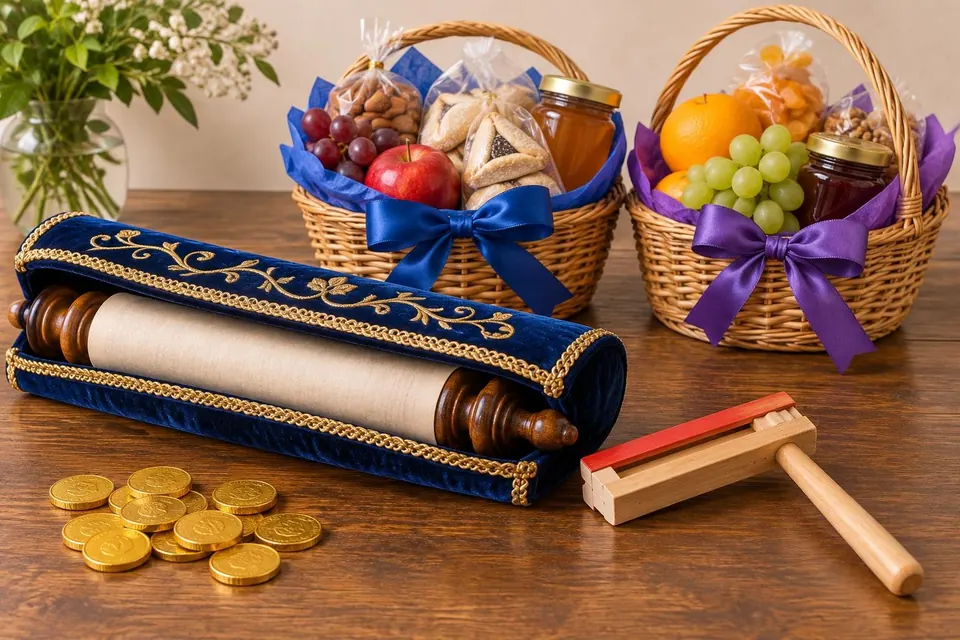
The next mitzvah is mishloach manot umatanot laevyonim: sending gifts of food to friends and gifts to the poor. The Talmud says that mishloach manot means portions of food that can be eaten. By law it is enough to give one friend two different portions: say, challah bread and a portion of meat or cooked fish. A drink can also be included, such as grape juice or wine: one portion of food and one drink also count, but there must still be two portions. The Mishnah Berurah brings a dispute. According to the first opinion, the food must be something already cooked and ready to eat. According to the second, something already slaughtered and ready to be cooked is also fine [Mishnah Berurah 695:20]. But the first opinion is that the food must be fully ready. As for gifts to the poor, you give to two poor people, one gift to each.
Everything I have just listed is the minimum. Many people usually give to more than one friend, and do the same with gifts to the poor.
Maimonides writes about where to spend more money if a person has to choose between gifts to friends, gifts to the poor, and the Purim meal (seudat Purim). The Mishnah Berurah quotes him: it is best to give more gifts to the poor. Why? "Kol hamarbeh matanot laevyonim": it is better to give more gifts to the poor. "Ein lecha mitzvah gedolah umefoeret": there is no greater or more glorious mitzvah than "lesameach evyonim, yetomim vealmanot," to gladden the poor, orphans, and widows. That is the greatest joy.
In general, one important side of Purim is not only to rejoice ourselves, but to make others rejoice. We know how Haman accused the Jews: "mefuzar umeforad," "scattered and dispersed" [Esther 3:8]. They are apart, each person on his own, with no friendship between them. On Purim we are meant to repair that, so that there will be friendship and unity among Jews. One gives a gift to another. If, God forbid, someone has a grievance against someone else, or the relationship is bad or cold, Purim is a good time to bring a gift, stop by, drink a lechaim together, and mend things. It is a very fitting day to repair and improve relations between people.
Once more, what the law requires: two portions of food for one friend, and a gift for each of two poor people. But of course it is good to give more, as you are able.
The Purim Meal and "Al HaNissim"#
Now, the Purim meal. It is said that on Purim it is good to get up early, pray early, and start the day early. Most people hold the festive meal closer to sunset, but the greater part of the meal should still fall during the day. I don't know exactly when sunset is this year, 5:45 or 5:50, but I think you should begin properly at least at four-thirty or a quarter to five, so that a substantial part of the meal takes place earlier. You can also begin at four, or earlier.
And if someone wants to hold the Purim meal in the morning, that is very good. My father, of blessed memory, always held a meal in the morning himself. It is hard to gather all the guests and the whole family by morning, but he would have the morning meal himself. To be honest, I too try to have a meal for myself every Purim morning. I come back from prayer, my wife asks me to read the Megillah to her, and I read it. Then I sit down to a meal with bread, the Purim meal, with a little wine, with whatever there is. And then around four there is another meal. But I try to make the first one in the morning.
"Al HaNissim" is said both in the prayer and in Grace After Meals (Birkat Hamazon). If someone did not say it in the prayer, the prayer still counts. Likewise, Grace After Meals still counts if "Al HaNissim" was not said in it, for several reasons; the Mishnah Berurah gives the main opinions. If the Purim meal was begun before sunset, say at four, and finished at six-thirty, when it is already night, the Shulchan Aruch gives two opinions on whether to say "Al HaNissim," and the conclusion is: yes, you say it. But if you did not say it, Grace After Meals still counts. In addition, at the end of Grace After Meals, in the "HaRachaman" section, we ask that He do for us "nissim veniflaot," miracles and wonders, as He did for our ancestors "bayamim haheim bazman hazeh," in those days at this time, "bimei Mordechai," in the days of Mordechai...
Jerusalem and Cities That Read on the Fourteenth#
In the Land of Israel this is quite a practical question. Someone travels from Jerusalem, where the Megillah is read on the fifteenth, to Beitar or Kiryat Sefer, where it is read on the fourteenth, or to Bnei Brak, and then comes back. When does he have two Purims, when does he have one, and which one?
If a person was in Beitar from the start, from Monday evening, and stayed there until the morning, he has the Purim of Beitar. If he returned to Jerusalem the same day, he will also have the Purim of Jerusalem. Whether he needs to say the blessing at the second reading of the Megillah, on the second day, is less of a practical issue and not entirely clear: let the reader say the blessing, and he fulfills his obligation by listening to it.
Something else is clear-cut. If a person goes from Jerusalem to Beitar on Tuesday (say he leaves at nine in the morning, arrives at eleven or noon to sit with them and drink a lechaim, and leaves at four or five), he has no obligations in Beitar. He returns to Jerusalem and keeps his Purim there in peace. Likewise, a resident of Beitar who comes to Jerusalem on Wednesday morning has no Purim obligations. He may drink a lechaim with a Jerusalemite, but the obligations of Purim are not on him. That too is clear-cut. And if a person was in Beitar from the evening and meant to stay until morning, from Monday to Tuesday, and did stay, then he has the Purim of Tuesday, an ordinary Purim, as outside Jerusalem. That, too, is clear-cut.
Purim and Yom Kippur: Two Paths of Serving God#
Purim is a great festival. It is brought in the name of the Holy Ari (Rabbi Isaac Luria) that Yom HaKippurim is "like Purim," which means that Purim is higher. This is explained as follows. There are two paths of serving God. One is to withdraw completely from material life: on Yom Kippur a person is in the synagogue, does not eat or drink, and does not wear leather shoes. A person can reach this only to a limited degree, according to their strength and ability. The second path is to be inside this world and still do everything leshem shamayim, for the sake of Heaven, and serve God fully. That is Purim: we eat and drink, and at the same time we care for others, for those in need, we try to repair and improve our relationships with friends, and we remember and feel the hand of God, how He guides the world, and we do all of this for the sake of Heaven. Combining the one with the other is harder, but this is exactly what God wants from us on Purim. It is said that Purim is the holiness of the Jewish body.
There is an interesting observation on this subject. Non-Jews could bring a sacrifice to the Temple, and it was accepted from them; Jews could too, but there is a difference. I am speaking of voluntary offerings. Non-Jews could bring only an olah, a burnt offering, while Jews could bring both an olah and shelamim (peace offerings). It is explained like this: a non-Jew too can withdraw from the material. "This I give to God, I have no connection to it, it is consumed entirely on the altar." A Jew can have another level: to eat and drink for the sake of Heaven. That is the level of shelamim. As it is written: "Kohanim ochlim, uvaalim mitkaprim," the priests eat, and the owners receive atonement through it; and the owner also eats from the shelamim. Not eating for the sake of Heaven is an understandable level; that is what we do on Yom Kippur. But eating for the sake of Heaven is a level we have to work on.
They tell of Rabbeinu HaKadosh (Rabbi Yehudah HaNasi) that when he was leaving this world he said: "Lo nehenti afilu beetzba ketanah," "I did not take pleasure from this world even with my little finger" [Ketubot 104a]. Tosafot on this passage ask: it is said of Rabbeinu HaKadosh and Antoninus that neither radish nor lettuce was ever missing from their table, and that they lived at an aristocratic level in general. How can the one fit with the other? The Vilna Gaon, in his commentary on the Shulchan Aruch, answers: yes, all of this was on the table, and Rabbi Yehudah HaNasi ate, but he did not take pleasure from it even with his little finger. That is the level: doing everything leshem shamayim. Maimonides also says that everything a person does should be for the sake of Heaven. Not eating for the sake of Heaven is one kind of act, and eating for the sake of Heaven is another, and it is usually harder.
The Hidden Miracle and the Unseen Hand of God#
So our work on Purim is to serve God through our eating, drinking, and rejoicing. Not to think about ourselves, but to think about serving Him: to recall God's miracles, to see His greatness and how He has guarded the Jewish people in every era, to reflect on the miracles He did for the Jewish people on Purim and the ones He does for us in our own time; to see how He directs all events and cares for us from behind the scenes. At Passover there were nes nigleh, open miracles, and on Purim there is nes nistar, a hidden miracle. One of our main tasks on Purim is to feel the unseen hand of God, which from behind the scenes guards the Jewish people and helps them survive.
Honestly, how do we exist here in Israel, among a mass of enemies on every side? All the years of our life here are a constant miracle: so many attempted attacks, and God helps, so that we are preserved. Our economic life, too, is completely unnatural. Everyone remembers the crisis in the United States, in Europe, in Russia. In Israel, apparently, there are such resources and such riches as exist nowhere else in the world: we heard nothing about any particular crisis! And what percentage of our budget goes to defense? A gigantic one. And the economy still exists, which is also a miracle.
One of the thoughts we should keep in mind on Purim is to sense the unseen hand of God, which watches over the Jewish people and helps us. It is clear that God's attitude toward us matches our attitude toward Him. We need to think about what to improve and what to fix, to see the hand that helps us, to serve Him, and to feel God's closeness.
From a lesson by Rabbi Ben Zion Zilber
Practical law. This page reports a ruling given for a specific question. For your own situation, ask a rabbi who knows you.
Keep reading
More →Why Did Mordechai Refuse to Bow to Haman?
Mordechai’s choices in the Purim story reveal his understanding of spiritual and material effort.
PurimPurim, Lots, and the Meaning of Chance
The name Purim invites us to consider the difference between chance and divine providence.
PurimWhy Do Jews Drink on Purim?
The Talmud’s teaching about drinking on Purim has inspired different interpretations and a reflection on closeness to God.
Guide · PurimIs It Permissible to Wear Costumes on Purim?
The reasons for Purim costumes and the boundaries Jewish law places on them.







