And Mordechai Would Not Bow
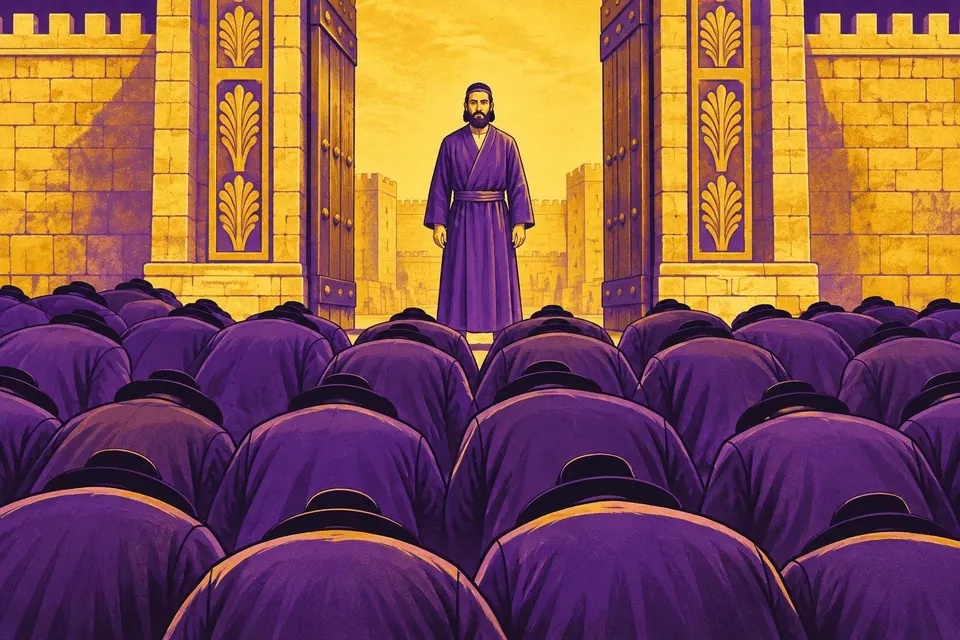
Mordechai’s defiance of Haman offers a way to understand the struggle against evil and the dangers of confronting it.
In brief
- The Talmud describes the Jewish community’s complaints about the events that led to Mordechai’s defiance of Haman.
- The Maharal explains that Mordechai confronted Haman to sanctify God’s name.
- The author describes both confronting and avoiding evil as ways of struggling against the evil inclination.
- Openly challenging evil is dangerous, but Torah study must be pursued without compromise.
At first glance, Mordechai’s behavior toward Haman seems very strange. Who asked him to confront this wicked man directly? One might think that he put the entire Jewish people in mortal danger, God forbid. Indeed, the Talmud says as much:
Rava said: The whole community of Israel says, “See what the Judean [a descendant of the tribe of Judah] did to me, and how the Benjaminite [a descendant of the tribe of Benjamin] repaid me.” “What the Judean did to me” refers to David, who did not execute Shimei ben Gera when Shimei insulted him. Mordechai later descended from Shimei, and his defiant behavior aroused Haman’s anger. “How the Benjaminite repaid me” refers to King Saul, a descendant of Benjamin, who did not kill Agag, king of Amalek. Haman later descended from Agag. (Megillah 12b)
This shows how strongly the community of Israel complained about Mordechai for provoking Haman’s anger. They compared King David, whose restraint led to Mordechai’s birth, with Saul, whose mistake led to Haman’s birth. A similar idea appears in Midrash Aggadah: “The community of Israel said to Mordechai, ‘Know that you are killing us with the sword of this wicked Haman!’” (Midrash Aggadah on Esther 3:2).
Mordechai’s Defiance#
The Maharal of Prague also writes:
“But Mordechai would not bow” (Esther 3:2): “Would not bow” is in the future tense. Although Mordechai could have taken another road and avoided meeting Haman, he deliberately went out to meet him so that he would not bow to him. (Or Chadash on Esther 3:2)
The Maharal adds: “A book of Midrash also relates that the king’s servants said to Mordechai, ‘Shall we tell Haman [that you do not bow]?’ He replied, ‘Tell him.’”
The Targum, an Aramaic translation and commentary on the book of Esther, comments on the words “he neither rose nor moved from his place” (Esther 5:9):
When Haman saw Mordechai studying the words of Torah with children … Mordechai did not rise before his idol and was not afraid of him. Instead, he extended his right foot and showed him the document confirming that he [Haman] had sold himself to him [Mordechai as a slave].
In light of all this, we need to understand why Mordechai provoked Haman, why he did things that fueled his anger, and why he was not at all afraid that he was endangering the entire people of Israel.
The Maharal answers:
This is not difficult to understand. In the first chapter of Berakhot (7b), Rabbi Yochanan says in the name of Rabbi Shimon bar Yochai: “In this world, one may challenge the wicked, as it says, ‘Those who abandon the Torah praise the wicked, but those who keep the Torah confront them’ (Proverbs 28:4). And if someone whispers to you, ‘Do not compete with evildoers; do not envy those who do wrong’ (Psalms 37:1), tell him that these are the words of someone troubled by doubt. In fact, ‘do not compete with evildoers’ means ‘do not try to be like them’ [and ‘do not envy those who do wrong’ means ‘do not be jealous of them’].”
I also found in the Vilna Gaon’s commentary on Proverbs 28:4 that “those who keep the Torah confront them” means they confront the wicked and those who praise them—the people mentioned earlier in the verse.
The Maharal continues:
All the more so does this apply to a wicked man like Haman, who planned to harm the entire people of Israel. That is why [Mordechai] challenged him. Mordechai’s refusal to bow to Haman was an even greater sanctification of God’s name. One must sanctify God’s name; it is a mitzvah, even though Mordechai could have avoided doing so.
The Maharal also wrote about the words “he neither rose nor moved from his place”:
A book of Midrash also relates that Mordechai said, “I cannot flatter a wicked man, because I am descended from kings. For it says, ‘Of Benjamin he said: The beloved of God will dwell securely beside Him; He protects him all day long, and He dwells between his shoulders’ (Deuteronomy 33:12). And I cannot bow to him, lest the Divine Presence that is between my shoulders [that is, between the hills in my tribal territory] leave me.”
The Maharal explains the Midrash:
Since the Divine Presence rests in Benjamin’s territory, it would be a desecration of God’s name if he did not trust in God and feared a wicked man. Therefore Mordechai, a descendant of Benjamin, of whom it is said, “He dwells between his shoulders,” sanctified God’s name … and God saved him from this wicked Haman.
This is what the Midrash says: “They said to him, ‘But your ancestors bowed to him [Esau] many times.’ He answered, ‘My father Benjamin, who was in his mother’s womb, did not bow.’” [This refers to the meeting between Jacob and Esau, when Jacob’s whole family bowed to Esau. Benjamin had not yet been born; he was in the womb of his mother, Rachel.]
The Divine Presence [the Temple] was in Benjamin’s territory. And because the Divine Presence is in his territory, he is meant to sanctify God’s name as much as possible.
These are the Maharal’s words.
Two Ways to Struggle Against Evil#
To begin to understand the depth of this, we need to know that the conduct of the greatest righteous people in different generations toward Esau’s descendants contains hints about how to struggle against the yetzer hara (the evil inclination), a struggle assigned to every member of the people of Israel.
This service of God has two aspects: confronting the forces of evil, as Mordechai did, and avoiding them, as the Jews demanded that Mordechai do. Our forefather Jacob used both strategies. Before meeting Esau, he prepared both gifts and a plan for war.
One can fight the evil inclination face to face, or one can avoid encountering it. The second approach underlies all forms of serving God that are “not for its own sake”—performing mitzvot with less than ideal intentions, for example, to earn honor. These gradually lead a person to act “for its own sake”: performing mitzvot solely because they express God’s will, as explained below.
In this way, a person avoids direct conflict with the evil inclination by giving it something that is “not for its own sake”: a secondary benefit besides doing the Creator’s will. We also know that for this same reason the scapegoat is sent to Azazel; see Nachmanides (the Ramban) on Parashat Acharei Mot.
Directly fighting wicked people—the forces of evil—can be described, however, as “clearing the territory” for the Divine Presence to appear in this world. Here, acting “not for its own sake” is entirely unsuitable. We use that approach only as a tool to reach the level of acting “for its own sake.”
As the Sages said about the words “with all your heart” (Deuteronomy 6:5), this means with both inclinations, the evil and the good [Mishnah Berakhot 9:5]. A person can use even the evil inclination to arrive at good. Of course, there is nothing good in the evil inclination itself; even God calls it “evil.” Nevertheless, it too can be used to achieve good.
But even if a person reaches the level of acting “for its own sake” in this way, there was a stop along the way at “not for its own sake.” This is a flaw that obstructs the revelation of the Divine Presence. The involvement of evil, even as a minor stage on the way to acting “for its own sake,” causes damage there. That place can no longer serve as the foundation for the revelation of the Divine Presence, which occurs only when there are no compromises.
There had to be at least one tribe in Israel whose role was not to submit in the slightest degree to the evil inclination or to its army: the wicked, who rule through violence. Instead, its members openly challenge the wicked, thereby revealing the sanctification of God’s name and complete trust in Him.
[Perhaps this kind of struggle corresponds to the words “I will utterly erase the memory of Amalek” (Exodus 17:14), so that nothing with any connection to the memory of Amalek remains. The second kind of struggle against evil is the battle with Amalek at Rephidim, about which it says, “Joshua weakened Amalek” (Exodus 17:13). Rashi explains that God explicitly commanded him not to destroy Amalek completely.]
This is what the Sages said above: if someone whispers to you, “Do not compete with evildoers; do not envy those who do wrong,” tell him, “These are the words of someone troubled by doubt.” This refers to a person who tries to avoid a direct struggle with the evil inclination, whose heart has not yet been completely purified. Such a person is not yet among those who fight the evil inclination until it is completely destroyed. This is also what the commentary on Berakhot says there: the person is afraid because of their sins.
The Danger of Open Defiance#
Sanctifying God’s name by openly challenging the wicked, however, is very dangerous, and one must be extremely cautious about it. The Sages said:
Rabbi Acha bar Yaakov moved his lulav, a palm branch used on Sukkot, back and forth. He said, “This is like an arrow in Satan’s eye.” (Sukkah 38a)
Rashi explains: It is like an arrow in Satan’s eye because he sees that he cannot remove the burden of the mitzvot from us.
The Talmud continues: “But this is not right”—Rashi explains that one should not say this—“because it provokes him.” Rashi explains that Satan will attack the person with all his might and lead him away from the Creator.
The Talmud teaches us here that there is a way of serving God that is like “an arrow in Satan’s eye,” but it is suitable only for great people. Even they may not say these words openly. For someone who has not reached such a high level, it is dangerous even to think this way. Besides the trace of pride one can see here, there is also the principle that the greater a person is spiritually, the greater their evil inclination. At high spiritual levels, fighting the evil inclination is incredibly difficult. Someone who has not reached those heights cannot even imagine what it is like.
Torah Without Compromise#
If we think about this more deeply, we find that these questions arise at every level. In the deepest state of the soul—that part of the human spirit in which the Divine Presence resides—one must be steadfast to the end, without any compromise. Only in the part where there is “not for its own sake” is it possible to give Satan a bribe and, as it were, get rid of him, even though he lives in our hearts.
As for us, at our low level, the Vilna Gaon wrote that “for its own sake” means loving the study of Torah for the sake of Torah itself. See Nefesh HaChaim 4:3, which quotes Rabbeinu Asher’s commentary on Nedarim 62a: “Speak about them for their own sake: let all your conversations and discussions of the words of Torah be for the sake of Torah—for example, to know, to understand, and to add understanding and deeper explanation.”
Here there must be no concessions or compromises; we must fight with all our strength. About this the Sages said: “If only they had abandoned Me”—that is, doing everything solely for the sake of Heaven, for the sake of the One who gave the Torah—“and preserved Torah study”—that is, doing it for the sake of Torah—“for the light within it brings a person back to good” (Eicha Rabbah).
This is what is meant by “Torah is a remedy” (Kiddushin 30b). Torah study influences a person even at the lowest of the inner spiritual levels needed for spiritual growth. Therefore, whatever happens, one must never turn away from it. Torah is an absolute necessity.
Keep reading
More →Why Did Mordechai Refuse to Bow to Haman?
Mordechai’s choices in the Purim story reveal his understanding of spiritual and material effort.
PurimPurim, Lots, and the Meaning of Chance
The name Purim invites us to consider the difference between chance and divine providence.
PurimWhy Do Jews Drink on Purim?
The Talmud’s teaching about drinking on Purim has inspired different interpretations and a reflection on closeness to God.
Guide · PurimIs It Permissible to Wear Costumes on Purim?
The reasons for Purim costumes and the boundaries Jewish law places on them.







