The Klausenberger Rebbe's 1945 Rosh Hashanah Sermon
A survivor recalls the Rebbe's words to his fellow survivors and his meeting with General Eisenhower.
In brief
- Before the shofar was sounded, the Rebbe urged survivors to return to God out of love.
- On Yom Kippur, he questioned how the traditional confession applied to those who had survived the camps.
- He also asked the survivors to confess moments when their faith and trust had weakened.
- When General Eisenhower visited, the Rebbe asked for help obtaining the four species for Sukkot.
From recollections about the Rebbe of Sanz-Klausenburg, Rabbi Yekutiel Yehudah Halberstam
A Rosh Hashanah Sermon in 5706 (Fall 1945)#
Survivors of the camp still speak with deep emotion of the unforgettable impression the Rebbe made on them. Even more than 50 years later, they cannot forget what he said on the second day of Rosh Hashanah 5706, before the sounding of the shofar. It was his traditional annual address to the large congregation gathered for prayer in his beit midrash, or study hall.
His words were heartbreaking. The ideas he presented drew on words spoken 200 years earlier by Rabbi Yechezkel Landau of Prague, author of Noda BiYehudah. Against the tragic reality of the Holocaust and the destruction of the foundations of Jewish life, they had taken on a special urgency.
The Rebbe began by quoting several verses from the haftarah, the reading from the Prophets, read that day. Among them was: “This is what God says: A voice is heard in Ramah, lamentation and bitter weeping. Rachel weeps for her children; she refuses to be comforted for her children, for they are gone” (Jeremiah 31:15). Why, he asked, is the word “children” repeated?
“This alludes,” he explained, “to two kinds of suffering endured by the holy Shechinah, the Divine Presence, because Israel is in exile.” Those familiar with the hidden teachings of the Torah know that the name “Rachel” refers to the Shechinah. The first suffering—“Rachel weeps for her children”—is over the calamities that have befallen them, for all their troubles cause the Almighty to suffer. The second is over the many Jews who have distanced themselves from holiness and forgotten that they are holy offspring. Of this suffering the verse says, “for her children, for they are gone”: They have lost their standing as God's children.
Besides the loss of that standing and the great shame of now being “slaves,” they face another danger in this condition: destruction, God forbid. In the Talmud (Sanhedrin 111a), we find a dispute about the verse “I will take you, one from a city and two from a family” (Jeremiah 3:14). Rabbi Shimon ben Lakish says that it must be understood literally. Rabbi Yochanan says that one person from a city saves the whole city, and one from a family saves the whole family.
Rabbi Yechezkel Landau explains: If Jews have remained at the level of children, and children of one father are close to one another and care about one another, then one can save another and those close to them. But if they are at the level of slaves, who are not close and do not care about one another, the verse will be fulfilled literally: Only one from a city and two from a family will be saved.
“Because of our many sins,” the Rebbe cried, “this harsh second interpretation has already been fulfilled for us! Rachel weeps for her children, for those murdered for the sanctification of God's name. And besides this, the holy Shechinah refuses to be comforted ‘for her children, for they are gone’: Those who remain among the children of the living God have forgotten their Rock, who gave them their souls, and have lost the name of ‘children.’ Look at what has happened to us: That prophecy has been fulfilled, and only ‘one from a city and two from a family’ have been saved from the ovens—in the literal sense!”
The Rebbe also explained what follows in Jeremiah. God answers Rachel: “This is what God says: Hold back your voice from weeping and your eyes from tears, for your labor will be rewarded, says God; they will return from the enemy's land. And there is hope for your future, says God; the children will return to their own borders” (Jeremiah 31:16–17).
Here, too, there is a repetition: “They will return from the enemy's land” and “the children will return to their own borders.” But this repetition corresponds to the repetition in the words about Rachel's weeping. The words “Rachel weeps for her children,” over their suffering, are answered by “they will return from the enemy's land.”
And the words “she refuses to be comforted for her children, for they are gone” mean that they have lost their standing as children. They are like a prince banished from the palace to live among villagers, who has completely forgotten the manners and ceremonies of royal palaces and no longer wishes to return to his father. Here God promises, “The children will return to their own borders”: They will yet return to their standing as children beloved by God!
There are several stages in this process of returning to their Rock. First, “they will return from the enemy's land.” While still there, outside the borders of holiness and without the standing of children, they will nevertheless turn their hearts toward returning. The process of return will begin within the “enemy's land” itself. Afterward, the prophecy “the children will return to their own borders” will be fulfilled: the return of children, a “return out of love.”
For in truth, without such a return, when the time comes God will need to “set over them a king whose decrees are as harsh as Haman's,” as the Sages said (Sanhedrin 97b). And because of our many sins, such a one has already ruled over us—the Nazi monster, may his name be erased—and then Israel will return to God. But that path also brings great harm to Israel. Rachel therefore refuses to be comforted until God comforts her with the news that they will ultimately return to the standing of children and return to Him out of love.
“Israel, holy people!” the Rebbe cried with deep emotion as he concluded. “Listen to the cry of the suffering of the holy Shechinah, who ‘refuses to be comforted for her children, for they are gone’—the voice of the Shechinah, suffering because many Holocaust survivors have lost the standing of ‘God's children,’ and one cannot even see that they are Jews! My brothers, let us return to our Father in Heaven and once again become Jews worthy of being called His children! Let us accept the yoke of God's kingship, and then the words ‘The children will return to their own borders’ will be fulfilled for us, according to every interpretation of this verse!”
The Great Confession on Kol Nidrei Night#
On the night of Yom Kippur, after the Kol Nidrei prayer, the Rebbe addressed us with fiery words in the beit midrash, before the open ark containing the Torah scrolls. It was a speech that shook worlds. This time he spoke chiefly to Heaven, in defense of the holy people of Israel. He wept intensely, speaking from the depths of a raging storm within his soul.
His words came from the heart. Standing with an open machzor, the High Holiday prayer book, in his hand, he read the confession, the Vidui: “We have sinned, we have betrayed,” and so on—but with a meaning different from the usual one. He spoke the words as questions, with astonishment: “We have sinned? We have betrayed?”
Hasidim tell of an episode involving a disciple of the Baal Shem Tov, the holy maggid, or preacher, Rabbi Michel of Zlotchov. He once became gravely ill, and those close to him thought his time had come. His beloved disciple, Rabbi Aharon Leib of Premishlan, came to his bedside and whispered in his ear, “Rabbi! The time has come for you to say the confession!”
Rabbi Michel began: “Yes, that is so. I will confess before my Creator. In all my days I have never committed an unworthy deed. In all my days, forbidden speech has never once passed my lips. I have never stumbled, even in my thoughts.” The disciple became greatly agitated and cried, “Enough, Rabbi! You have confessed already—quite enough and more than enough!”
Our Rebbe, may his merits protect us, was now making a similar confession. It was as though he were arguing a case in court with his Master. “We have sinned?” he asked in astonishment. “We have betrayed?” Had we, God forbid, betrayed God and failed to remain faithful to Him? “We have robbed?” Whom had we robbed in Auschwitz and in Mühldorf, the camp where the Rebbe himself had been imprisoned? Was there anyone there for us to rob?
Then he suddenly stopped, like someone who has remembered something, and cried: “Oh yes, I am a robber. I confess. Once, after returning from forced labor, I sank weakly onto my bunk in our barrack to rest a little. Suddenly, a piece of my dry, shriveled skin caught between two boards, so that I couldn't move. I tried to pull myself free, straining until the skin split a little over the bone and blood began to flow. ‘Oh!’ A muffled groan escaped me against my will. I groaned softly, but it was enough to wake the prisoner on the neighboring bunk! And so, ‘we have robbed!’ I robbed a tired prisoner of his sleep! That is my only ‘robbery.’ And I confess before You, Master of the Universe, beating my fist against my heart: ‘I have sinned!’”
He continued reading from the machzor: “‘We have spoken falsely’? We had no strength even to talk! And if a ‘speaking soul’ had a drop of strength left, we saved it for our cruel guards, to answer their questions properly! ‘We have acted deceitfully’? ‘We have acted wickedly’? Who? We? ‘We have mocked’? Who could mock anything there? ‘We have rebelled’? Against whom? Against You, Master of the Universe—did we rebel? Didn't we submit to every blow, knowing that ‘You are just in all that has come upon us’ [Nehemiah 9:33]? Did we rebel against those wicked men? Could we have rebelled, even if we had wanted to?”
And so the Rebbe read on and on, passage after passage, through the sections “We Have Sinned” and “For the Sin,” rejecting one by one the accusations of crimes that had nothing to do with the survivors of the concentration camps. They had not “acted wickedly”; they had not “acted lawlessly.” “This confession was not written for us!” And he closed the machzor. The congregation was astonished and shaken by his words.
“But,” he raised his voice again a moment later, “we are guilty of sins that are not written in the machzor. We sinned through our lack of faith and trust. Didn't we sometimes have sinful thoughts there in the camp, out of despair? At night, on our bunks, when we said ‘Shema, Israel’ before sleep, didn't we think, ‘Oh, if only this were the last time in my life I would say the blessing “Who casts the bonds of sleep,” so that my suffering would end!’
“How many times did many of us pray: ‘Master of the Universe! I have no strength left! Please take my soul, so that I won't have to say in the morning, “I thank You…”!’ And when dawn broke, we were forced, against our will—for we are Jews—to thank God again and again: ‘For You have mercifully returned my soul to me,’ and we were filled with bitter disappointment. And when the bodies of the ‘fortunate ones’ who had already died and given up their souls were carried out of the barracks, didn't we look at them with envy?
“So we have sinned. We sinned through weakness of faith, through insufficient trust; we did not rely enough on our Rock. And now we must beat our fists against our hearts and confess: ‘For the sin…’ We must ask the Master of the Universe to restore our faith and trust in full! ‘Trust in God forever!’ [Isaiah 26:4] ‘Trust in Him at all times, people; pour out your hearts before Him’” (Psalms 62:8).
These were the words our Rebbe spoke that Kol Nidrei night, when the camp survivors felt the prophet's words so vividly that they could almost touch them: “For the day of God is great and exceedingly fearsome; who can endure it?” (Joel 2:11).
Before Kings#
The next day, on the holy day of Yom Kippur, General Dwight Eisenhower visited the refugee camp. He was then commander in chief of the American occupation forces in Europe and would later be elected the 34th president of the United States. The refugees gathered at the camp gates in his honor. Our Rebbe also went out to meet him. The general was presented with a braided challah and salt, while the Rebbe held a Torah scroll in his arms.
A truly royal reception was organized in the camp for the occasion. The community demanded that the Klausenberger Rebbe be the principal speaker, expressing the feelings and requests of all the refugees to this important guest. But a group of activists from nonreligious parties opposed the majority. They loudly declared that they would never allow the Rebbe to speak unless he first undertook not to mention God's name or use his speech to promote Yiddishkeit, the Jewish way of life. They also warned that he must speak briefly and leave time for the other speakers.
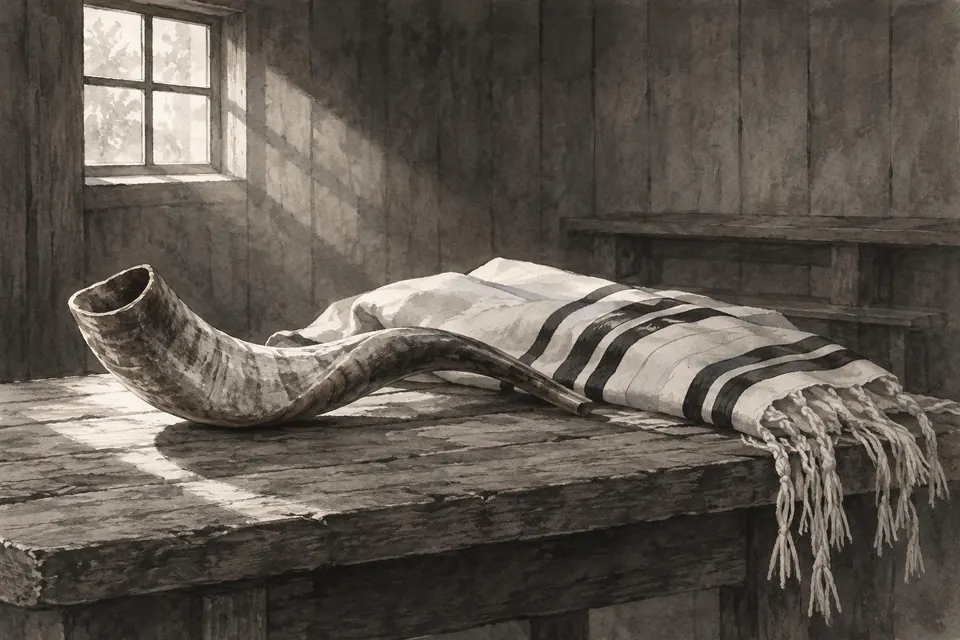
As might have been expected, the Rebbe paid no attention to their threats. During the formal ceremony, he acted freely, as he saw fit. When he stepped onto the speakers' platform, an attendant handed him an ornate tallit, a prayer shawl, which the attendant had been hiding inside his clothing. The Rebbe spread it wide and wrapped himself in it before the entire gathering, first reciting the blessing, as always, loudly and with enthusiasm: “…who has sanctified us with His mitzvot and commanded us to wrap ourselves in tzitzit,” the ritual fringes.
The enormous crowd was deeply moved by the majestic sight: the Rebbe wrapped in the holy tallit, with four fringes hanging from its four corners. His appearance reminded them of their holy fathers, murdered by the cursed Nazis, may their names be erased. They seemed to have lost the power of speech. No one dared break the silence.
Then the Rebbe began to speak, his voice striking sparks of flame. He spoke of the destruction and suffering of the Jews, of the Jewish fate, and of our role and place in the world as the chosen people, God's people. He welcomed the general, who had been granted from Heaven the great merit of taking part in the liberation of innocent people condemned to death. But his speech was addressed chiefly to his brothers, the members of his people.
He reminded all the Jews present that they must not forget the source of their souls in Heaven. He also reminded the “cultured” and “enlightened” world, the nations of the “free world,” the “world of democracy,” not to forget what the Nazis had done to us. He spoke with extraordinary emotion, which grew with every moment. The entire gathering, tens of thousands of people, was swept up in his speech. It made an enormous impression. People streamed with tears; adults wept like small children.
When the Rebbe finished speaking, he immediately told his attendant, the cantor Rabbi Aaron Miller, to recite El Male Rachamim (“God, Full of Mercy”), the memorial prayer, for the elevation of the souls of the holy victims, as is done on the day of remembrance for the departed. Once again a roar rose from the crowd of thousands, waves of bitter wailing and weeping. The gathering became an overwhelming display of awe of God and sanctification of His name.
The mood of the gathering had, of course, completely changed during the speech. The Rebbe's opponents on the left forgave him his “crime”—mentioning God's name—and the other speakers gave up their opportunities to speak. The Rebbe was the only speaker at the ceremony. His Yiddish speech was translated into English for General Eisenhower, who was deeply moved by everything he saw and heard. He promised to do all he could to improve the former prisoners' situation and help them in every way.
From then on, he and the Rebbe maintained friendly ties for many years, and those ties were used more than once for the benefit of our people.
At the end of the ceremony, the general asked the Rebbe how he could help him. The Rebbe replied, “I ask for nothing but one thing: Please give instructions to help obtain the four species of plants for me and the whole community for Sukkot, which begins in just a few days.”
The general was deeply moved by this answer. He understood that the righteous man before him was a holy man of God. How else could one explain such a wonder? A Jew in a refugee camp hears personally from the commander in chief of the American armed forces that he is ready to grant any request immediately—and asks for nothing but an etrog, a citron, and a lulav, a palm branch! As the story is told, a special plane was sent on the commander in chief's orders to the Italian occupation zone, and lulavim and etrogim were brought from there to the Rebbe.
Keep reading
More →What Is Elul and Why Is It Special?
The month of Elul invites us to draw closer to God through gratitude, Torah study, and repentance.

The King's Son and the Small House
Rosh HashanahThe Chafetz Chaim on Judging Others Favorably
The way we judge others can shape the way we are judged.
Rosh Hashanah“Restrain Your Voice From Weeping”: The Matriarchs’ Prayer
The stories of the matriarchs reveal the power of prayer born from suffering.







