The High Holidays in the Shadow of Death
Survivors recall the Klausenberger Rebbe's prayers and words of faith during the High Holidays of 1944.
In brief
- The Klausenberger Rebbe organized communal prayers in the camp for Rosh Hashanah and Yom Kippur.
- He made Kiddush and said the Shehecheyanu blessing with deep feeling.
- On the second night of Rosh Hashanah, he obtained an apple for the blessing and later gave it to sick prisoners.
- Survivors remembered his prayers and his words of faith long afterward.
From recollections of the Rebbe of Sanz-Klausenburg, Rabbi Yekutiel Yehuda Halberstam, who was imprisoned in a Nazi concentration camp during World War II.
On the Day of Judgment#
As the High Holidays of 5705 approached in the fall of 1944, the Rebbe began speaking privately with those close to him about the need to organize communal prayers for Rosh Hashanah and Yom Kippur, despite the danger.
Survivors recalled that the approach of the Day of Judgment was usually clearly visible on our teacher's face. They saw the same thing in the camp: his face reflected gravity and sacred awe, as if he were gazing into an infinite distance. His lips moved constantly. His whole appearance was that of a man preparing to stand at any moment before a great and fearsome court (K. Hermetz, Kashmaren, p. 225).
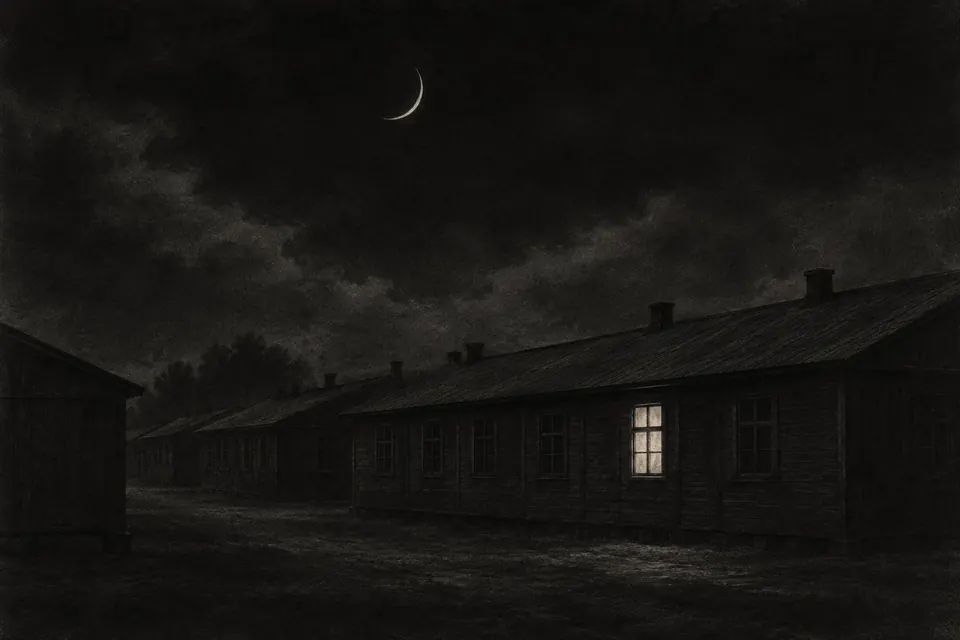
Rabbi David Grintzvaig related that on the eve of Rosh Hashanah, a rumor spread that the Rebbe would pray that night in the round barracks, one of the first in the camp. It was large and spacious, but it had not been used as living quarters for a long time and stood abandoned.
“At the end of the day, when we had returned from working at the airfield, tired and exhausted, hundreds of Jewish prisoners from almost every block in the camp gathered in that barracks, filling it to capacity. The Rebbe came forward to lead the prayer. It shook our souls and pierced the heavens, although he tried not to raise his voice too much, so that the Nazi executioners would not hear us. We could barely hear the words coming from his lips; they seemed to catch in his throat. Only heart-rending sobs and groans echoed through the barracks, accompanied by the muffled weeping of those at prayer:
“Pour out Your anger on those who say, ‘Destroy!’ and on those who entered the vineyard (the people of Israel), the planting of Your right hand, and stripped it, leaving not a single grape…”
The words were from the liturgical poem Ahot Ketanah.
“After the prayer, we wished one another, ‘May you be inscribed and sealed for good in the Book of Life,’ and exchanged New Year greetings. When everyone had gone back to their blocks, my brother, Rabbi Moshe Tuvia—may he be blessed with a long life—followed the Rebbe, who lived in the same block, to find out whether he would make the holiday Kiddush.
“The Rebbe did indeed make Kiddush over bread. With deep feeling, he said the blessing: ‘…Who chose us from among all peoples and raised us above all languages…’ Then, with fiery fervor, he said the Shehecheyanu blessing: ‘…Who has given us life, sustained us, and enabled us to reach this time.’ He spoke as though he were standing at the table with his Hasidim in Klausenburg, not in the sadistic clutches of the Nazi monsters.”
“Who Has Given Us Life and Sustained Us”#
The next night, the second night of Rosh Hashanah, it all happened again: the large gathering for prayer, the weeping and groaning, and Kiddush in the barracks. To everyone's surprise, the Rebbe once again said the blessing, “Who has given us life and sustained us,” with the same fiery fervor.
Why did he say it again, and over what? After all, the blessing is said for something important that has newly arrived. Then the astonished Rabbi Moshe Tuvia saw that the Rebbe was holding a fresh, juicy apple—the kind that everyone in the holy community of Israel always tries to obtain before Rosh Hashanah, “so that nothing sweet will be lacking on such a day.”
Where did the Rebbe get such an apple?
One of the camp survivors told the story:
“I worked there as a harness maker. That was my trade, and because of it I had quite a few privileges in the camp. My rations were also considerably better than usual. On the eve of Rosh Hashanah, the Klausenberger Rebbe approached me and asked whether I could get him an apple for the Shehecheyanu blessing. I did as he asked. Later, I learned that the Rebbe did not eat the whole apple, but gave it to the sick people in the infirmary barracks.”
“Raise Your Voice Like a Shofar”#
The next day, the second day of Rosh Hashanah, many Jews gathered again to be near the Rebbe on this solemn day. Rabbi Eingoren, a member of the “night watch,” stood guard to warn of any danger. There was only one prayer book, but the Rebbe knew all the prayers by heart, and the congregation repeated them after him: Malchuyot, Zichronot, and Shofarot, the special sections of the Amidah (the central prayer, also known as the Eighteen Blessings) that are said only on Rosh Hashanah.
There was no shofar, the horn sounded on Rosh Hashanah, but the Rebbe literally fulfilled the verse, “Raise your voice like a shofar” (Isaiah 58:1). Many Jews gathered around him, as if beneath the crown of a spreading tree, out of sight of the camp guards, to hear him speak about the holiday.
The verse says, “Happy is the people that knows the shofar's call” (Psalms 89:16). As Rashi explains, this means a people that knows how to win its Creator's favor through the Rosh Hashanah shofar blasts. It is enough that this people “knows”: even when there is no way to hear the shofar, the essential thing is what follows in the verse, “They walk, Lord, in the light of Your face”—even when they walk through “the valley of death” (see Psalms 23:4).
He spoke with fire, urging everyone to strengthen their faith that “you are children of the Lord your God” (Deuteronomy 14:1). Just as a father has compassion on his children, he said, the Almighty would surely have compassion on us. Deliverance was near: in a moment it would be here.
“We must trust in the Almighty and in the certainty that all those who hate Israel will perish,” he said.
Wonderful News: Yom Kippur Will Come for Our Good#
K. Hermetz tells in his memoirs about our teacher's prayer as Yom Kippur night began. Kol Nidrei is recited before that night begins, before sunset.
“Jews came from all corners of the camp for Kol Nidrei—everyone who had somehow learned the secret. I am sure that no one who was there in the ‘forest camp’ will ever forget it. The Klausenberger Rebbe began in a muffled voice. A heavy groan broke from his heart, like a rumble rising from the depths of the earth: ‘Kol-l-l-l Nidrei…’
“The congregation took in that soul-rending groan and answered with a loud, deep, frightening murmur. In an instant it became a terrifying cry and wail, as though every heart had poured out at once everything it held. Through all the murmuring, groaning, and sobbing, the Rebbe's voice broke out, growing stronger until it thundered: ‘And my prohibitions… And my oaths… And my bans… [may they be annulled].’ Then all the fountains of tears burst open. Water streamed from people's eyes; they could no longer restrain themselves.
“That night, each person remembered home, hometown, family, synagogue. And when they thought, ‘Who knows what happened to my family, what has become of my synagogue, and what the coming day holds for us? Will we ever be privileged to leave this hell?’ they wept even harder, more inconsolably, and tears flowed from every eye.
“The Rebbe was the only one whose spirit was not broken. His voice grew stronger and rose higher as he repeated Kol Nidrei a second and a third time. When he declared, confidently and resolutely, like a herald, ‘From this Yom Kippur until the next Yom Kippur, which will come to us for good,’ everyone felt that at that moment the Rebbe had revived and his spirit had been renewed, as though good news had burst from his lips. It was as if he were promising that we would live to see a Yom Kippur that would come to us for good, as if he had managed to tear our harsh sentence to pieces. He concluded in a clear, comforting voice, with its traditional sweetness: ‘…[May our vows be] forgiven and invalid, void and annulled, without force or existence.’
“The people in the barracks were lost in thought, each person with their own thoughts. Even the man standing guard outside was so absorbed that he failed to notice the camp elder approaching. The elder asked what was happening. When everything was explained to him, he understood us, for he too was a prisoner. Even so, he asked everyone to disperse. An SS patrol might notice the crowd and take it for a demonstration against the camp administration; the consequences could be grave and tragic.
“The people had to disperse, their hearts aching as wounds that had never healed were opened again. Sleep escaped us that night on our bunks. The Klausenberger Rebbe's prayer continued to ring in our ears: ‘Until Yom Kippur, which will come to us for good!’”
“Before the Lord You Shall Be Cleansed”#
In fact, not everyone dispersed and went to sleep. Late that night, Jews gathered around the Rebbe once more, hungry and thirsty. But the hungry did not hunger for bread, nor did the thirsty thirst for water; they longed for the word of the living God. The Rebbe responded to their request and spoke to them with great fervor about Yom Kippur.
This is what Rabbi Jacob Eliezer Direnfeld, a survivor of the camp, told me:
“Over the years, many details of what the Rebbe said have faded from my memory, but the powerful impression his words made on me is still alive. His talk was a masterpiece of fresh insight and remarkable clarity of thought. In the terrible atmosphere of the camp, people had long since lost the ability to think clearly and understand, and sometimes even to reason at all. All their thoughts were focused on pain and suffering, on trying somehow to lessen them, get a little food, and stay alive.
“And suddenly we heard our Rebbe speaking about spiritual things, about a Jew and God: ‘For on this day atonement will be made for you; before the Lord you shall be cleansed’ [Leviticus 16:30]. He spoke about things and ideas that we ourselves could not even have imagined.”
Keep reading
More →What Is Elul and Why Is It Special?
The month of Elul invites us to draw closer to God through gratitude, Torah study, and repentance.

The King's Son and the Small House
Rosh HashanahThe Chafetz Chaim on Judging Others Favorably
The way we judge others can shape the way we are judged.
Rosh Hashanah“Restrain Your Voice From Weeping”: The Matriarchs’ Prayer
The stories of the matriarchs reveal the power of prayer born from suffering.







