What Does the Shofar Mean on Rosh Hashanah?
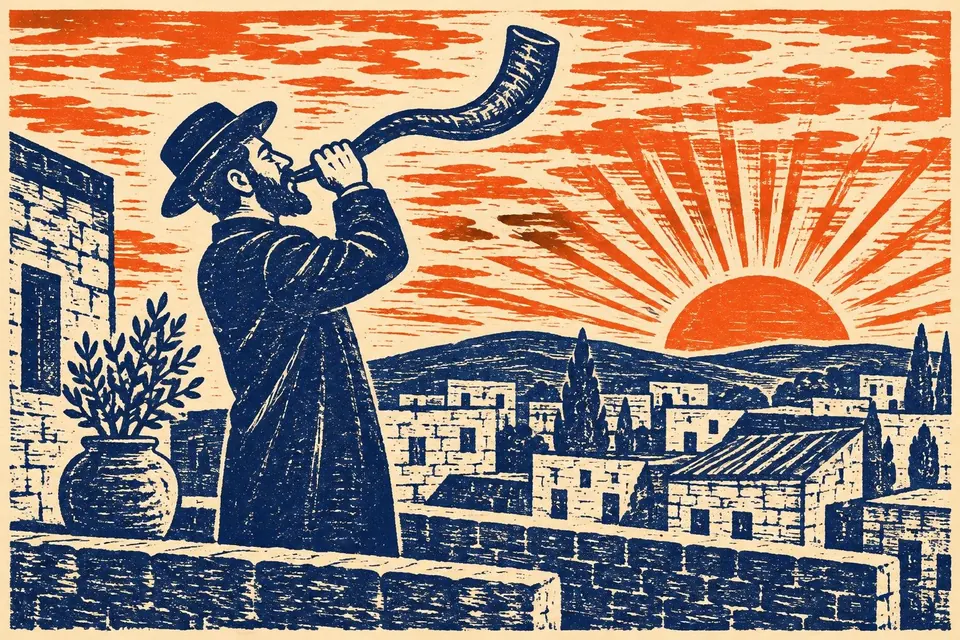
The shofar calls us to wake up and see our lives more clearly.
In brief
- Maimonides describes the shofar as a call to wake up, examine our deeds, and return to God.
- The illusion of sleep can make us forget our true purpose.
- Wisdom can expose the illusions presented by the evil inclination.
- The shofar also reminds us that Rosh Hashanah is a time of judgment.
Maimonides (the Rambam) writes: “Although sounding the shofar on Rosh Hashanah is a decree of the Torah [whose true meaning is hidden—translator’s note], it contains a hint” [Maimonides, Laws of Repentance 3:4].
Maimonides’ general approach is that although the true and complete meaning of the Torah’s laws is hidden from us, we should still reflect on them and explain whatever we can. “For our Sages said that King Solomon understood most of the reasons for all the commandments.”
Maimonides reflected on the commandment to sound the shofar and found a hint of its purpose: “It is as if it says: Wake up, sleepers, from your sleep; arise, those who slumber, from your slumber. Examine your deeds, repent, and return; remember your Creator. You who forget the truth in the rush of time and spend your days pursuing distractions and empty things that will neither help nor save you: Look to your souls and improve your ways. Let each person abandon their evil path and wrongful thoughts” [Maimonides, Laws of Repentance 3:4].
A Remarkable Idea#
Do you know what Maimonides is saying here? All those who made mistakes, lost their way, sinned and did wrong, who sank to the very bottom and did whatever they did—all of them did it in their sleep. They were simply fast asleep! All they need to do is wake up, come to, and regain their senses. That’s all!
Incredible News#
And indeed, the Talmud says just that: “A person sins only when a spirit of folly enters them” (Sotah 3a). Reason is pushed aside, and knowledge is ignored. Sleep takes a person into a world of imagination, fantasy, and dreams.
The Ponevezh rabbi once said to me, “Rabbi Yaakov, I want to ask you a question. Imagine that someone falls asleep and dreams he’s in a dense forest. Evening is falling, and he hears lions growling, bears roaring, and wolves howling. They come closer and closer. He stands there trembling, surrounded by a ring of fierce, glowing yellow eyes that draws tighter and tighter. He’s shaking with fear, covered in a cold sweat, and crying out for help...
“How can you help him? How can you save him?”
Oh, the way Rabbi Kahaneman spoke—his language was so vivid and alive. I began to tremble myself. The fear and horror!
Then the rabbi gave his wonderful smile and answered, “It’s very simple: wake him up!” Then he’ll see that it was all imagined. The whole world that seemed so real to him has disappeared, melted away...
The Talmud says: “If a person goes seven nights without a dream, they are called bad, as it says in Proverbs: ‘Satisfied, he lies down and will not remember—bad.’ Read not ‘satisfied’ (savea), but ‘seven’ (sheva)” [Berakhot 55b; Proverbs 19:23]. The Smichut Chachamim says that after reading the word as “seven,” we should read it again as it is written, and then everything becomes clear. The Vilna Gaon explains it: A person can spend all six days of the week as if immersed in a dream and take it for reality—material possessions, the pursuit of money, and a sense of their own power. They forget that only God gives them the strength to succeed. Yet at least on Shabbat, they should realize that they have been asleep. If they do not understand even then, they are called “bad.”
That is the meaning of “satisfied, he lies down”: he is satisfied and content with his situation, with his endless sleep. “And will not remember”: he does not recall his true purpose. That is when he is “bad.”
What, then, can we say about someone who spends the whole year immersed in this sleep? Let them wake up, at least when they hear the shofar!
A story is told of a yeshiva head who turned to one of his students and asked, “Well, do you have an answer to the captain’s question?”
The young man tried to remember what he meant. What was the question about? Which tractate was it in? It was embarrassing, but he had no choice. “Rabbi, please remind me...”
“The captain who turned to the prophet Jonah and asked, ‘What are you doing asleep?’” [Jonah 1:6].
The sea is raging, the ship is about to sink, and he’s asleep...
This really happened: A fire broke out in the middle of the night. The family managed to run out of the house, and suddenly the mother cried, “Avreimi! We forgot him—he’s asleep in his room!” The flames were raging, and it was impossible to get inside. Everyone began shouting, “Avreimi, wake up! Jump out of the window!” They stood ready to catch him. But from inside the house came a sleepy voice: “Leave me alone. Let me sleep...”
Let’s study a passage from the Talmud commenting on a verse in Ecclesiastes: “There was a small city with few people in it. A great king came against it, surrounded it, and built siege works and walls around it. There was found in it a poor [in the eyes of the city’s residents—no one listened to him] but wise man, and he saved the whole city through his wisdom. Yet afterward no one remembered that poor man” [Ecclesiastes 9:14–15].
The Talmud explains: The “small city” is the body. The “few people” are its limbs. “A great king came against it and surrounded it” refers to the evil inclination. “He built siege works and walls” refers to sins. “There was found in it a poor but wise man” refers to the good inclination. “He saved the whole city through his wisdom” refers to repentance and good deeds. “No one remembered that poor man” means that when the evil inclination attacks, no one remembers the good inclination [Nedarim 32b].
What is this telling us? Let’s look more closely at the parable. There is a small city with few inhabitants. A great king comes and besieges it. What are the city’s chances of survival? Not very good... The king builds siege works and walls. What are its chances now? Zero.
But then a wise man is found, and he saves the city. How? Through his wisdom.
This is hard to understand. The wise man is trapped inside the besieged city, while the enemy surrounds it and has built great fortifications. How can wisdom help? How can wisdom destroy the fortifications and break the siege?
Rabbi Leib Chasman [the spiritual mentor of the Hebron yeshiva] offers a wonderful parable about this.
The Village Visitor#
A villager—let’s call him Vanya—heard about the wonders of the big city. He saved penny by penny, and at last the long-awaited day arrived: he set off for the city. When the carriage entered the city, the driver said, “You have six hours. I’m leaving for home at four.”
Vanya walked along the broad avenues, gazing at the tall buildings and colorful store windows. He couldn’t get enough. Everything he had seen before paled in comparison. When he got back to the village, he would have stories to tell for hours. No one he knew would believe their ears!
Yes, that was the problem. They wouldn’t believe him; they’d think he was making it all up. Which of them had ever heard of carriages without horses, or lamps without oil and wicks?
He entered a huge store and shyly approached the clerk. “I’m from a village, and I’m going home soon. If I tell people what I’ve seen here, they just won’t believe me. What do you have that would amaze them, something that would really capture their imagination?”
“How much money do you have?” the clerk asked.
“Oh, a great deal! Twenty dollars!” By village standards, that was...
“Look,” said the clerk, “I’m sure you don’t have electricity out there...”
“What’s that?”
Just as he thought. “How do you light your homes in the evening?” Next he’ll ask what a home is.
But no. “Well, we have kerosene lamps...”
“I’ll give you a flashlight. It costs ten dollars, batteries included. Look: press here and it turns on; press again and it turns off. See how it shines?”
Our visitor took the flashlight and began switching it on and off. Amazing! That evening he would tell everyone about his adventures, turn on the flashlight, and the whole room would light up! He could already hear their cries of delight...
He paid and went outside. He found out the time: he still had two hours. He continued walking and suddenly saw a building with a huge poster on its front, decorated with colored lights. People were standing in line, paying, and going inside.
“What’s this?” he asked, curious.
“They’re showing a movie here: ‘Wonders of the Jungle.’”
“What’s a movie? And what’s a jungle? Is it some kind of juggler?” Vanya asked, confused.
They laughed. “Where did you come from, a village?” Exactly! How did they guess?
“Listen,” someone said, “if you came to the city and didn’t go to the movies, you missed the best part!”
“How much is it?”
“Ten dollars”—just what he had left.
“And how long does it take?”
“An hour and a half. It starts in ten minutes.”
He paid and entered the dark theater. He sat down and waited curiously to see what would happen.
Suddenly music began to play, the curtains opened, and behind them was a huge screen. The screen lit up, and on it—wonder of wonders!—appeared tall trees, grass, and birds... Then a yellow, maned head appeared out of the grass. A huge lion rose to its full height, opened a mouth full of yellow fangs, and roared so fiercely that it made you tremble! What wonders the city had...
Then a thought struck him: if all this was so beautiful in the dark, how wonderful it would look in the light! Vanya remembered his flashlight. He took it out of his pocket, switched it on, and pointed it at the screen. Suddenly the picture disappeared. All he could see was a pale screen. Irritated voices called out from every direction: “Hey, turn off the light! We can’t see anything!”
He apologized. “But I was trying to see better...”
“You don’t understand!” they told him. “You can only see it in the dark!”
The Light of Wisdom#
That is the point, says Rabbi Leib Chasman. “There is a small city with few inhabitants”—that is a person. “A great king comes and besieges it”—that is the evil inclination. And there is no chance of escape. “A poor wise man is found in the city”—the good inclination—“and saves the city.” How? “Through his wisdom.” Wisdom is light! It shows that the evil inclination is only an illusion. There is no siege, no fortifications, no reality, and no temptation. Nothing but a false set of scenery!
But a question arises: If the evil inclination is merely showing us an imaginary “movie,” a fake, and the flashlight is in our hands—if with one movement of a finger we can shine a light on it and make it disappear—how do so many people, including ourselves, fall into its trap?
The answer is simple and shameful: We want to watch the movie! We plead, “Don’t wake us up. We’re in the middle of a dream. Don’t steal our sleep!”
That is how Ecclesiastes ends the passage: “No one remembered that poor man.” Under the sway of the evil inclination, people do not want to remember the good inclination!
Now we can understand the words of the author of Chovot HaLevavot (Duties of the Heart) about the evil inclination: “You sleep for it, and it is awake for you.” It stays awake precisely because you are asleep!
We used to think that on Rosh Hashanah we had to change, and we despaired in advance. We are weak; we will not succeed. But now we see that we only have to wake up. And that is not difficult at all!
This is the meaning of the shofar.
That is why the Jerusalem Talmud says: “One who sleeps on Rosh Hashanah—his fate sleeps.”
And the Bach [Rabbi Yoel Sirkes, author of Bayit Chadash] writes in the name of Maimonides that the sounding of the shofar alludes to judgment. He means that we must be awake at this time, as the prophet Amos says: “Can a shofar be sounded in a city and the people not tremble?” [Amos 3:6]. That is why the Jerusalem Talmud says that it is forbidden to sleep on Rosh Hashanah: A person would not sleep while on trial!
Sleep also points to laziness, as it says of Jonah: “What are you doing asleep? Get up and call out to your God!” [Jonah 1:6].
Let us get up and take heart! Let us call out to Him, and He will soon save us!
Keep reading
More →What Is Elul and Why Is It Special?
The month of Elul invites us to draw closer to God through gratitude, Torah study, and repentance.

The King's Son and the Small House
Rosh HashanahThe Chafetz Chaim on Judging Others Favorably
The way we judge others can shape the way we are judged.
Rosh Hashanah“Restrain Your Voice From Weeping”: The Matriarchs’ Prayer
The stories of the matriarchs reveal the power of prayer born from suffering.







