A Rosh Hashanah Story: The Main Thing Is Not to Get Angry
When one mishap followed another, a rabbi and his wife found a way to welcome the new year in peace.
In brief
- Rabbi Yehudah Fetaya and his wife faced a series of mishaps on Rosh Hashanah.
- The rabbi urged his wife not to get angry and suggested ways to make their holiday meal.
- Though they had no symbolic foods, they had peace and mutual respect in their home.
- The rabbi later recalled that the year that followed was exceptionally happy.
It was the evening of Rosh Hashanah. Rabbi Yehudah Fetaya, a rabbi of the Baghdad community and a great Kabbalist, was walking home after the holiday evening prayer, reflecting on the great day—the Day of Judgment. His face shone with a special radiance, and in his snow-white robe he looked like an angel who had descended into our material world for a brief moment.
His wife, Rachel, sat at the table with a book of Psalms, waiting for him. Candles lit with olive oil illuminated the house, which was ready for his arrival. This time she had found a new place for the candles near the door, so their light would reach every corner of the room.
At last she heard his familiar footsteps and rose to greet him. The rabbi entered, still deep in thought, and turned toward his wife. His magnificent new robe swung through the air and knocked over the candles in an instant. Glass shattered, and the house went dark. Rachel was stunned. But before she could say a word, she heard her husband’s voice.
“My dear wife, please don’t get angry. Please! Of course, it’s a shame about the candles, and I sincerely ask your forgiveness. But the main thing is not to get angry on Rosh Hashanah!”
“All right, I’m not angry,” she said. “But how will we eat? It’s completely dark in here.”
“That’s no problem! Let’s go up to the roof. We’ll have our meal by starlight. It’ll be beautiful.”
“Yes, that’s a good idea,” she agreed. They sometimes ate on the roof, enjoying the cool breeze after a hot Baghdad day, so it was a perfectly reasonable solution. The rabbi went upstairs to set up a place for them, while Rachel took the pot off the stove, put the little plates of simanim (symbolic foods eaten for a good year) on top, and headed toward the stairs.
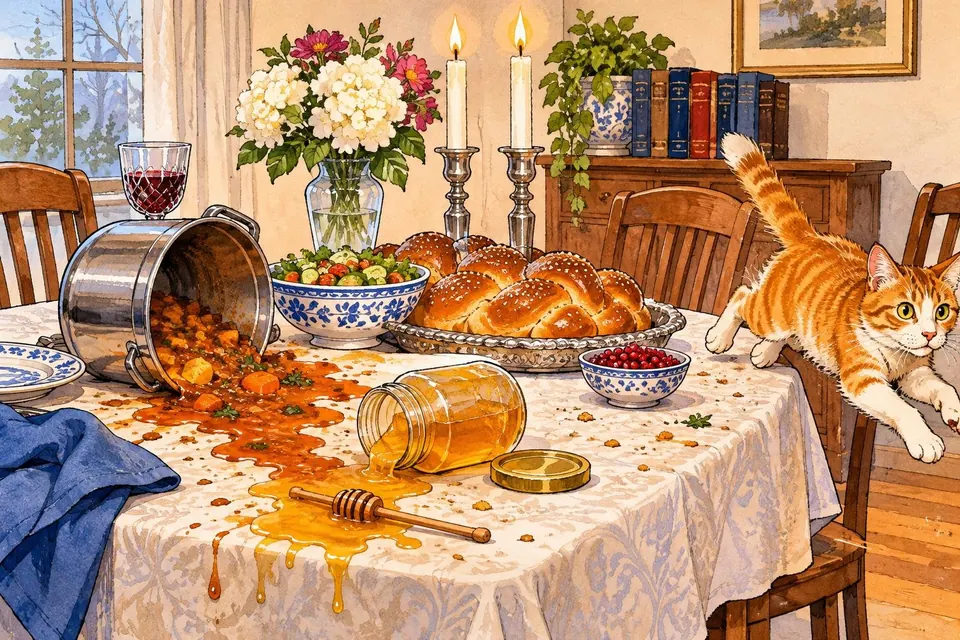
But she never reached them. In the darkness, she did not see the pool of oil from the candles. She slipped and fell, sending broken pieces of the plates and their contents flying across the room.
Hearing the crash, the rabbi hurried downstairs and helped his wife up.
“Dear wife, the main thing is not to get angry. Everything is for the best, so this must have been meant to happen. Look how luckily the pot fell: The meat didn’t spill out, so there’s no harm done. The main thing is not to get angry.”
Rachel took a deep breath, wiped her hands, and decided that she really should meet the test with dignity. Besides, who was there to be angry with? Herself? Her husband? Or the Almighty? After all, everything He does is for the best.
But the tests were not over. When Rachel bent down to feel for the unfortunate pot of meat, she let out an involuntary cry: Her hand had touched something furry. A second later, the couple saw a shadow running away as fast as it could. A cat, attracted by the delicious smell of the well-cooked meat, had slipped quietly into their little house through the unlocked door. It grabbed the largest piece, walked over the remaining food with its less-than-clean paws, and escaped before the stunned couple could do anything.
Rachel sank into a chair, exhausted, not knowing whether to laugh or cry. And once again the rabbi said:
“Dear, the main thing is not to get angry. Just don’t get angry, please! It’s no problem. We’ll take a little of the food you prepared for the second day of Rosh Hashanah and have our meal. Or we can just eat challah. All your challahs are so delicious—we’re sure to have enough. The main thing is not to get angry!”
At that meal there was no lamb’s head, no apples with honey, and no pomegranate—not a single one of the simanim that promise a good year. But there was the most important symbol of all: calm, mutual respect, and peace in the home.
“You won’t believe it,” Rabbi Fetaya would tell his children and grandchildren when he told them this story, “but never in my life, before or since, did I have such a fortunate and happy year as that one!”
Our Sages said that a home where wine flows like water will always be blessed [Eruvin 65a]. One explanation is that if someone spills expensive wine by mistake, the people in the house will not get angry, just as if it were water that had spilled.
Keep reading
More →What Is Elul and Why Is It Special?
The month of Elul invites us to draw closer to God through gratitude, Torah study, and repentance.

The King's Son and the Small House
Rosh HashanahThe Chafetz Chaim on Judging Others Favorably
The way we judge others can shape the way we are judged.
Rosh Hashanah“Restrain Your Voice From Weeping”: The Matriarchs’ Prayer
The stories of the matriarchs reveal the power of prayer born from suffering.







