Shavuot Laws and Customs: A Guide to the Holiday
A guide to the preparations, prayers, meals, and customs of Shavuot and the month of Sivan.
In brief
- Shavuot celebrates the giving of the Torah on 6 Sivan.
- The days leading up to the holiday are a time of preparation and Torah study.
- Customs include eating dairy foods and studying Torah throughout the night.
- Communities outside Israel observe a second day of Shavuot.
On 6 Sivan, the Jewish people celebrate Shavuot, the day the Torah was given. Mount Sinai was engulfed in fire, and the sounds of the shofar filled the world. The people standing at the foot of the mountain were overcome with awe. Their souls left their bodies, but at God's command, they returned.
Let us begin our discussion of the laws and customs of the day with a short story. A Jewish merchant once hired a Jewish wagon driver to take him and his goods to a fair in a large city. They agreed that if they arrived on time, the driver would be paid well, but if they were late, he would not receive a penny. The winter was especially harsh, a blizzard broke out, and the wagon was delayed. They arrived in the city very late, long after the fair had ended.
The merchant was upset and refused to pay. After such a long, difficult, and exhausting journey, the driver was not happy about going unpaid either. The two went to a rabbi for a ruling. After hearing both sides, the rabbi decided that the merchant was right and did not have to pay: an agreement was an agreement.
“Is that what the Torah says?” the driver asked.
“Yes,” the rabbi replied.
“And when was the Torah given?”
“In Sivan,” the rabbi answered.
“Well, if the Torah had been given in winter, when the roads are buried in snow and a blizzard is raging outside, it certainly would have ruled that the merchant has to pay me!”
The driver's frustration is understandable, as is his lack of knowledge. The Creator looked into the Torah and created worlds. The Torah has always existed and remains forever. It will not be changed or renewed. It contains answers to every question; it is perfect and boundless. Someone who can study and understand it fully can see everything clearly within it: what was, what is, and what will be. The destiny of each of us is recorded in the Torah in every detail. The Torah was given to us so that each of us could find true happiness and joy.
The Month of Sivan#
On the eve of the month of Sivan, prayer for children's success in studying and fulfilling the Torah has special power. This prayer is commonly attributed to Rabbi Isaiah Horowitz, a great Torah scholar and Kabbalist and the author of Shnei Luchot Habrit (The Two Tablets of the Covenant). According to some, the prayer is older, and Rabbi Horowitz, known as the Shelah, copied it and strongly recommended saying it regularly, especially before the new month of Sivan.
Beginning on 1 Sivan, one is obligated to study and review the laws of Shavuot.
The days from the beginning of Sivan until the holiday are a time of direct preparation for receiving the Torah. During these days, Tachanun (supplicatory prayers) is omitted from both Shacharit (the morning service) and Minchah (the afternoon service), and Yehi Leratzon (a prayer of acceptance) is not recited after the public Torah reading on weekdays. Some communities omit Tachanun through 12 Sivan, and everyone should follow their community's custom. This is because people who came to the Temple brought their festival offerings during the week after Shavuot, making these days special. Fasting and eulogizing the dead are forbidden on these days, except in the case of the death of a great Torah scholar.
On the Shabbat before the holiday, Av Harachamim (a memorial prayer) is recited even if a circumcision takes place in the synagogue that day. Tzidkatecha Tzedek (verses affirming God's justice) is omitted from Minchah that Shabbat. Vihi Noam (a passage beginning “May the pleasantness”) is omitted from Maariv (the evening service) at the end of Shabbat.
The three days before the holiday are called Yemei Hagbalah, the Days of Restriction. Before the giving of the Torah, our people prepared for this event by purifying and sanctifying themselves. Today, it is customary to devote ourselves especially to Torah study on these days.
The Eve of Shavuot#
For Shavuot, as for the other two regalim (pilgrimage festivals), Sukkot and Passover, a man is obligated to give his wife and children gifts that will bring them joy. It is customary to give especially generously to those in need before the holiday.
On the eve of Shavuot, bloodletting and medical intervention are forbidden if there is no danger to life. In years when Shavuot begins immediately after Shabbat, as it does this year, this precaution should also be observed on the Friday before the holiday.
As before any other festival, it is customary before Shavuot to get a haircut, cut one's nails, wash, immerse in a mikveh, and put on festive clothing. One should review the meaning of the prayers in advance and read books and articles that create an atmosphere suited to this great day. From approximately 3 p.m., it is forbidden to begin any substantial work or to hold a large meal.
In years when Shavuot begins immediately after Shabbat, as it does this year, someone who lies down to sleep during the day on Shabbat should not say that they want to rest so they will have the strength to study on Shavuot night. This would look like preparing for the festival on Shabbat, which is forbidden.
In years when Shavuot falls on Friday, anyone who plans to cook on the festival for Shabbat meals must make an eruv tavshilin (a food preparation that permits cooking on a festival for Shabbat). Before the festival begins, they take a whole loaf weighing at least 60 grams (about 2.1 oz) and a boiled egg or another cooked food weighing at least 30 grams (about 1.1 oz). They recite a special text, which they must understand, ending with the appropriate blessing. The text appears in prayer books. Someone who has not made an eruv tavshilin is forbidden to cook on the festival for Shabbat.
Someone who does not plan to cook on the festival for Shabbat must nevertheless make an eruv tavshilin to be permitted to light Shabbat candles at the end of Yom Tov, before sunset. In that case, they recite the eruv tavshilin text without the blessing. Those who do not cook on the festival for Shabbat and whose candles are lit by others do not need to make an eruv tavshilin at all.
On the eve of the festival, a 24-hour candle is lit in memory of deceased parents. If it is not difficult, one candle is lit for each deceased parent. Another candle is lit so that, if necessary, a flame can be taken from it, since it is forbidden to kindle a new fire on festivals. In years when Shavuot begins immediately after Shabbat, as it does this year, it is important to obtain candles that burn for two days for these purposes and light them before Shabbat begins.
Women say the blessing over candle lighting: “Blessed are You, Lord our God, King of the universe, who has sanctified us with His commandments and commanded us to kindle the Yom Tov light,” and light the festival candles. In many communities, women also say Shehecheyanu (the blessing for reaching a special occasion): “Blessed are You, Lord our God, King of the universe, who has granted us life, sustained us, and brought us to this time.” Some light the festival candles, like Shabbat candles, some time before sunset. Others always light Yom Tov candles after nightfall. In years when Shabbat begins immediately after Shavuot, the Shabbat candles should also be prepared before the festival so they will not need to be prepared on Yom Tov.
Laws and Customs of Shavuot#
The name Shavuot is connected with the completion of the count of seven weeks after the offering of the Omer (a measure of barley brought to the Temple). Shavuot means “weeks” in the holy language. The name is also connected to shvuot, meaning “oaths.” At the revelation at Sinai, God swore that He would never exchange the people He had chosen for another, and we swore that we would not be unfaithful to Him or worship anyone else.
The holiday is also called Atzeret, because many activities forbidden on Shabbat are forbidden on this day. Other festivals have additional mitzvot, such as shofar, sukkah, lulav, and matzah. On Shavuot, the only mitzvah is to refrain from certain activities forbidden on Shabbat.
Two other names for the holiday are the Festival of the Harvest and the Day of the Offering of the First Fruits of the New Harvest. The first refers to the wheat harvest, which is at its height in the Land of Israel at this time. The second refers to the two loaves baked from the new wheat harvest and brought to the Temple as a communal offering. It also refers to the bikurim (first fruits): beginning on Shavuot, the first wheat, barley, olives, grapes, figs, dates, and pomegranates of the new season were brought to the Temple.
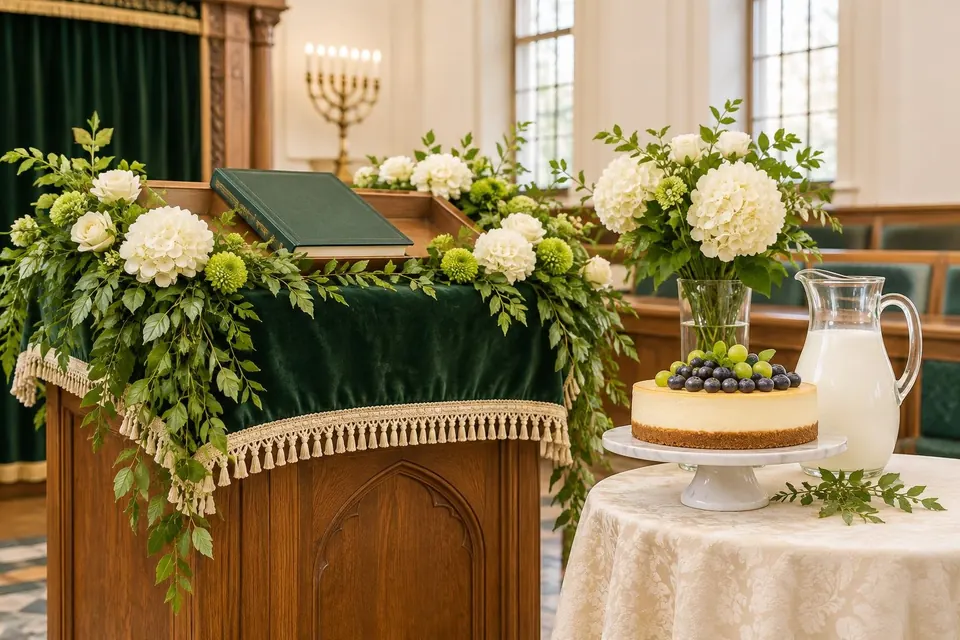
On Shavuot, it is customary to decorate homes and synagogues with flowers and tree branches as a reminder of the greenery that blossomed on Mount Sinai when the Torah was given. Some rabbinic authorities maintain that, because of certain circumstances, this custom was discontinued.
So that the count of the Omer will be complete, Ashkenazi communities customarily delay the Shavuot Maariv somewhat. Sephardim begin Maariv at the usual time. There is a mitzvah to add time from the weekday to the festival, but there is no special ceremony for accepting the festival as there is before Shabbat. Each person should therefore say, or at least think, that they are accepting the holiness of Yom Tov and the prohibition on work. This should be done at least 10–15 minutes before sunset. In years when Shavuot begins immediately after Shabbat, as it does this year, a special passage, Vatodienu (distinguishing the holiness of Shabbat from that of Yom Tov), is added to the Amidah.
After the evening prayer, people return home for a festive meal, preceded by a special Kiddush. It includes a blessing over wine, mentions the special character of the day, and includes Shehecheyanu. According to one opinion, a woman who said Shehecheyanu when lighting candles does not answer “amen” to that blessing during Kiddush.
In years when Shavuot begins immediately after Shabbat, as it does this year, the following blessing is recited during Kiddush after the blessings over wine and the festival: “Blessed are You, Lord our God, King of the universe, who creates the lights of the fire.” The text of Havdalah, separating the holiness of Shabbat from the holiness of Yom Tov, follows. Shehecheyanu is then recited.
On festivals, as on Shabbat, the blessing over bread is recited over two challahs. The upper challah is cut first. It is desirable to include meat dishes, not only poultry, in the festival meals. It is customary to drink wine. In Grace After Meals, recited after a meal with bread, Shavuot is mentioned in the passage Yaaleh Veyavo (a prayer asking God to remember us). If it was forgotten, Grace After Meals must be recited again. Another festival passage is added at the end of Grace After Meals.
There is a custom to eat dairy foods on Shavuot. The customary practice is to have meat meals in the evening and during the day, and to make a festive Kiddush in the morning and serve a dairy meal. Before eating, the following is recited: “These are God's appointed festivals, sacred gatherings that you shall proclaim at their appointed times. And Moses told the children of Israel about God's festivals” [Leviticus 23:4, 23:44]. Then the blessing is recited: “Blessed are You, Lord our God, King of the universe, who creates the fruit of the vine,” and a glass of wine or juice is drunk.
There are many explanations for the custom of eating dairy on Shavuot. The Torah is compared to milk and honey. It is also like a mother's milk, which changes as an infant grows. Similarly, a person of any age can find a depth of understanding in the Torah suited to their own “taste.”
After the Torah was given, restrictions concerning kosher food and utensils came into effect. The people's first meal was therefore dairy, made from what was entirely kosher. Today, a number of concerns prevent the use of dairy products made without special rabbinic supervision.
Another explanation is that white symbolizes purity and holiness. Milk, a child's food, suggests that a person should not be conceited, since humility is an essential condition for receiving the Torah.
Jochebed, Moses' mother, could not hide her child from Pharaoh's servants for more than three months. She made him a watertight cradle and set it on the waters of the Nile. Pharaoh's daughter found the child and decided to care for him. She turned to Egyptian wet nurses, but Moses would not drink their milk: a mouth that would one day speak with the Creator and transmit the Torah to the Jewish people could not take in impure milk. Pharaoh's daughter hired Jochebed to nurse Moses herself.
Moses was born on 7 Adar, so on 6 Sivan, the day the Torah was given, he drank his mother's milk. In remembrance of this, we too eat dairy foods. The Talmud and Midrash state that the 365 prohibitions correspond to the days of the solar year. Rabbi Chaim Vital notes that the prohibition against eating a mixture of meat cooked with milk corresponds specifically to 6 Sivan.
There is an ancient custom to study Torah throughout Shavuot night. Books teach that someone who studies Torah all night without any distraction will come to no harm throughout the year. A person who stayed up studying all night on Shavuot in previous years but cannot do so this year is not required to seek release from a vow.
Some study a specially compiled collection of passages from the Five Books of Moses, the Prophets, the Writings, the Zohar, the Mishnah, and the Talmud. Others make their own study program. Women are not obligated in the mitzvah of Torah study, and it is not customary for them to remain awake all night.
According to Kabbalah, marital intimacy on Shavuot night is undesirable unless immersion in the mikveh falls at that time. At dawn, one should wash one's hands immediately without reciting a blessing. Some immerse in a mikveh before Shacharit; according to Kabbalah, this is done before the first light of dawn.
An Ashkenazi who stayed awake all night and did not sleep during the preceding day does not recite the blessings over Torah study, the blessing for the return of the soul, Elokai Neshamah (“My God, the soul”), or the blessing for the end of sleep, Hamaavir Shenah (“Who removes sleep”). It is preferable to hear these blessings from someone who slept during the night and answer “amen.” The person reciting them must intend to say them on behalf of the listener as well, and the listener must intend to fulfill their obligation through them.
It is preferable to do the same for the blessing over washing hands. If this is not possible, the person may use the bathroom before prayer and recite the blessing over washing hands themselves. A member of a Sephardic community recites all the blessings as usual, even after remaining awake all night. The exception is the blessing over washing hands: they hear it from another person and answer “amen.”
Someone putting on a tallit gadol (a large prayer shawl) should intend the blessing over it to cover their tallit katan (a small fringed garment) as well. Those who do not put on a tallit gadol should hear the blessing from someone who does and intend it to cover their tallit katan.
Shacharit on Shavuot is recited as set out in prayer books and festival prayer books. After the Amidah, the complete Hallel (psalms of praise) is recited. In Ashkenazi communities, it is customary to hear Megillat Ruth, the Scroll of Ruth, before the Torah reading. If a kosher scroll is used, two blessings are recited before the reading: “Blessed are You, Lord our God, King of the universe, who has sanctified us with His commandments and commanded us to read the Scroll,” and “Blessed are You, Lord our God, King of the universe, who has granted us life, sustained us, and brought us to this time.”
The reader recites the blessings and should intend to say them on behalf of everyone. The listeners should know that the blessings are being said for them as well. The scroll tells the story of Ruth, the ancestor of King David, who was born and died on Shavuot.
There is another connection between the scroll and Shavuot. Through conversion, Ruth accepted the laws of the Torah, adding 606 commandments to the seven Noahide commandments she had observed until then. The gematria (numerical value of the Hebrew letters) of the name Ruth is 606. Similarly, the Jews who left Egypt became a new people, the people of the Torah, when they accepted the commandments at Mount Sinai. The Book of Ruth also mentions the harvest season, another connection to Shavuot, which, as noted above, is also called the Festival of the Harvest. Someone who did not hear Megillat Ruth is not required to find another minyan to hear it.
The ark containing the Torah scrolls is opened, and the Creator's Thirteen Attributes of Mercy are recited three times, followed by the prayer Ribono Shel Olam (“Master of the Universe”). Two Torah scrolls are taken from the ark. Five people are called to the first scroll, and the passage from Parashat Yitro describing the giving of the Torah is read (Exodus 19:1–20:26). In some communities, it is customary to stand when the Ten Commandments are read.
A sixth member of the congregation is called to the second scroll for the maftir (the final Torah reading), and the passage from Parashat Pinchas about the festival of first fruits is read (Numbers 28:26–31). This is followed by the haftarah (a reading from the Prophets), from Ezekiel 1:1–28, with Ezekiel 3:12 added. Shavuot is mentioned in the blessings after the haftarah.
In Ashkenazi communities, after the kohen, a priest, is called to the Torah and before the Torah reading begins, it is customary to recite Akdamut (a poem praising the Creator and the Torah). Before Musaf (the additional festival service), Yizkor, a special memorial prayer for the dead, is recited. For those who follow the custom of the Vilna Gaon, the psalm of the day is Psalm 19, which praises the greatness of the Torah.
Because King David was born and died on Shavuot, reciting Psalms on this day has a special effect. Books teach that someone who brings a Torah scroll into a synagogue on Shavuot is like someone who has brought an offering to the Creator at its proper time.
There is another mitzvah connected with the festival: visiting one's spiritual teacher.
The day after Shavuot is Isru Chag (the day following the festival). It is customary to wear festive clothing, hold meals, and rejoice on this day.
Shavuot in the Diaspora#
In communities outside Israel, where Shavuot is observed for two days, nothing may be prepared on the first day for the second. Even the candles for the second day may be lit only after nightfall.
Candles for both days of Shavuot should be prepared in advance so they will not need to be prepared on Yom Tov.
In years when the second day of Shavuot falls on Shabbat, the blessing at candle lighting is: “Blessed are You, Lord our God, King of the universe, who has sanctified us with His commandments and commanded us to kindle the light of Shabbat and Yom Tov.” In this case, Ashkenazi women say the blessing after lighting the candles. In such years, the third Shabbat meal is held after Minchah on the second day of Shavuot.
In the diaspora, where a second day of Shavuot is observed, there is no universal custom to study Torah on the second night of the festival. Nor is there a custom to eat dairy foods on the second day. Megillat Ruth is read on the second day. Akdamut is not recited on the second day. Yizkor, the memorial prayer for the dead, is recited on the second day of Shavuot.
There is also a public Torah reading on the second day. From the first scroll, a passage from Parashat Re'eh is read (Deuteronomy 15:19–16:17). Five people are called for this reading if the second day of Shavuot falls on a weekday, and seven if it falls on Shabbat. On Shabbat, the reading begins earlier, at Deuteronomy 14:22. From the second scroll, a passage from Parashat Pinchas is read (Numbers 28:26–31). The haftarah then follows, from Habakkuk 2:20–3:19, which describes the giving of the Torah.
When the second day falls on a weekday, those who follow the custom of the Vilna Gaon recite Psalm 68 as the psalm of the day.
May the Torah study, praises, and prayers offered to the Creator on this great day be pleasing to Him, and may the light of the giving of the Torah always illuminate the world from end to end!
Practical law. This page reports a ruling given for a specific question. For your own situation, ask a rabbi who knows you.
Keep reading
More →What Did Mount Sinai Add to the Israelites' Faith?
The revelation at Sinai brought Israel's faith to its fullest expression and established its trust in the Torah from Heaven.
ShavuotWhy Do We Count the Omer?
The counting of the Omer connects Passover and Shavuot, recalling both the Temple offering and the anticipation of receiving the Torah.
Guide · ShavuotShavuot Laws and Customs
- A Night of Torah
- Morning Blessings After a Sleepless Night
- The Tzitzit Blessing After a Sleepless Night
Is Shavuot a Men’s Holiday or for Women Too?
Receiving the Torah anew on Shavuot has meaning for both men and women.







