Why Do We Count the Omer?
The counting of the Omer connects Passover and Shavuot, recalling both the Temple offering and the anticipation of receiving the Torah.
In brief
- In Temple times, the Omer was a barley offering brought after the first day of Passover.
- The Torah commands a count from the time of the Omer offering until Shavuot.
- One explanation is that the count expresses anticipation of receiving the Torah.
- The essay sets out the laws and customs of counting, including what to do if a day is missed.
The Omer Offering#
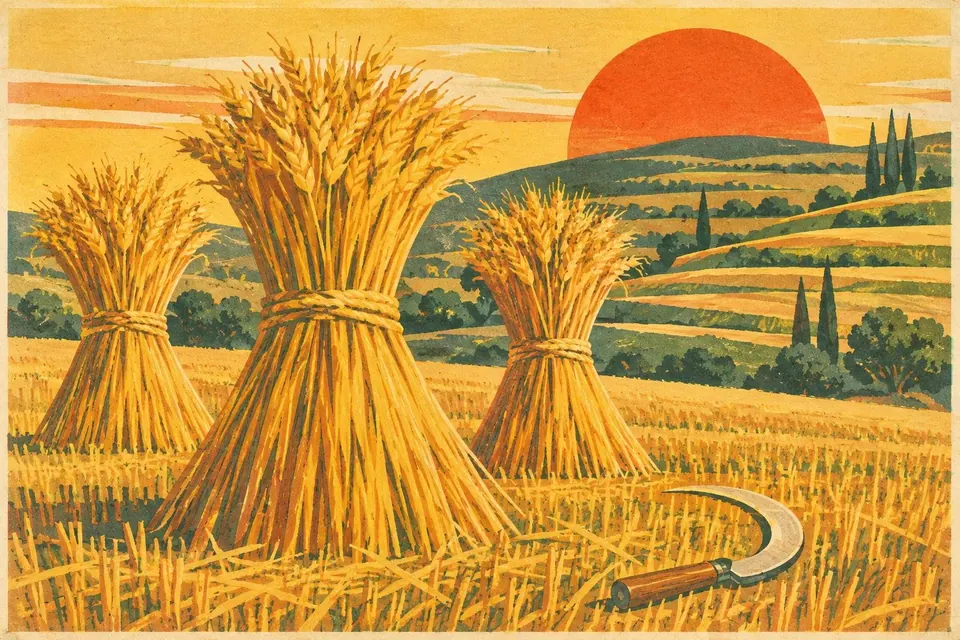
In the days of the Temple—both the portable sanctuary and the permanent Temple—Jews would go outside Jerusalem after the first day of Passover, on the night of 16 Nisan, to cut barley for the Omer meal offering. A large crowd would gather, whether it was a weekday or Shabbat.
They collected three seah, a measure of volume, of barley—approximately 42 liters (about 11.1 gallons), or 24.9 liters (about 6.6 gallons) according to other opinions. Three people cut the barley with three separate sickles and placed the stalks in three separate baskets. The baskets were brought to the Temple, where the barley was threshed, the grains were separated out and roasted over a fire, and then finely ground and sifted through 13 sieves.
From this choice flour they took an issaron, a measure also called an Omer, equivalent to 2.25 kilograms (about 5 pounds), or 1.666 kilograms (about 3.7 pounds) according to other opinions. The flour was mixed thoroughly with a log, a measure of volume, of olive oil: 0.6 cubic centimeters, or 0.3456 cubic centimeters according to other opinions. A little fragrant resin, levonah (frankincense), was then placed on top.
Standing beside the altar, a kohen (priest) moved the vessel containing the meal offering forward and back, right and left, and up and down. Some of the flour, together with the fragrant resin, was burned on the altar. The kohanim serving in that shift made flour products for themselves from the remaining flour.
Only after the Omer and the year-old ewe brought with it as a burnt offering were burned was it permitted to eat flour products made from the new crop. Today, when there is no Temple and no offerings are brought there, flour products made from the new crop may be eaten from the night of 17 Nisan.
Why We Count#
From the night when the barley for the Omer meal offering was cut until Shavuot, the Torah commands us to count each passing day aloud:
“You shall count for yourselves from the day after the Shabbat (the first day of Passover), from the day you bring the Omer of the wave offering (the movements in different directions made by the kohen holding the vessel containing the Omer meal offering): seven Shabbats (weeks) there shall be. Until the day after the completion of the seventh week, you shall count 50 days, and you shall bring a new offering to God” (Leviticus 23:15–16).
Some Torah sages maintain that even today, when the Omer is not offered, the mitzvah to count the days is a Torah obligation. According to the majority of opinions, counting the Omer is a mitzvah instituted by the Sages, and the law follows that view.
There are many explanations for the meaning of this mitzvah. The great service for which God brought the children of Israel out of Egypt was receiving the Torah. As we eagerly await that event, we count each passing day that brings us closer to the giving of the Torah (Maimonides (the Rambam), The Guide for the Perplexed, and Sefer HaChinuch).
Another reason, also given by Sefer HaChinuch, is that people working in the fields would know when Shavuot would arrive by counting each day. The count takes place at night, when they are no longer occupied with work (Shibbolei HaLeket, in the name of Rabbi Yehudah HaHasid).
Another explanation is that cleansing ourselves of the tumah, or spiritual impurity, of Egypt requires counting seven sets of seven days. As we find in the Torah, spiritual purification requires a cycle of seven. There are other beautiful explanations, but the foundation of this mitzvah, like all the others, is that we perform it because that is the Creator's will.
Who Counts and When#
The following are the basic laws of the counting of the Omer. Each person performs the mitzvah individually and must count for themselves each time. Someone who cannot count correctly should repeat word for word after someone who knows how, while understanding what they are saying.
Before counting each day, we recite the blessing: “Blessed are You, Lord our God, King of the universe, who has sanctified us with His commandments and commanded us to count the Omer.” Someone who cannot recite the blessing themselves should hear another person—a man over the age of 13—recite it, and need not repeat the words. The person reciting the blessing should have in mind that he is also saying it for the other person. The listener should pay careful attention to every word, intending to fulfill the blessing through it, and say “Amen” at the end.
Women are not obligated to count the Omer. In many communities, however, it is customary for women to count the days but not to recite the blessing. Ashkenazi women who are especially committed to the mitzvot and confident that they will not miss a day may count with a blessing.
It is customary to train children to count each day with a blessing. A boy who turns 13 during the Omer continues to count with a blessing, even though he was not previously obligated in this mitzvah by Torah law and had counted only under the Sages' enactment of mitzvat chinuch, training children to perform mitzvot. A person who converts to Judaism during the Omer counts without a blessing.
The count begins, as mentioned, on the night of 16 Nisan and continues until Shavuot, not including the festival itself: 49 days. The time for the mitzvah is from the appearance of the stars until dawn. As a general rule, a mitzvah should be performed as soon as the opportunity arises, so it would be right to count as soon as the stars appear.
In this case, however, the evening prayer, Maariv (also called Aravit), should be recited first, because a more frequent mitzvah takes precedence over one performed less often. It is therefore best to pray as soon as the stars appear and count the Omer after the prayer. Someone who usually prays at a fixed time may continue to do so throughout these 49 days and count after praying.
Someone concerned that they might forget to count after praying may count beforehand. Since those who pray without a minyan—a group of 10 adult men—are especially likely to forget, they should make some kind of reminder for themselves.
Speaking of the count of 50 days, the Torah says that there must be “seven complete weeks.” The Sages explain that “complete” means full: the days and weeks being counted should contain their full number of hours. For this reason, people try to count the first day of the Omer as close as possible to the appearance of the stars and to end the last day as late as possible, reciting the evening prayer of Shavuot a little later.
Outside Israel, the first day of the count falls on the second festival day of Passover, and it is usually counted during the second Passover Seder.
It is preferable to count with the community. In some communities, the count takes place at the end of the evening prayer, after the Kaddish known as Titkabel and before the Aleinu prayer. In others, the Omer is counted after Aleinu.
On Shabbat, in communities where the psalm LeDavid is recited at the end of the prayer, it is customary to count after that psalm.
Missed Counts and Daily Practice#
Someone who did not count at night for any reason should count during the day before sunset, even on the eve of Shabbat if they have already accepted the sanctity of Shabbat. They do not recite a blessing for that count. On the remaining nights, provided there has been no break in the count, they continue with a blessing.
If a person completely misses even one count—that is, they count neither at night nor during the day—they must continue counting on the remaining days without a blessing. In that case, it is desirable to hear someone else recite the blessing before counting. If there is doubt whether a day was missed, the person continues to count with a blessing. If someone is unsure whether they counted today, they should count without a blessing.
From half an hour before the appearance of the stars until one has counted the Omer, it is forbidden to eat a meal with bread or other baked goods or to engage in any activity, so as not to forget to count. If a meal or work was begun before that time, it may be continued as long as time remains to count. Someone who usually prays at a fixed time, or who has asked another person for a reminder to count, may eat and work even after the stars appear.
The blessing is recited each time before counting. If a person counted without a blessing, the mitzvah has nevertheless been fulfilled.
It is not customary to recite the Shehecheyanu blessing over counting the Omer: “Blessed are You, Lord our God, King of the universe, who has kept us alive until this time.” It is customary to recite the blessing for the count and count while standing. People who are ill or elderly and find it difficult to stand may recite the blessing and count while seated from the outset.
The count should follow immediately after the blessing, without an interruption. If someone spoke between the blessing and the count about matters connected with the mitzvah, they do not recite the blessing again. If they interrupted with unrelated conversation, they must recite the blessing again.
How to Count#
It is customary for the chazan (prayer leader) or the head of the community to recite the blessing and the count aloud, and then for each person to recite the blessing and count separately.
Some communities say laOmer, the wording used by the Arizal. For example: “Hayom shtayim veesrim yom, shehem shloshah shavuot veyom echad laOmer”—“Today is 22 days, which are three weeks and one day of the Omer.” Others say baOmer, the wording used by the Vilna Gaon. Some count the completed weeks before saying laOmer, and others do so afterward. On the first day, the word is specifically echad (“one”), not rishon (“first”).
Ideally, each person should try to follow the custom of their family or community. If someone made a mistake and said rishon instead of echad, laOmer instead of baOmer or vice versa, or counted the weeks before laOmer instead of afterward or vice versa, the mitzvah has nevertheless been fulfilled.
From the seventh day onward, it is customary to mention the number of completed weeks. Until the tenth day of the Omer, the Hebrew word for “days,” yamim, is said in the plural. Starting with the 11th day, the units are said before the tens, and the singular word for “day” is used: “Hayom shivah vearbaim yom”—“Today is 47 days …”
Someone who is unsure which day of the Omer it is should mention all the possible numbers, without a blessing. If the correct number was among them, they may continue counting with a blessing the next day. If they learn the correct day later that same day, they should count again with the correct number, but without a blessing.
Someone who did not state the total number of days of the Omer, but said only that today is a certain number of weeks and days, has fulfilled the mitzvah. Still, it would be right to count again properly, without a blessing. An exception is a day that completes a week, when there are no additional days—for example, “Today is four weeks of the Omer.” In that case, the mitzvah has not been fulfilled, and the person must count again, preceded by a blessing.
Someone who stated only the total number of days and did not mention the weeks has fulfilled the mitzvah. However, on days that complete a week—the seventh, 14th, 21st, and so on—there is a dispute about whether the mitzvah is fulfilled if the number of completed weeks is omitted. Therefore, the person must count properly again, mentioning both days and weeks, but without a blessing.
Before counting, one should not say which day of the Omer it is, so as not to lose the opportunity to recite the blessing over the mitzvah. Particular care is needed on Lag BaOmer: the day of the Omer appears in the name of this semi-festive day, and everyone is saying it that day. If someone who has not yet counted is asked which day it is, they should answer, “Yesterday was such-and-such a day,” without stating today's number.
One may count in any language one understands. Even someone counting in lashon hakodesh (the holy language, Hebrew) must understand the meaning of what they say.
Someone who counted silently in their thoughts has not fulfilled the mitzvah and must count aloud with a blessing.
Someone who wrote down today's Omer count must also count aloud, but without a blessing, because there is doubt whether writing the number fulfilled the mitzvah.
During the Omer, it is customary to note the day's count in correspondence (letters), either instead of the usual date or alongside it.
The Second Passover and the Hope for the Temple#
On 14 Iyar, we mark the Second Passover (Pesach Sheni), the day when, in Temple times, those who had not brought the Passover offering at its appointed time could make it up. Fasting is forbidden on this day, and many communities omit Tachanun (supplicatory prayers) from the morning and afternoon services. Some eat matzah in remembrance of the Passover offering, although leavened food is not forbidden.
After counting each day of the Omer, it is customary to ask that the Temple be rebuilt and its service restored. Then we will merit once again to perform the mitzvah of the Omer meal offering and count the Omer at a time when, according to all opinions, doing so fulfills a commandment from the Torah.
The Midrash relates that, through the merit of the mitzvah of the Omer—the meal offering and the counting of the days—our forefather Abraham and the children of Israel merited inheriting the Land of Israel. We pray that, through the merit of this great mitzvah, God will have mercy on us, gather us from the ends of the earth, and unite us in love and peace in the Holy Land. There, all the laws of the Torah will be observed in purity and joy, with the Temple and an anointed king from the house of David, when everyone will see the glory of the Creator and the whole earth will be filled with knowledge of His wisdom.
By Rabbi Leib Nachman Zlotnik
Practical law. This page reports a ruling given for a specific question. For your own situation, ask a rabbi who knows you.
Keep reading
More →What Did Mount Sinai Add to the Israelites' Faith?
The revelation at Sinai brought Israel's faith to its fullest expression and established its trust in the Torah from Heaven.
Guide · ShavuotShavuot Laws and Customs: A Guide to the Holiday
- The Month of Sivan
- The Eve of Shavuot
- Laws and Customs of Shavuot
Shavuot Laws and Customs
- A Night of Torah
- Morning Blessings After a Sleepless Night
- The Tzitzit Blessing After a Sleepless Night
Is Shavuot a Men’s Holiday or for Women Too?
Receiving the Torah anew on Shavuot has meaning for both men and women.







