A Home Open Like the Wilderness
A yeshiva student’s search for food leads to a lesson in Abraham’s hospitality.
In brief
- Abraham’s home was open to everyone, including people in need of food.
- Rabbi Abraham Yaffen’s home was similarly open to yeshiva students, though the family had little to eat.
- One night, the hungry students shared a jar of honey intended for Passover.
- Years later, when the narrator apologized, the rabbi’s wife insisted that she was the one who owed an apology.
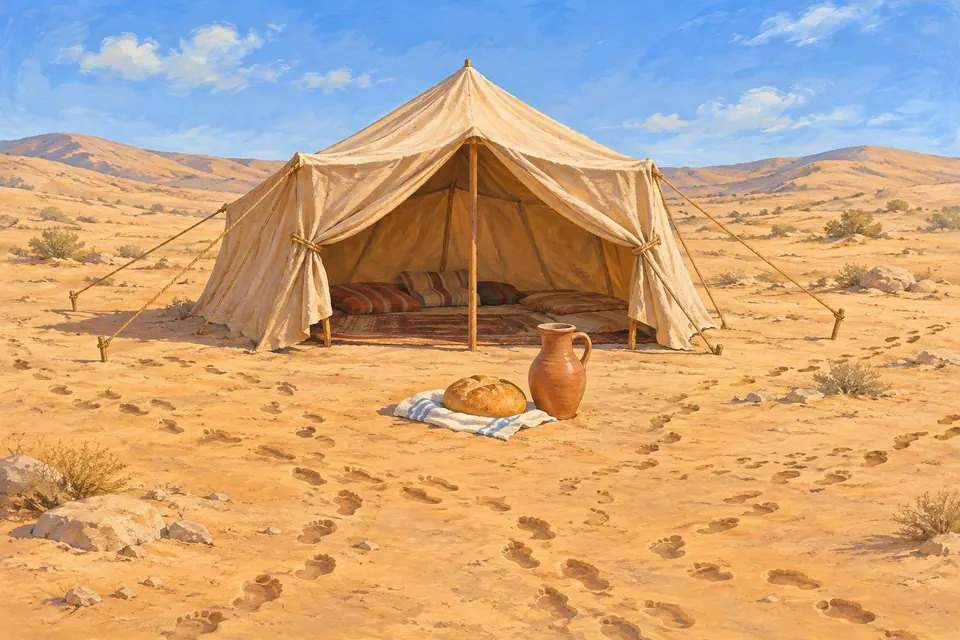
The Talmud compares the home of our forefather Abraham to the wilderness: just as the wilderness is open to everyone, so was his home. Rashi explains that it was open to the poor, so they could eat there. This is one of the ways in which “a person must ask himself: When will my deeds reach the level of the deeds of my forefathers Abraham, Isaac, and Jacob?”
I knew such a home, and I was even treated as one of the family there. It belonged to Rabbi Abraham Yaffen, the head of the Novardok yeshiva in Bialystok and a great Torah scholar. True, they did not feed us tongue seasoned with mustard, because he had no oxen. There was no butter or milk either—and who even dreamed of butter? There was barely enough bread. But whatever they had was like the wilderness, open to everyone. The boys slept in the living room, the hallway, and the children’s room. They ate at his table as if they belonged there and went into the kitchen as if it were their own.
In winter, Shabbat began at 2:30. By five we had finished our meager meal: a piece of challah and a fish patty. From then on, we had to go hungry until lunch the next day, when we got another piece of challah. Some of the boys discovered that the Anshei Mishmar synagogue offered Torah classes all night: classes on the Talmud, the Mishnah, and the weekly Torah portion. Between classes, they handed out tea and a piece of cake—a real treasure! But the synagogue was small, and there were many people studying there. How many yeshiva boys could join them and enjoy both Torah and the pleasures of this world? And what about everyone else?
One night at ten, the head of the yeshiva gave a class in his home. He lifted us to the greatest heights of Torah. But when the class ended, our empty stomachs reminded us they were there. My friends looked at me. “Yankel, think of something!”
I went into the kitchen and searched every corner—and I found something! I set challah and a small jar of honey before them. How happy we were! As it says in Psalms, “He saw how hard their plight was when He heard their joyful song” [Psalms 106:44]. When you hear what makes people happy—a piece of challah and a drop of honey—you understand how hard their lives are, how poor they are.
Later I learned that the rabbi’s wife had turned the house upside down looking for the jar of honey. It was meant for the mead they brewed for Passover, and now it was gone. My heart sank, and I waited for a chance to confess and apologize. But the chance never came. In the meantime, war broke out, and we were driven farther and farther away until we found ourselves in Siberia, where life hung by a thread. I told myself that if I was fortunate enough to survive, I would certainly ask her forgiveness.
And I did survive! I made my way to Uzbekistan, then to Germany, and finally to the Land of Israel. In 5711 (1951), Rabbi Yaffen and his wife came for a visit. We former students gathered, and the head of the yeshiva asked each of us in turn to speak and offer suggestions for rebuilding the network of Novardok yeshivas, this time in the Holy Land. When my turn came, he announced, “Let’s hear what Yankel from Krynik has to say.” I stood up and said, “First of all, I have to apologize.” The rabbi’s wife was sitting on a couch in the corner of the room, listening to the speakers. I confessed that the jar of honey had disappeared because of me.
Suddenly, she stood up, speaking for the first time. Her eyes flashed, and we were all astonished. “You have to apologize?! We’re the ones who have to apologize! When yeshiva students are hungry, how can we keep a jar of honey? We gave you everything we had, and we hid a jar of honey? I should have given it to you myself! I’m the one who has to ask forgiveness!”
That is a home like the wilderness!
By Rabbi Yaakov Galinsky
Keep reading
More →Vaera: The Soccer Player and the Magician
A story about a soccer player helps explain why seeing something can affect us more deeply than knowing it.
CharacterLashon Hara and Free Speech: Life and Death in the Tongue
Jewish teachings on the power of speech challenge us to consider how we use our words.
ParashaBehaalotecha: What Makes a Response to Tragedy Cruel?
Maimonides calls it cruel to dismiss communal tragedy as simply part of life.
ParashaKorach: Who Wins an Argument?
Moses’ response to a painful accusation offers a lesson in walking away from conflict.







