A Lesson in Respect From the Chazon Ish
Rabbi Yaakov Galinsky recalls how a visit to the Chazon Ish helped a yeshiva student understand the importance of Torah study.
In brief
- Rabbi Galinsky invited a student who talked during study to spend Shabbat with him.
- The student was deeply moved to receive a blessing from the Chazon Ish.
- Rabbi Galinsky used the encounter to help him appreciate God’s presence during Torah study.
- He explained that concrete examples can help us understand spiritual ideas.
Parashat Yitro#
Today, thank God, what a wonderful generation we have. Look at the yeshiva students and the young men studying in kollels (study programs for married men). They are pure gold. It is hard to believe that not so long ago, when I headed a yeshiva in Hadera, we had to deal with problems like these.
We brought in the children of new immigrants who knew very little Torah. One young man, for example, thought nothing of starting a conversation about the latest news with his study partner in the middle of a study session. I know how terrible it sounds to disregard so casually the law in the Shulchan Aruch: “In a house of study, it is forbidden to talk about anything other than Torah.” But it happened.
The question was what to do. He was doing something wrong himself, leading his study partner astray, and creating a frivolous atmosphere in the study hall. The Jerusalem Talmud (Taanit 3:10) says that someone who did this was subject to excommunication from the community. But our teachers teach us to take a different approach.
Inviting Him for Shabbat#
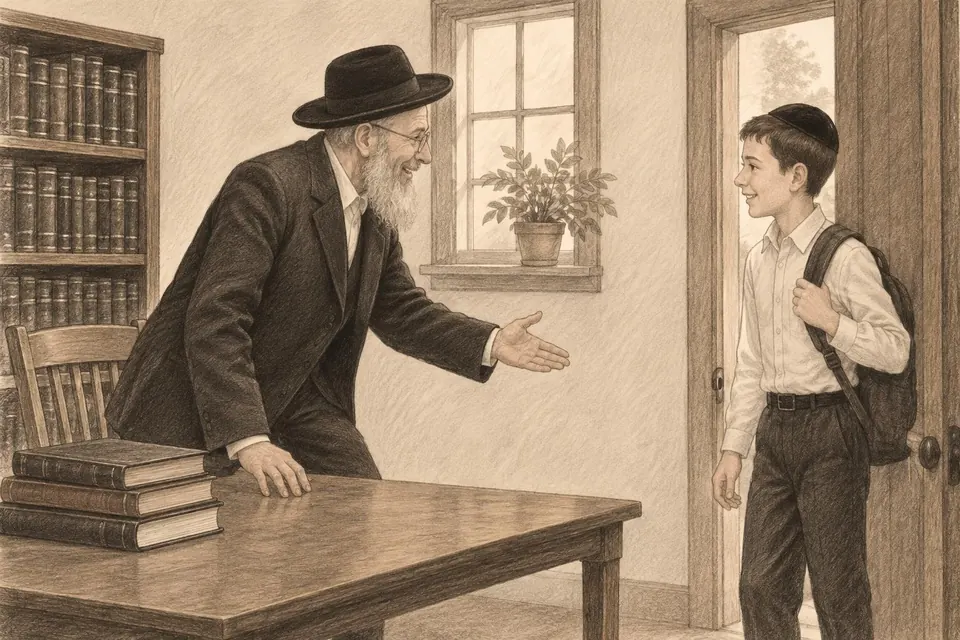
So I called the young man over and said, “On Thursday evening, I’m going home to Bnei Brak. I’d like to invite you to spend Shabbat with me.” He was delighted.
We set out, and I told him, “On Fridays, I say the afternoon prayer at the Chazon Ish’s home. If you’d like, come with me. I’ll introduce you, and you can ask him for a blessing.” He was deeply moved and excited.
Then I added, “Sometimes he asks what you’re studying and what you’ve learned recently. Don’t be afraid; it’s not a test. He never tries to catch anyone out for not knowing something. Still, let’s sit down beforehand and study the passage of Tosafot—the Talmud commentaries—that you’re studying in yeshiva. I have a wonderful insight into it, so if he asks, you’ll be ready.”
He agreed, though he was a little apprehensive. We spent three wonderful hours studying. He reviewed the subject thoroughly. He was a talented young man, and he understood the argument in the Tosafot passage they were studying in yeshiva, the question it raised, and the answer it offered. By the end, he was eager to explain what he had learned.
We went to the Chazon Ish’s home, and after the prayer I introduced the young man to the rabbi. The Chazon Ish greeted him warmly and asked where he was from, whether he was studying well, and whether he liked the yeshiva. He did not question him about what he had learned.
I said, “Rabbi, he would like a blessing.” The Chazon Ish smiled and blessed the young man.
On our way home, he was so excited that it was impossible to have a conversation with him. He had met a rabbi who was like an angel and received his blessing.
On the Way Back#
We had a wonderful Shabbat, and on Sunday we set out for the yeshiva. On the way, I said to him, “You know, at first I wanted to invite both you and your study partner for Shabbat. I thought you’d enjoy yourselves more together. I could see that you got along well.
“But then I thought you’d surely want to pray with the Chazon Ish and receive his blessing. And just as you were standing before him and he reached out his hand to bless you, you’d remember some interesting news and turn to your friend to tell him. Well, it wouldn’t be right to embarrass the leader of the generation just as he wanted to bless you.”
The young man looked at me indignantly. How could I suspect him of such a thing?
I quickly reassured him. “Of course I wasn’t serious. I know I could never suspect you of behaving that way. But understand: I see you sitting and studying the Talmud. And thank God, you have talent. We studied so well together on Friday.
“Yet there you are, sitting and studying, when suddenly you turn to your study partner and start chatting about unrelated things. And I remember the words of the Mishnah (Avot 3:6): How do we know that even when one person sits and studies Torah, the Shechinah—God’s presence—is with them? From what is said in the portion of Yitro: ‘In every place where I permit My name to be mentioned, I will come to you and bless you’ [Exodus 20:24].
“Now imagine: You are studying, and through your study, you are, as it were, bringing the Shechinah close to you. As Tanna Devei Eliyahu Rabbah 18 says, when a Torah scholar sits and studies, reviews, and engages with Torah, God, as it were, sits opposite him, studying and reviewing with him. And then, ‘I will come to you and bless you.’ God comes and wants to bless you, and you turn to your study partner and start chatting.
“Well? You wouldn’t dare treat the Chazon Ish that way, but you can treat God that way?”
Honoring Shabbat Through Imagination#
Where did I learn that this is the way to persuade and influence a person? From the Talmud.
Shabbat 119a tells how our teachers prepared to welcome Shabbat. Among other things, it describes how Rav Nachman bar Isaac personally carried items, dishes, food, and the like. He said, “If I were preparing for my teachers, Rabbi Ami and Rabbi Asi, to visit me, wouldn’t I make an effort in their honor and carry things for them?”
The Elder of Kelm asks in Chochmah UMussar (1:163): How can respect for Rabbi Ami and Rabbi Asi serve as proof of the respect due to Shabbat? On the contrary, isn’t it a disgrace to Shabbat to learn how to honor it from the honor due to the Sages?
The answer is that honoring Shabbat is an abstract idea, something we cannot touch. We have no choice but to use our imagination, drawing on something real and familiar. Similarly, Rabbi Yochanan ben Zakkai explained his fear of the Heavenly Court by comparing it to the fear people feel before a king of flesh and blood and his court [Berakhot 28b].
We, too, should ask ourselves: If a great righteous person wanted to bless us, would we let ourselves be distracted by unrelated conversations? Yet when a person studies Torah, God Himself comes to bless them.
Let us try to study diligently, and we will be blessed from Above. May what is said in Psalms (109:17) not, God forbid, come true for us: “He did not desire blessing, and it remained far from him.”
By Rabbi Yaakov Galinsky
Keep reading
More →Vaera: The Soccer Player and the Magician
A story about a soccer player helps explain why seeing something can affect us more deeply than knowing it.
CharacterLashon Hara and Free Speech: Life and Death in the Tongue
Jewish teachings on the power of speech challenge us to consider how we use our words.
ParashaBehaalotecha: What Makes a Response to Tragedy Cruel?
Maimonides calls it cruel to dismiss communal tragedy as simply part of life.
ParashaKorach: Who Wins an Argument?
Moses’ response to a painful accusation offers a lesson in walking away from conflict.







