What Does Jewish Law Say About Kindness to Animals?
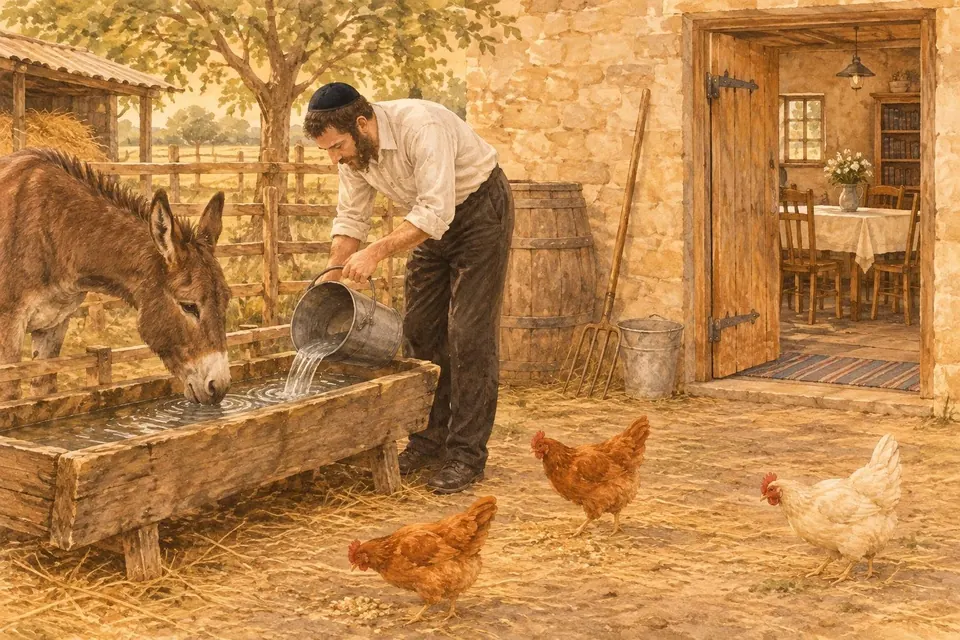
The Torah’s commandments and Jewish law teach compassion for animals while recognizing their use for human needs.
In brief
- The Torah teaches people to imitate God’s compassion for all His creatures.
- Many commandments have been understood as lessons in kindness toward animals.
- Causing animals needless suffering or killing them without benefit to people is forbidden.
- Using animals for human needs is generally permitted, subject to conditions and limitations.
Walking in God’s Ways#
The Torah gives us an extraordinarily honored and lofty task: “You shall walk in His ways” (Deuteronomy 28:9). Our teachers derive from this an obligation to imitate the virtuous ways in which the Creator governs the world (Maimonides, Laws of Character Traits 1:5). One of those qualities, without which our world could not exist, is compassion. The Creator extends His compassion not only to people but to all His creatures, as it says: “God is good to all, and His compassion extends to all His works” (Psalms 145:9). The Sages of the Talmud say that anyone who shows compassion to the Creator’s creatures will receive compassion from Heaven (Shabbat 151b). Someone who truly loves God cannot help but love His creatures (the Maharal of Prague, Netivot Olam, Netiv Ahavat HaRea 1).
It is hard to overstate the importance of the obligation to treat people with compassion. The Torah expresses this obligation in the general commandment, “Love your neighbor as yourself” [Leviticus 19:18], and it is put into practice through many more specific mitzvot. Compassion for animals certainly cannot be compared with this area of mitzvot, nor can it come at the expense of compassion for people. At the same time, the fullness of a person’s compassion is reflected in their pity and care for all living things.
In this article, we will touch on some of the many mitzvot and laws that require us to treat animals compassionately. Many of the mitzvot we discuss are chukim: commandments for which there is no rational explanation. We are obligated to keep them simply because Divine Wisdom has commanded them. Even so, Torah scholars throughout the centuries have sought moral lessons even in chukim, without allowing their explanations to limit how the commandments are observed.
Do Not Muzzle an Ox While It Threshes#
The Torah prohibits preventing an animal used for threshing from eating grain while it works (Deuteronomy 25:4). Our teachers explain that through this commandment, God wants to teach us to be kindhearted and humane. By learning to have pity on animals, we become sensitive and responsive to people as well, developing a desire to give, help, express gratitude, and repay kindness (Sefer HaChinuch 596). Some Torah scholars derive the prohibition against causing animals suffering from this commandment (Shitah Mekubetzet in the name of the Raavad, Chidushei HaMeiri, and Ashlamah on Bava Metzia 32b; Moshav Zekenim LeBaalei HaTosafot on Deuteronomy 25:4).
Unloading an Animal Under Its Burden#
The Torah says: “If you see the donkey of someone who hates you lying under its burden, do not leave him unaided; you must help him release it” (Exodus 23:5). This mitzvah contains the foundations of great moral principles: overcoming negative feelings toward someone you hate and being willing to help that person. These words also contain an obligation to free animals from situations in which they are suffering physically. The mitzvah teaches us compassion and mercy toward all living things (Sefer HaChinuch 80). Some commentators consider this the source of the prohibition against causing animals suffering (Rashi on Shabbat 128b; Rabbeinu Nissim on Bava Metzia 32b).
Helping Load an Animal#
If someone sees another person about to load a donkey, the Torah requires them to help (Deuteronomy 22:4). The primary purpose, of course, is to help the other person, but that is not the only purpose. The act also expresses concern for the animal: when the load is held from both sides and distributed evenly, loading causes the animal less discomfort and pain (Bava Metzia 30a; Orchot Tzadikim, Shaar HaRachamim; Sefer HaChinuch 540; Shitah Mekubetzet in the name of the Ritva on Bava Metzia 30a).
What happens when two people need help at the same time, one loading an animal and the other unloading one? The law says to unload first, because doing so relieves the animal’s suffering.
An Animal and Its Young#
The Torah says: “You shall not slaughter an ox or a sheep and its offspring on the same day” (Leviticus 22:28). Commentators consider one of the revealed purposes of this commandment to be cultivating compassion and uprooting cruelty (Nachmanides on Deuteronomy 22:6; Sefer HaChinuch 294).
Meat and Blood#
From the Torah’s words, “Do not eat the life with the meat” (Deuteronomy 12:23), we learn that it is forbidden to eat parts cut from an animal before kosher slaughter, or shechitah. From the words in Leviticus, “Do not eat with the blood” (Leviticus 19:26), we derive a prohibition against eating parts of an animal before it has died, even if it has already undergone shechitah (Maimonides, Laws of Slaughter 1:2). [For the sake of accuracy, Rashi (Chullin 121b) considers this a rabbinic prohibition: the Sages treated eating parts of an animal before it dies as comparable to eating its limbs before shechitah.]
With the words “You shall not eat any blood” (Leviticus 7:26), the Torah prohibits eating blood. Some teach that these Torah instructions call on us to distance ourselves from cruelty and callousness toward animals, and all the more so toward people (Sefer HaChinuch 452).
Other Commandments of Compassion#
We will briefly list several more commandments that Torah scholars connect with the prohibition against causing animals suffering.
“If you come upon a bird’s nest along the way, in a tree or on the ground, with chicks or eggs, and the mother is sitting on the chicks or the eggs, do not take the mother together with the young” (Deuteronomy 22:6). Commentators write that animals suffer when their young are taken before their eyes (Nachmanides on Deuteronomy 22:6; Sefer HaChinuch 545). Therefore, the Torah commands us to send the mother away before taking the chicks or eggs (Deuteronomy 22:7).
When an animal is killed for food or as an offering to God, a comparatively painless method, shechitah, is used. It is forbidden to slaughter animals for offerings in a place not designated for that purpose, because doing so makes them unfit, and killing animals for no purpose is forbidden (Leviticus 17:3–5; see Sefer HaChinuch 186). [In addition, someone who needlessly destroys animals violates the Torah’s general prohibition against destroying usable things, bal tashchit (Deuteronomy 20:19).] An animal may not be offered as a sacrifice until seven days have passed since its birth (Leviticus 22:27; see Pesikta Rabbati 1:1).
We must allow our animals to rest on Shabbat (Exodus 23:12). We may not begin a meal before feeding our animals (Deuteronomy 11:15; Berakhot 40a). When plowing, it is forbidden to harness two or more different species of animals to the plow together (Deuteronomy 22:10).
[The author of Sefer HaChinuch (550) writes that this commandment is entirely connected to the prohibition against causing animals suffering. He explains that close contact with other species causes animals great distress. Some explain that if one animal chews its cud and the other does not, the latter is constantly envious, thinking that its “partner” is always eating because it is always chewing, while it is given nothing. Other commentators explain that when different species are harnessed together, the work is distributed evenly, placing an extremely heavy physical burden on the weaker animal and, of course, causing it suffering.]
According to various Torah commentators, all these commandments convey the idea of treating animals compassionately.
Additional Sources#
We know that an angel rebuked Balaam for mercilessly beating his donkey when she refused to carry him to Moab, where he intended to curse the Jewish people (Numbers 22:32). Some of our teachers derive from this an obligation to treat animals with kindness and compassion and a prohibition against causing them pain and suffering (Maimonides, Guide for the Perplexed 3:17; Sefer Chasidim 666). [Since the source of the prohibition concerns a non-Jew, it follows that the prohibition against tormenting animals also applies to people of other nations.]
Other Torah scholars derive the obligation to treat animals compassionately from the story of the miracle in which God gave water to thirsty people in the wilderness (Yom Teruah on Rosh Hashanah 27a). Scripture emphasizes, for a reason, that not only the people but also their livestock benefited from this great miracle (Numbers 20:8).
Some consider the source of the obligation to treat animals compassionately to be the verse in Psalms: “God is good to all, and His compassion extends to all His works” (Psalms 145:9; Chatam Sofer on Bava Metzia 32a).
We should also take into account that, in theory, any animal may contain the soul of a person who once lived and whose soul entered the animal to complete its mission in this world. Thus, by causing an animal suffering, one might unintentionally cause suffering to a human soul (Radbaz 302; see also Sefer Charedim, which tells of a Spanish Jew whose father appeared to him in a dream and asked him to buy a bull from the organizers of a bullfight, because his father’s soul had entered it after his death).
Stories of Compassion#
The Talmud tells of a calf being led to slaughter that broke away from its drivers, ran to Rabbi Yehudah HaNasi, and buried its head in his clothing, lowing plaintively as though asking him to spare its life (Bava Metzia 85a; see Tomer Devorah, chapter 3). Rabbi Yehudah did not protect the calf. “Go,” he told it, “for this is what you were created for.” Because this treatment of the animal did not befit his high spiritual level, Rabbi Yehudah was sent terrible physical suffering from Heaven. Some time later, he saw his housekeeper preparing to sweep away newborn rat pups. He took pity on them and asked her to leave them alone. The punishment was lifted, and the great righteous person and Torah sage immediately stopped suffering.
Our teachers tell of an occasion when the great Kabbalist the Arizal noticed that his student’s face was clouded by the shadow of a sin, and that it was connected to a violation of the prohibition against causing animals suffering (Sefer Charedim, Mitzvot Aseh Min HaTorah HaTeluyot BaVeshet 4:1). He told the student, who asked his wife about it and discovered that she did not prepare food for their domestic birds, but let them out to find food for themselves. He asked his wife to prepare food for the birds every day. Soon afterward, the Arizal brought his student the happy news that the sign of sin had disappeared.
The Midrash relates that Moses and King David proved they were ready to lead the Jewish people through the care they showed the flocks entrusted to them (Shemot Rabbah 2:2).
Using Animals for Human Benefit#
God placed the world and everything in it entirely at humanity’s disposal, as it says: “Let them rule over the fish of the sea, the birds of the sky, the livestock, the whole earth, and every creeping thing that moves on the earth” (Genesis 1:26; see the Malbim and Emek HaDavar on Genesis 1:26). There is a reason for the familiar expression, “Humanity is the crown of creation.” Scripture says: “You gave him dominion over the works of Your hands; You placed everything beneath his feet: all sheep and cattle, and also the beasts of the field, the birds of the sky, and the fish of the sea, all that travel the paths of the seas” (Psalms 8:7–9).
In the Holy Tongue, an animal is called behemah, while a raised platform is called bimah. Our teachers see in the relationship between these words a hint that animals were created so that, with their help, people could grow and rise spiritually, directing all their aspirations and strength toward serving the Creator (Rabbi Samson Raphael Hirsch on Genesis 1:25).
Using animals for human benefit is not only permitted; it also fulfills a higher design in which every creature has its role (Kiddushin 82a). God created a world in which an enormous number of elements exist in precise order and absolute harmony. This remarkable unity is indisputable evidence of the Creator’s dominion over the world and sings the praises of His power and glory. Organic compounds nourish plants, plants feed animals, and people in turn use animals for their needs. People themselves fulfill the Creator’s will by doing what is good and just. This is the meaning of the phrase: “God placed Adam in the Garden of Eden to work it and guard it” (Genesis 2:15). Someone who faithfully fulfills their mission therefore dwells in the Garden of Eden—a garden of light and well-being—without leaving this world.
Selected Laws#
Killing Animals and Causing Them Suffering#
Killing animals or causing them suffering when there is no benefit to people is unequivocally forbidden.
[The authorities disagree about whether causing animals suffering is prohibited by the Torah or by rabbinic decree. According to the Rif, Maimonides (Laws of Yom Tov 3:4), Nachmanides (on Shabbat 154b and Genesis 1:29), the Rashba (on Bava Metzia 33a), and others, it is prohibited by the Torah. Yereim (352), Mordechai (Avodah Zarah, chapter 1, 799), Pnei Yehoshua (on Bava Metzia 33a), Or Sameach (Laws of Shabbat 25:26), and others consider it a rabbinic prohibition.
It is interesting to note that the author of Pri Megadim (Eshel Avraham, Orach Chaim 308:8) writes that, on Shabbat, causing an animal suffering is forbidden by the Torah according to all opinions, since it says, “So that your ox and your donkey may rest” (Exodus 23:12). Many commentators (Tal Torah on Shabbat 154b; Imrei Yosher, part 3, 18; Levushei Mordechai; and others) write that this assertion appears to conflict with the opinion of Rabban Gamliel cited in Shabbat 154b, according to which causing animals suffering, even on Shabbat, is prohibited by the Sages rather than by the Torah. They answer that the Torah prohibits causing one’s own animal suffering on Shabbat, while causing someone else’s animal suffering is prohibited by rabbinic decree. Rabban Gamliel was speaking about an animal that did not belong to a particular person.
According to the authors of such authoritative works as HaEshkol (Laws of Slaughter 10), Noda BiYehudah (Yoreh De'ah 10), and others, killing animals is not included in the prohibition against causing them suffering. According to the Ri Migash (cited in Shitah Mekubetzet on Bava Batra 20a), Shoel UMeshiv (part 3, 25), and others, it is included. Sheilat Yaavetz (part 1, 110) states that according to Kabbalah, it is forbidden to destroy animals of any species. Whether an animal may be killed to end its suffering is not a simple question and requires detailed consideration in each individual case.]
Using animals for human needs is generally permitted, even when it involves causing them suffering or taking their lives (Terumat HaDeshen 105; Sefer HaChinuch 586; Shulchan Aruch, Even HaEzer 5:14). But if the desired result can be achieved without causing the animal suffering, or with less suffering, one must do so. Using animals in ways that are not normally used for the purpose in question and that involve suffering or death is generally forbidden. In any case, before using such methods, one must consult a competent rabbi.
The prohibition against causing animals suffering and destroying them without cause applies to every species, including insects.
The prohibition against causing animals suffering applies both to their owners and to other people, and it also includes animals that belong to no one.
It is forbidden to cause animals suffering directly or indirectly; personally or through others; by hand or with objects; through action or through inaction, such as failing to provide food, access to air, or heat.
Relieving an Animal’s Suffering#
When someone encounters an animal that is suffering—for example, a kitten trapped in a pit or a bird unable to fly out—they should take steps to relieve its suffering (Beitzah 30b). Alongside the natural feeling of pity, one should remember that this fulfills an important Torah commandment: measure for measure, God protects those who care for His creatures. Of course, it is forbidden to allow children to throw stones at animals or cause them suffering in other ways. If rescuing an animal would compromise a person’s dignity, there is no obligation to rescue it (Rabbeinu Nissim on Bava Metzia 32b).
A number of requirements apply during shechitah. An animal should not see other animals being slaughtered. When an animal is laid on the ground before shechitah, it should be done very carefully so as not to cause it needless suffering. When animals are killed for purposes other than food, the least painful method should be chosen (Shevut Yaakov, part 1, 110).
This subject also touches on several Shabbat laws. Tiltul muktzeh, moving an item that may not ordinarily be moved on Shabbat, can arise, for example, when moving an animal that is muktzeh to relieve its suffering (see Shulchan Aruch, Orach Chaim 308:40). Tircha yeterah, excessive exertion, can arise when feeding someone else’s animals or ownerless animals that are clearly suffering from hunger (see Avnei Yashpeh, Orach Chaim 88), helping an animal give birth, or providing other medical care (see Aruch HaShulchan, Orach Chaim 332:2, and Tehilah LeDavid 332:1).
Bitul keli meheichano, making an object unavailable for its permitted use, can arise when placing objects under the feet of an animal that has fallen into a pit so it can climb out, even though the objects then become forbidden to move. Another example is placing objects beneath a fragile muktzeh load that must be removed from an animal because its weight is causing the animal suffering. Amirah leakum, asking a non-Jew to perform an otherwise prohibited act, can arise when asking a non-Jew to milk an animal on Shabbat or a festival if the animal is suffering from not being milked. If no non-Jew can be found, a Jew may milk the animal on condition that the milk goes to waste (see Shemirat Shabbat Kehilchatah 27:48–49).
Leniencies exist in the cases listed when the purpose is to reduce an animal’s suffering. In each individual case, a competent rabbi should be consulted for further guidance.
The Shehecheyanu Blessing#
As a compassionate creature, a person cannot rejoice in the death of a living being. Therefore, although the Shehecheyanu blessing is generally recited over new clothing—“Blessed are You, God, our God, King of the universe, who has kept us alive, sustained us, and brought us to this time”—it is not recited over clothing made of genuine leather, for which an animal had to be killed.
Feeding Animals Before Eating#
A person may not eat before feeding the animals for whose nourishment they are responsible, including pet birds and fish (Shevet HaKehati, part 6, 112; Deuteronomy 11:15; Berakhot 40a). [Some authorities, including Maharam of Rothenburg (part 4, 302) and Magen Avraham (Orach Chaim 271:12), consider this a Torah requirement. Other authorities, including Pri Chadash (Orach Chaim 66:9), Shevut Yaakov (part 2, 13), and Biur Halacha (167:6), consider eating before feeding an animal a rabbinic prohibition. According to a third opinion, it is worthy conduct but not an obligation (Maimonides, Laws of Slaves 9:8).]
If an animal finds its own food, or if its owner has appointed someone to feed the animals and provided everything needed to do so, the owner may eat before the animals are fed (Yad Ephraim, Orach Chaim, chapter 167, commentary on Magen Avraham 167:18). If an animal eats what is left after a meal, its owner may eat first and then feed it (Torat Yosef, page 10). According to many opinions, a person may drink before giving an animal water in any case (Magen Avraham 167:18; Eliyah Rabbah 167:10; Mishnah Berurah 167:40).
[Some explain the difference between eating and drinking by saying that a person’s need to quench thirst is far more pressing than the need to eat, and relieving a person’s suffering takes priority over relieving an animal’s suffering. Another reason for the distinction is that a meal can last quite a long time, during which the animal will suffer from hunger. A person drinks fairly quickly, so the animal will not remain hungry for long (Har Tzvi, part 1, 90).]
When May Animals Be Killed?#
Animals may be killed to reduce a person’s physical suffering, and all the more so to eliminate it entirely. This is also permitted to prevent a violation, for example, to keep an insect from getting into food (Avodah Zarah 13a; Sheilat Yaavetz, part 1, 110). An animal may be killed to fulfill a mitzvah, as was done with the scapegoat that was cast off a precipice on Yom Kippur. Animals may be killed to prepare medicines and for medical treatment, including medical experiments (Shevut Yaakov, part 3, 71; Seridei Esh, part 3, 7). This is also permitted to protect oneself, avoid unpleasant sensations and fear, or prevent financial damage, as in the case of predatory animals, venomous reptiles, harmful rodents, insects, and the like (Shabbat 12a; Moed Katan 6b). Animal suffering and death may also be allowed for the sake of increasing material prosperity (Minchat Yitzchak, part 6, 145).
The authorities disagree about whether an animal may be caused suffering to make its appearance more attractive or improve its other characteristics.
Hunting for idle amusement is forbidden. When a person needs something from an animal, such as meat, a hide, or tusks, hunting it is permitted even if this involves killing it or causing it suffering (Noda BiYehudah, second series, Yoreh De'ah 10). For this reason, it is permitted to use a fishing rod, even though it tears the fish’s mouth.
It is permitted to perform various customary tasks with animals, such as transporting loads and plowing. Animals may be used for guarding and for detecting drugs, weapons, explosives, contraband, and the like. Riding is permitted even when done solely for recreation or sport (Daat Kedoshim, Yoreh De'ah 24:12).
Using animals as live targets, for example during military exercises, is forbidden. A bird is not plucked while it is alive (Shulchan Aruch, Even HaEzer 5:14).
Animals may be displayed in a zoo, menagerie, or zoological garden. Training animals and staging performances with them are permitted when they do not cause the animals suffering. Otherwise, a rabbi should be consulted about how to proceed. Bullfights and other fights involving animals are unequivocally forbidden. Attending such spectacles expresses support and approval for the violation being committed and is therefore categorically forbidden (Yechaveh Daat, part 3, 66).
By Rabbi Leib Nachman Zlotnik
Practical law. This page reports a ruling given for a specific question. For your own situation, ask a rabbi who knows you.
Keep reading
More →Vaera: The Soccer Player and the Magician
A story about a soccer player helps explain why seeing something can affect us more deeply than knowing it.
CharacterLashon Hara and Free Speech: Life and Death in the Tongue
Jewish teachings on the power of speech challenge us to consider how we use our words.
ParashaBehaalotecha: What Makes a Response to Tragedy Cruel?
Maimonides calls it cruel to dismiss communal tragedy as simply part of life.
ParashaKorach: Who Wins an Argument?
Moses’ response to a painful accusation offers a lesson in walking away from conflict.







