How Can the Jewish People Become One Body?
The Jewish people become whole when each person recognizes and respects the role of others.
In brief
- Each Jew is part of the greater body of the Jewish people.
- A complete body allows the Divine Presence to dwell among the people.
- We can fail to recognize another person's strengths because they differ from our own.
- Respect for others helps build a united Jewish people.
“Israel encamped there opposite the mountain” (Exodus 19:2).
“As one person, with one heart” (Rashi on Exodus 19:2).
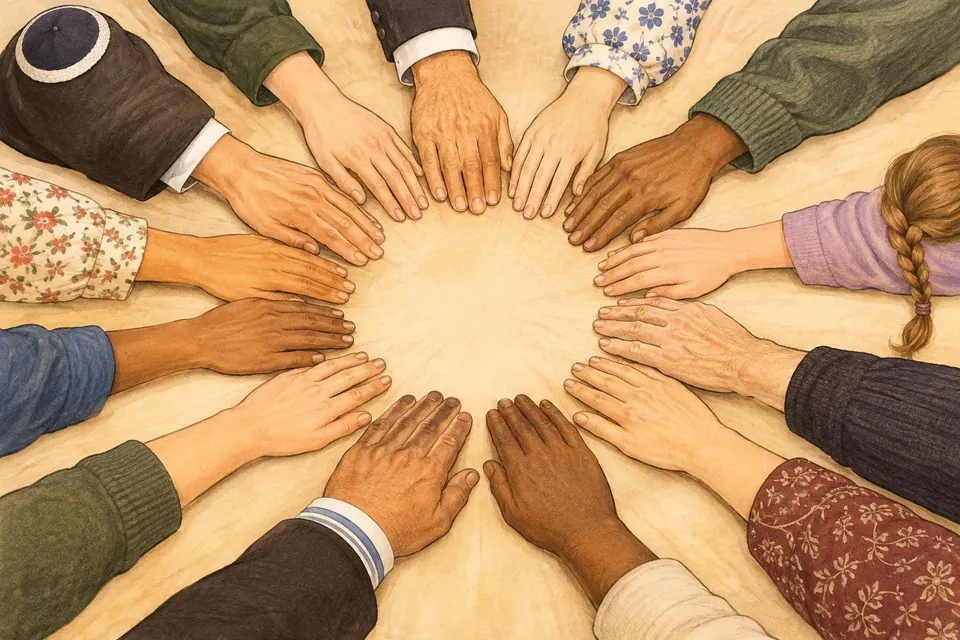
The people of Israel join together as a single organism, like one complete person, as it says: “You are a human being” (Ezekiel 34:31). The goal is to recreate the “body” of the first human being before the sin. Each Jew is an organ and a part of this greater body.
Of course, the soul is the essential part of a person. A person becomes whole only when God “breathed into his nostrils the breath of life” [Genesis 2:7]. For the people as a whole, this corresponds to the presence of the Shechinah (Divine Presence) among Israel, as it says: “God is the strength of my heart and my portion forever” (Psalms 73:26).
Nevertheless, a body is also needed. When the whole people unite to become one organism, the Shechinah can dwell among them. But if the head is here and the feet are in another city, the soul cannot inhabit such a body.
Sins in our relationships with others happen largely because one person dismisses another and sees them through the lens of their shortcomings.
What is this like? Let's listen to how the eyes and ears talk about each other. The eyes say, “Look at those two friends of ours on either side of us. What strange things to have sticking out of a head! They're completely blind. They can't see a thing!”
If someone replies, “But they do have a strength: hearing. They can hear sounds!” the eyes will scoff. “What is hearing? We've never seen anything like that! We've been all over the world and seen everything, from sunrise to sunset, and we've never seen anything called hearing. We've never seen sounds. Leave us alone with your silly fantasies and nonsense. Those ears are nothing but proud paupers. And you, trying to make peace, just try denying what's plain to see.”
The ears, with their own special intelligence, also have something to say about their neighbors, the eyes. In their opinion, they're nothing but “holes in the head.”
The point is clear: this is how people look at one another. Each person feels absolutely certain that the other is a complete nobody. But a thoughtful person will not dismiss others. Instead, they will say to themselves: If this person looks like a complete idiot to me, it surely means that they have a role in this world that I cannot even imagine.
If I treat that person with respect, together we can build the complete body of the Jewish people. And when the body is whole, we merit having God “breathe into his nostrils the breath of life.”
By Rabbi Shimshon Pincus
Keep reading
More →Vaera: The Soccer Player and the Magician
A story about a soccer player helps explain why seeing something can affect us more deeply than knowing it.
CharacterLashon Hara and Free Speech: Life and Death in the Tongue
Jewish teachings on the power of speech challenge us to consider how we use our words.
ParashaBehaalotecha: What Makes a Response to Tragedy Cruel?
Maimonides calls it cruel to dismiss communal tragedy as simply part of life.
ParashaKorach: Who Wins an Argument?
Moses’ response to a painful accusation offers a lesson in walking away from conflict.







