The Waters of Noah
Noah’s story reminds us of the power of prayer and the importance of praying for the sick.
In brief
- The Flood is called the waters of Noah because he did not pray for mercy for his generation.
- Even when we do not know whether prayer will help, we must try.
- Visiting a sick person can inspire heartfelt prayer for their recovery.
- Prayer can bring life, health, peace, goodness, and success.
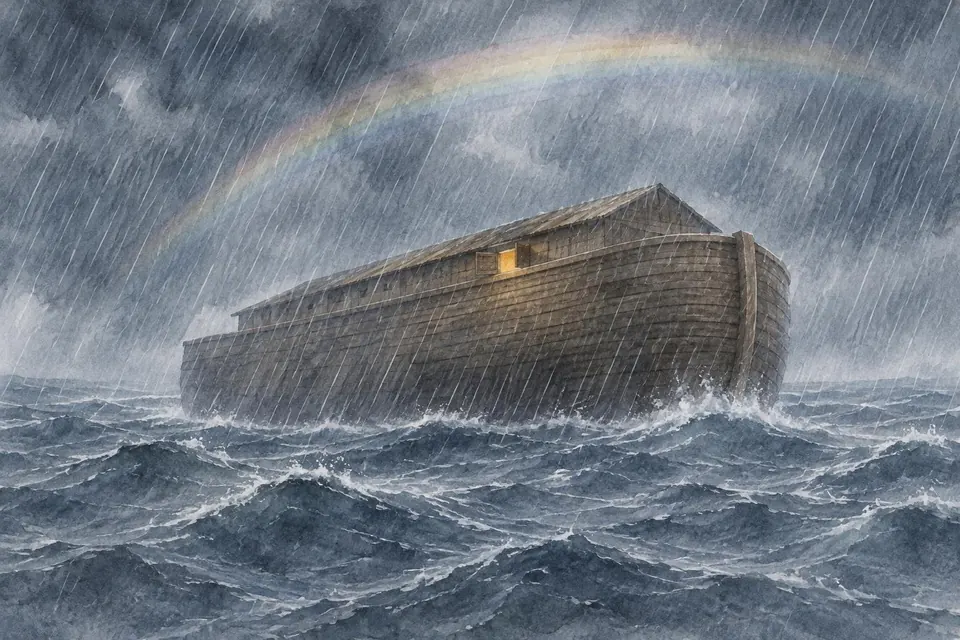
Our Sages say that the Flood is named for Noah, as the prophet Isaiah says in the haftarah of the portion of Noach: “For this is like the waters of Noah to Me” [Isaiah 54:9]. It bears his name because he did not ask God to have mercy on his generation, and its people were wiped from the face of the earth.
This is hard to understand. Noah spent 120 years building the ark and rebuking them, and it was all completely useless. Not one of them joined him! How could he have known that prayer might help overturn the decree against the world?
Apparently, he should have tried. After all, he is held responsible: the Flood is called “the waters of Noah.”
And what about us? How much suffering could we spare ourselves through hours of prayer and pleas to God! Who knows what is recorded in our name, what, God forbid, we are held responsible for?
A person’s soul ascends to Heaven...
He was an avrech, a married man devoted to Torah study. He studied Torah all his life, God was pleased with him, and people were pleased with him. He raised a family in a Torah home and came to Heaven with all the Torah he had studied throughout his life. Then, suddenly, he is told that he killed many people!
He is a murderer? He never even hurt a fly! There must be some mistake; they must have confused him with someone else.
There is no confusion in Heaven. They mean him!
He wonders whether perhaps he humiliated someone. After all, the Sages say, “Anyone who humiliates another person in public is as if he sheds blood” [Bava Metzia 58b]. But that is still only “as if.” We are also told that anyone who becomes angry is as if he worships idols, and that an arrogant person is as if he denies the entire Torah. Yet the Sages write that when something is described as “as if,” it is still not quite the same as the sin itself.
This is not an absolute rule, however. Tosafot, the medieval Talmud commentaries, say that humiliating another person is also subject to the rule that one must be killed rather than commit the transgression (Sotah 10b). And Rabbeinu Yonah writes that humiliation is more bitter to a person than death, so there is a “trace” of murder in it.
But here they mean murder in the most literal sense! Many people died because of you! Because of you, yes, you!
Something is not right. This is the world of truth, so how can they be framing him?
They open the Talmud before him: “Anyone who visits a sick person brings him to life, and anyone who does not visit brings him to death” (Nedarim 40a). A person who visits someone sick is filled with compassion and asks God for mercy with all his heart, thereby bringing the sick person to life. But if he does not visit, even if he prays at home, his prayer does not come from the depths of his heart and does not have its effect. By ignoring the sick person, he has brought about his death.
How many sick people did you fail to visit? And when you did visit, how often did you fail to pray, to overturn the decree or soften it? And they died—because of you!
He will be shocked: “Me? With my prayer? Could I really have softened the decree and replaced death with life? I was just an ordinary avrech. What do you want from me?”
But the Talmud says it plainly: “Anyone who visits a sick person...,” “anyone who does not visit...”
Every person, every Jew: “For You hear the prayers of every mouth of Your people Israel with mercy” [Amidah, blessing of Shema Koleinu]!
Our prayer has the power to save another person, and “the prayer of the sick person is better than the prayer of others on his behalf, and it is accepted more readily” (see Rashi on Genesis 21:17). How much life, health, peace, abundant goodness, and success we can bring into our lives through prayer!
By Rabbi Yaakov Galinsky
Keep reading
More →Vaera: The Soccer Player and the Magician
A story about a soccer player helps explain why seeing something can affect us more deeply than knowing it.
CharacterLashon Hara and Free Speech: Life and Death in the Tongue
Jewish teachings on the power of speech challenge us to consider how we use our words.
ParashaBehaalotecha: What Makes a Response to Tragedy Cruel?
Maimonides calls it cruel to dismiss communal tragedy as simply part of life.
ParashaKorach: Who Wins an Argument?
Moses’ response to a painful accusation offers a lesson in walking away from conflict.







