The Perfumer Who Became a Tanner
A parable about a perfumer shows how easily people can grow accustomed to what once disturbed them.
In brief
- A perfumer gradually grows accustomed to the stench of a tannery.
- Habit can make sin seem natural and dull our response to loss and miracles.
- We must flee from sin so that we do not become accustomed to it.
- Mitzvot, too, should be practiced without letting our feelings grow dull.
“Do not make yourselves impure through them, so that you become impure through them” (Leviticus 11:43).
What does this mean? Of course someone who makes themselves impure will become impure.
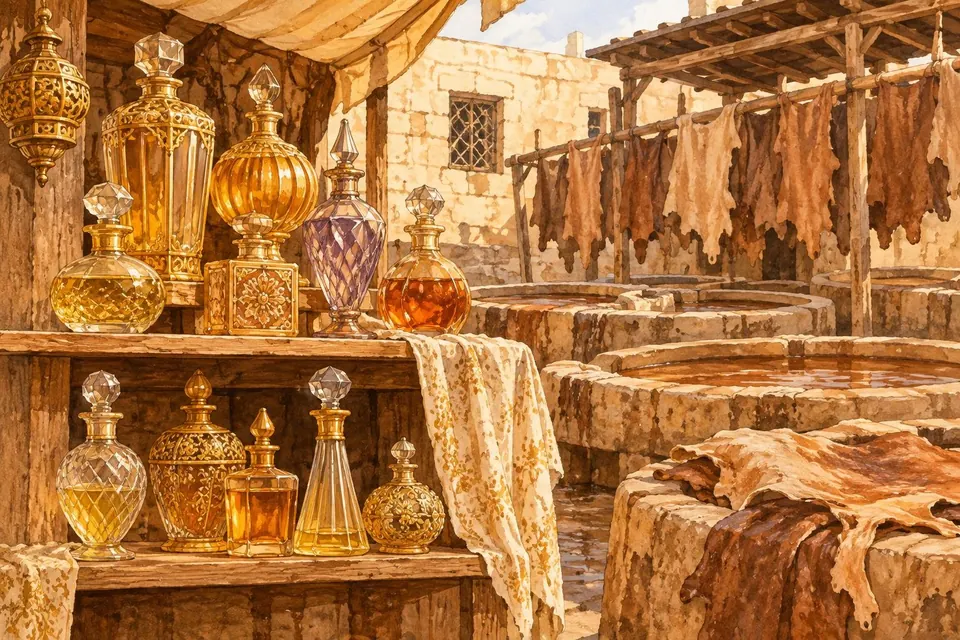
The Chafetz Chaim tells a parable that explains it all. Once there was a man who owned a perfume shop. Its storefront faced the street, so everyone who passed by breathed in its wonderful aromas. Unable to resist, they would come in to buy fragrant perfumes.
One day he arrived at his shop and was horrified: a tanner had opened a workshop right next door. The smells coming from it were so disgusting and nauseating that the poor, sensitive perfumer had to shut the doors and close himself inside. He sat there, pouring out his indignation to the silent perfume bottles in the empty shop. For the shop really had emptied out.
People hurried past the tannery as quickly as they could, and since it was right beside the perfume shop, they ran past that too. The few who wanted to come in found the doors closed and assumed the shop was not open for business.
His income fell, but he still had to make a living. So one unhappy day, the perfumer hung a “For Sale” sign on the door.
At last, the door opened. His neighbor the tanner stood on the threshold. He looked around the shop with an appraising eye.
“It's a good-sized space. I have a proposal for you. I don't have the money to buy the shop, but let's expand my workshop and work together. You'll be my partner, and we'll split the profits.”
“I'll think about it,” the perfumer replied coldly, fighting the urge to hold his nose. The proposal offended him to the core, and he had no intention of agreeing. More than anything, he wanted to sell the shop and open another one somewhere with fresh air.
But day after day passed, and no buyer appeared. His expenses did not shrink, and his debts kept growing. Soon he would have nothing to eat.
He had no choice. He knocked on his neighbor's door, briefly told him he agreed, and returned to his shop. The tanner wasted no time: within an hour, workers had taken down the wall between them, and a foul-smelling cloud rushed into the former perfume shop.
There was no going back now. The next day, the perfumer came to work, wrapped an apron around himself, put on gloves, and began stirring lime, just as the tanner had shown him. He struggled to breathe through his mouth, like a fish out of water. Now and then he couldn't help taking a couple of breaths through his nose, and the smell made him nauseated. The tanner could only shake his head sympathetically as he watched his miserable partner.
Nevertheless, the next day the stench was not quite so terrible. On the third day it still bothered him, but he could bear it. A few days later, the former perfumer was breathing freely. Of course, it wasn't the fragrance of the perfumes he was used to, but he could live with it.
Several years passed. The tannery brought in a good income, and in time our hero saved a respectable sum. His wife suggested, “Maybe you could use the money to open a perfume shop again, downtown?”
He grimaced and answered, “I can't stand those delicate types who can't breathe normal air and absolutely have to have the smell of perfume!”
Growing Used to Sin#
This is what the Torah warns us about: “Do not make yourselves impure through them, so that you become impure through them.” Do not even go near the source of a foul smell. It can cling to you, and you will grow used to it, until it comes to seem natural to you. As the prophet Jeremiah says, “They went after worthlessness and became worthless themselves” (Jeremiah 2:5).
The Mishnah says, “Consider three things, and you will not come into the grip of sin” (Mishnah Avot 2:1). The Talmud also says, “Accustom me to the mitzvah” (literally, “into the hands of the mitzvah”), “and do not accustom me to sin” (literally, “into the hands of sin”) (Berakhot 60b).
Rabbi Elya Lopian explains: As frightening as sin is, becoming accustomed to sin is far more frightening. Then a person really is “in the hands of sin.” The most frightening thing is to become used to sin, as the Sages say: “A person sinned once, then a second time, and it came to seem permitted to him” [Yoma 86b]. Habit becomes second nature.
This also explains the instruction to flee from sin. It is not enough simply to avoid committing it. Even if you have sinned, flee from it, so that you do not become accustomed to it.
Loss and Habit#
We saw this and experienced it ourselves. In the yeshiva we were like people in the Garden of Eden. We studied and grew in Torah and in mussar (ethical teaching). When we fled German-occupied Poland for Lithuania, we were not driven out of the Garden of Eden. We took it with us, fleeing with our books. When we were caught and sent to Siberia, each of us kept tefillin and a volume of Talmud with him.
When we arrived at a labor camp, they took away our books and tefillin, built a fire, and threw everything into it before our eyes. Our hearts were simply breaking. We walked around as though in mourning.
For how long? A day, a week?
On communal fast days, the table on which the Torah scroll is unrolled for reading was brought into the street and sprinkled with ashes, just as ashes were placed on each person's head. This expressed the words, “I am with him in his distress” (Psalms 91:15). Rabbi Zeira said, “At first, when I saw the Sages placing ashes on the table, my whole body would tremble” (Taanit 16a).
That was at first. And afterward? He grew accustomed to it.
The Great Shabbat#
The Tur says that the Shabbat before Passover is called Shabbat Hagadol (the Great Shabbat) (Tur, Orach Chaim 430). Why? Because a great miracle took place on that Shabbat. The Passover offering at the time of the Exodus had to be acquired on the tenth of the month. The people of Israel left Egypt on a Thursday, so the tenth was Shabbat.
Each person took a lamb for the Passover offering and tied it to a bed. The Egyptians asked why they were doing this, and the Jews answered, “To slaughter it and bring it as a Passover offering, as God commanded us.” The Egyptians gnashed their teeth because the Jews were going to slaughter their god, but they could not say a word to them. Because of this miracle, the Shabbat is called Shabbat Hagadol. All this is well known.
But I ask: When was the miracle greater? On the day they took the lamb to slaughter it, or on the 14th of the month, when they actually slaughtered it?
Why, then, is Shabbat called the Great Shabbat? Perhaps the eve of Passover should have been called “the Great Wednesday”?
The answer is one of two things: Either the Egyptians grew accustomed to the thought that the lamb would be slaughtered and no longer gnashed their teeth, even when it was slaughtered before their eyes. Or we grew accustomed to the miracle—that they remained silent and restrained themselves.
Keeping Our Feelings Alive#
There is another point. When the Torah was given, it was necessary to hold the mountain over us “like a tub” [Shabbat 88a]. But had the Jews not already said, “We will do and hear” [Exodus 24:7]? Had they stopped fearing the great fire about which they said, “Why should we die now? This great fire will consume us” (Deuteronomy 5:22)? And God answered, “If only their hearts would always be ready to fear Me” [Deuteronomy 5:26].
Only 40 days passed, and they made the golden calf. God wished to destroy the entire people. Moses our teacher said, “I turned and came down from the mountain. The mountain was burning with fire, and the two Tablets of the Covenant were in my hands” [Deuteronomy 9:15].
The mountain was burning with that same fire that had caused their souls to leave them, the fire they had so feared—and yet they made the calf?
The answer is the same: They grew accustomed to it.
How careful we must be not to grow accustomed to sin—and no less so, not to grow accustomed to mitzvot. On the one hand, we ask, “Accustom us (literally, make habitual for us) to Your Torah” and “Accustom us to the mitzvah.” But our hearts must not close, and our feelings must not grow dull.
For good reason, the Saba of Kelm advises that from time to time a person should imagine being a righteous convert who converted only today and is now saying the blessing over bread and Grace After Meals for the first time in their life (Chochmah UMusar, volume 2, section 219). What hidden meanings a person might discover in it, what words they might see that they never even imagined were there!
By Rabbi Yaakov Galinsky
Keep reading
More →Vaera: The Soccer Player and the Magician
A story about a soccer player helps explain why seeing something can affect us more deeply than knowing it.
CharacterLashon Hara and Free Speech: Life and Death in the Tongue
Jewish teachings on the power of speech challenge us to consider how we use our words.
ParashaBehaalotecha: What Makes a Response to Tragedy Cruel?
Maimonides calls it cruel to dismiss communal tragedy as simply part of life.
ParashaKorach: Who Wins an Argument?
Moses’ response to a painful accusation offers a lesson in walking away from conflict.







