Rabbi Yechezkel Levenstein: The Last to Leave Egypt
The life, faith, and teachings of the Mir Yeshiva’s spiritual guide.
In brief
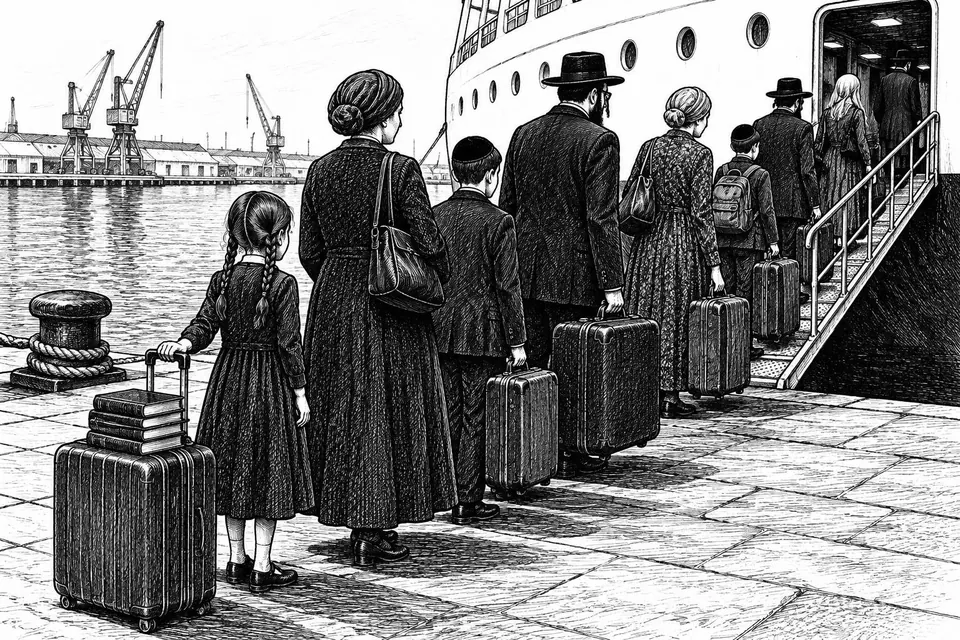
- Rabbi Yechezkel Levenstein was the spiritual guide of the Mir Yeshiva and accompanied it to Shanghai during World War II.
- He devoted his life to cultivating simple, deeply felt faith in God.
- His students described the power of his words and his tireless devotion to serving God.
- After the war, he served as the spiritual guide of the Ponevezh Yeshiva in Israel.
Biography#
Rabbi Yechezkel Levenstein was born in Warsaw in 5645 (1885) to a Hasidic family. His mother died when he was five, and at bar mitzvah age he began working as a messenger. Once, after the money he had earned was stolen, he became convinced of the futility of this world and left for the Chafetz Chaim’s yeshiva in Radin. The talks of Rabbi Yerucham Levovitz, who was then the yeshiva’s mashgiach (spiritual guide), made a profound impression on him.
Some time later, Rabbi Yerucham advised him to enroll in the renowned Talmud Torah yeshiva in Kelm, a “cradle of masters of mussar,” Jewish ethical teaching. There, Rabbi Levenstein’s character took shape under the influence of Rabbi Hirsh Broide, his most important teacher at the time. After marrying, he continued his studies in Kelm and then moved to the Mir Yeshiva.
After World War I, he served as the Mir Yeshiva’s mashgiach in Rabbi Yerucham’s absence, until 5684 (1924). When Rabbi Yerucham returned to the Mir, Rabbi Levenstein stepped down and continued studying there as an ordinary avrech (married yeshiva student).
He served as mashgiach at the yeshiva in Kletsk and at the Lomza Yeshiva in Petach Tikvah, in the Land of Israel, at the branch founded in 1926. In 5696 (1936), after Rabbi Yerucham’s death, he was appointed mashgiach of the Mir Yeshiva. Although he had permission to enter the Land of Israel, he accompanied the yeshiva on its travels and stayed with it in Shanghai. There he guided it with a firm hand, drawing on the strength of his faith and trust in God, until liberation in 5705 (1945) from Japanese occupation. The yeshiva itself was in the Shanghai ghetto and was repeatedly under threat of destruction.
From Shanghai he moved to the United States, and in 5709 (1949) he immigrated to the Land of Israel. In 5714 (1953), after the death of Rabbi Eliyahu Dessler, he was invited to serve as mashgiach of the Ponevezh Yeshiva. He died on 18 Adar 5734 (1974) and is buried in Bnei Brak.
After his death, his talks and letters were published in a series of books called Or Yechezkel.
“It Is Not the Arod That Kills, but Sin”#
An arod is a snake that killed people and that Rabbi Chanina ben Dosa overcame through the strength of his faith in God (Berakhot 33a).
I will begin my account of the mashgiach, Rabbi Yechezkel Levenstein, with an event that left an indelible impression on me.
Everyone who had the privilege of being close to Rabbi Yechezkel felt an awakening of reverence and a special awe of God. His whole being expressed that awe, and it inevitably affected everyone around him. The conversation that had the greatest effect on me personally was the following one.
A student at the Mir Yeshiva, who came from Hungary as I did, needed surgery on his cecum. The local doctor who examined him warned that the operation was urgent because his life was in danger.
The student asked me to travel with him to Vilna and help him with everything related to the operation. I approached the mashgiach, Rabbi Yechezkel, for permission; students at the Mir did not leave without the mashgiach’s permission.
I told him about my friend’s illness and mentioned the doctor’s warning that the operation was urgent because his life was at risk.
On hearing this, the mashgiach turned pale and began to tremble like a leaf. I did not understand what had suddenly happened to him. In my innocence, I thought he was shaken by the news that a student at his yeshiva was in such a serious and dangerous condition.
But the mashgiach immediately proved me wrong. He suddenly cried out with all his strength: “You must not say such a thing! People don’t die from the cecum! They die only from sin!”
The cry came from the depths of his heart. I was frightened. I could see that the mashgiach had turned white and was trembling all over. The awe and profound fear of Heaven that filled his words penetrated the depths of my heart. I felt myself trembling too, because I had said something that should not be said.
Seventy years have passed since then, yet the powerful impression of that conversation has not faded from my heart. I cannot forget his cry: “People don’t die from the cecum! They die only from sin!” I believe those words have stayed with me and influenced me throughout my life.
The Impact of One Talk#
Rabbi Levenstein’s greatness began with an awakening he experienced during a talk by Rabbi Yerucham Levovitz. Rabbi Yerucham had come to serve as spiritual guide of the yeshiva in Radin, and his first talk was about faith. Among other things, he discussed the Sages’ explanation of the blue techelet thread in tzitzit (ritual fringes): its color resembles the sea, the sea resembles the sky, and the sky resembles the Creator’s throne of glory [Menachot 43b]. Rabbi Yerucham said that people wear tzitzit and see the techelet and the sky, yet they are still not awakened. The reason, he continued, is that without studying mussar, no awakening is possible.
These words made a tremendous impression on Rabbi Yechezkel, who was there. Years later, he told Rabbi B. Rosenberg, head of the Slabodka Yeshiva and one of his students in Shanghai: “When I heard that, I felt that my faith was not faith, my tefillin were not tefillin, and my tzitzit were not tzitzit! From that moment on, I devoted my entire life to acquiring true faith.”
“The Righteous Person Shall Live by His Faith” (Habakkuk 2:4)#
Our teacher devoted his entire life to acquiring faith—simple faith. Over the years, he spoke about faith in almost all his mussar talks.
He regularly discussed the simplest matters of faith, repeating the same things again and again. He repeated to himself countless times the story of the exodus from Egypt, the splitting of the sea, the standing at Mount Sinai, and so on.
In his eulogy for Rabbi Levenstein, Rabbi Shlomo Wolbe recalled that he would sometimes come to visit him after an hour-and-a-half journey on the transportation available in those days. He would climb the stairs to Rabbi Levenstein’s room under the roof, and before he had caught his breath, Rabbi Levenstein would say, “Go, Rabbi Shlomo, and tell the students that the world has a Creator. Go in peace!” And with that, he would send him on his way.
Rabbi Shlomo continued: “But didn’t we already know that the world has a Creator? In the years that followed, I realized that the answer is yes: We really didn’t know! We can pray three times a day and say ‘Thank God’ and ‘God willing’ all day long, and still not know that the world has a Creator! His simple words carried an enormous force of vividly felt faith—a true feeling that yes, the world has a Creator! Not a superficial feeling, but a deep one, felt in every part of the body!”
When our teacher said those simple words, “The world has a Creator,” anyone who wanted to hear them heard them differently, in a special way. Rabbi Levenstein repeated these words again and again throughout his life. His final talk, on Shushan Purim (the day Purim is celebrated in Jerusalem and certain other walled cities), was also devoted to simple faith. He said: “And what will there be after everything? The same as there was before everything. And what was there before everything? Only God, blessed be He, He alone! And now? Yes, only He alone!”
“What About Eternal Life?”#
Rabbi Moshe Karlinsky told me that his nephew from California had taken a break from university to spend a year studying in a yeshiva. He came to the Kerem Yeshiva in Yavneh and studied there for a year, as he had planned. Before he returned to the United States, Rabbi Karlinsky took him to Rabbi Yechezkel.
The nephew told Rabbi Yechezkel about his plans and explained that he needed to finish university to establish himself in life. The rabbi asked him, “And what about eternal life?” With those words, which Rabbi Yechezkel spoke with his customary fear and awe, the visit ended.
The visit ended, but not the story. The mashgiach’s words, spoken from the heart, entered the young man’s heart, and he decided that instead of returning to university, he would study at the Mir Yeshiva in Jerusalem. His father was deeply disappointed when he heard that his son had changed his plans. He came from the United States especially to persuade him not to do it, but the young man stood firm and stayed at the yeshiva. In the years that followed, he excelled in his studies, and today he heads a yeshiva in the United States.
Even with a few words from the depths of his heart, Rabbi Yechezkel could transform the souls of those who heard him.
“Like Someone Who Has Put His Hand in Fire”#
With his simple, vividly felt faith, Rabbi Levenstein would say things like those the Chafetz Chaim had said. He wrote of the Chafetz Chaim: “When I was studying in Radin, the Chafetz Chaim wanted to explain the essence of faith in the Torah to one of the students. He said to him: ‘You see the sun; my faith is just as clear to me!’” (Or Yechezkel, Letters 22).
Rabbi Levenstein’s faith was so tangible that it could be seen clearly on his face. Rabbi Chaim Ozer Grodzinski, a leader of the generation, said of him when Rabbi Levenstein was still a young avrech: “On his face we see: ‘I have set God before me always’” (Psalms 16:8).
The Chazon Ish characterized three great mussar sages of his time. He said: “Rabbi E. E. Dessler: His great faith is in his head, in his clear mind. Rabbi E. Lopian: The depth of his faith is in his great heart. But Rabbi Yechezkel’s faith is in his hands. He touches faith, feeling it with his own hands. His faith is as clear as the sensation of someone who has put his hand in fire.” The Chazon Ish emphasized the point, repeating, “Like someone who has put his hand in fire,” and extended his own hand.
When people came to the Chazon Ish to ask for a blessing or a prayer, he would say, “Why do you come to me when Rabbi Yechezkel Levenstein is here among us?”
After Rabbi Levenstein’s passing, Rabbi Shlomo Wolbe exclaimed: “The last person who left Egypt has departed from this world! He truly was one who left Egypt! He had the privilege of seeing Moses our teacher gather the people of Israel, as each person took matzah and left; he went into the sea and came out of it! He sang the song at the sea!”
What Were His Talks Like?#
Rabbi Shlomo Wolbe, one of his students, described the distinctive approach of the talks in which Rabbi Levenstein taught his students simple faith: “There are mussar sages who were great educators, but our teacher was not an educator in that sense of the word. ... In his talks, he did not say what the listeners needed to hear. He spoke about what he was living at that moment. He gave us the privilege of walking with him. He allowed us into his innermost world. ...”
Rabbi Eliyahu Dessler said of Rabbi Levenstein’s talks: “He is one of the remaining true seekers of mussar, who speak ‘within themselves’—to themselves.”
Rabbi Levenstein himself wrote in one of his letters: “This is my way and my line of thought: first of all, to gain merit myself” (Or Yechezkel, Letters 23). He also wrote: “A person must first gain merit themselves, and only afterward help others gain merit. For their own merit is a condition for truly helping many others gain merit” (Or Yechezkel, Letters 33).
The Chazon Ish also encouraged yeshiva students to listen to Rabbi Yechezkel’s mussar talks. He said: “Rabbi Yechezkel has a pure heart, and words that come from the heart enter the listener’s heart.”
On Shabbat We Are Closer to God#
On Friday night of the week of Parashat Bechukotai in 5721 (1961), while the Nazi criminal Adolf Eichmann was on trial in Israel, the mashgiach decided to speak about the Holocaust to awaken and strengthen his listeners’ fear of Heaven. He said: “Even if one ought to refrain from speaking about such a painful subject on Friday night, what can I do? On Shabbat we are closer to God, and we must make use of this special time.” The students understood his point, and it strengthened their sense of the holiness of Shabbat.
A Servant of God#
Everything Rabbi Yechezkel did proclaimed his service of God, and he truly devoted superhuman effort to it.
As an example, I will mention one commitment he took upon himself, which he told Rabbi Shlomo Wolbe about. He decided that as people passed before him on Friday night to greet him with the words “Good Shabbat,” he would concentrate on wishing each one of them the privilege of truly having a good Shabbat. The four or five hundred people who passed before him each Friday night and Shabbat morning had no idea that at that very moment the rabbi was completely absorbed in serving God by fulfilling his commitment.
Our teacher managed to turn “Good Shabbat”—words we say without paying them much attention—into an act of service. From this we can conclude that his entire daily routine was built on hundreds, perhaps thousands, of such commitments, invisible to others and never known to anyone. This was service in every movement, keeping a commitment at every moment. And so it went, continuously, from five in the morning until midnight—he did not rest during the day—day after day and week after week.
The Torah says of our forefather Abraham: “Abraham ... died at a good old age, old”—or, alternatively, “wise”—“and satisfied” (Genesis 25:8). The Kli Yakar explains there that the words later used of Isaac when he died, “satisfied with days,” also apply to Abraham (Genesis 35:29). Rabbi Levenstein said that Abraham’s days were “satisfied”: They were full, packed with service, so that every movement was an act of service from the heart.
In a eulogy for our teacher, Rabbi Elazar Menachem Shach, a leader of the generation, said that throughout his life Rabbi Levenstein did not rest during the day, even on Shabbat. He continued: “As far as I can judge, I never knew anyone more upright and honest than he was! Even if he had lived five hundred years ago”—at the end of the era of the Rishonim, the medieval authorities—“he would have been called a chasid,” a person of exceptional piety. “In all the years I knew him, there was never a time or a moment when he looked for some way to make things easier. He was always looking for an opportunity to do as much as possible and to be more stringent with himself. That is what it means to be a chasid. ‘The chasid has vanished from the land!’” (Micah 7:2).
The Malbim explains that a chasid does more than is required, both in mitzvot between a person and God and in those governing relations between people.
Years after Rabbi Levenstein’s passing, Rabbi Shach stood before his students and reminded them of their obligation to pray in the yeshiva hall. Among other things, he said: “If we have been given the opportunity to pray in the place where the mashgiach prayed, can we neglect such a great opportunity?”
“How Can You Sit Down in Elul?”#
The mashgiach’s grandson told me that during the month of Elul, Rabbi Levenstein felt especially weak because he stood on his feet throughout those days. He would say, “How can you sit down in Elul?”
Keep reading
More →Vaera: The Soccer Player and the Magician
A story about a soccer player helps explain why seeing something can affect us more deeply than knowing it.
CharacterLashon Hara and Free Speech: Life and Death in the Tongue
Jewish teachings on the power of speech challenge us to consider how we use our words.
ParashaBehaalotecha: What Makes a Response to Tragedy Cruel?
Maimonides calls it cruel to dismiss communal tragedy as simply part of life.
ParashaKorach: Who Wins an Argument?
Moses’ response to a painful accusation offers a lesson in walking away from conflict.







