Why Don't I Feel Spiritual Growth After the Holidays?
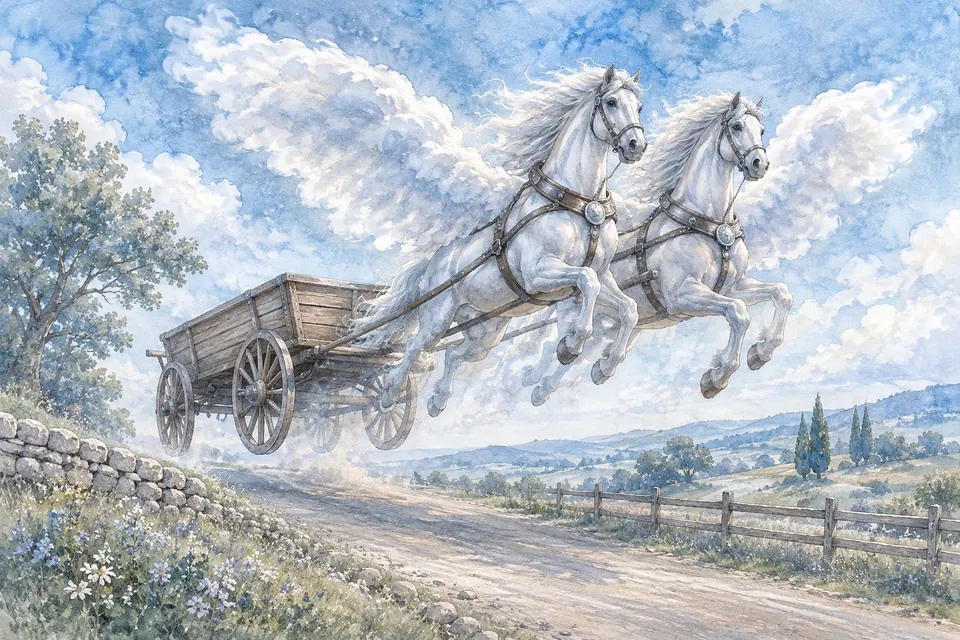
A parable about flying horses offers a perspective on the spiritual highs of the Jewish holidays.
In brief
- A Torah passage about the ark separates two troubling episodes in the Israelites' journey.
- A student wonders what remains of the spiritual heights reached over Passover and Shavuot.
- One parable suggests that even a small step forward can be lasting.
- Even when no step seems to remain, a break from spiritual emptiness has value.
Parashat Behaalotecha#
“When the ark set out…” (Numbers 10:35).
How many books are there in the Torah? Five, of course. Every child knows that from the song “Who Knows One?” And that is indeed the view of Rabbi Shimon ben Gamliel. Four blank lines separate each book from the next.
But Rabbi Yehudah HaNasi, known simply as Rabbi, maintains that the passage beginning “When the ark set out,” though it contains only 85 letters, is a book in its own right. It is not set apart by blank lines, but an inverted Hebrew letter nun appears before and after it. That would mean there are actually seven books of the Torah: Genesis, Exodus, Leviticus, Numbers up to “When the ark set out,” the passage about the ark itself, the last part of Numbers, and Deuteronomy. This is what Proverbs refers to when it says, “Wisdom has built her house; she has hewn her seven pillars” (Proverbs 9:1).
But according to Rabbi Shimon ben Gamliel, who says there are five books of the Torah, why is this passage set apart by the letters nun?
Because it was taken from its place in the account of the Israelites' travels, earlier in verse 11, and placed further on to separate two calamities. The first was that they “hurried away from the mountain of God,” and the second was that “the people began to complain.”
What Remains After the Holidays?#
This week an avrech—a married man devoted to Torah study—asked me a question that weighed heavily on his heart. “Two months ago, we celebrated Passover. We felt such a spiritual lift on Seder night, and then on the day the Sea of Reeds split. After that came 50 days of counting the Omer and the three special days before Shavuot. Then came Shavuot itself, the giving of the Torah. And what remains of all that? How have we become better?”
With bitterness and embarrassment, he told me a story.
A man once read in a book that anyone who fasts for 40 consecutive days will merit a visit from the prophet Elijah. This meant fasting during the daytime, from first light, amud hashachar, until nightfall, when the stars come out. He thought it was worth a try. He fasted for 40 days—and nothing happened.
He said to himself, “It's clear that I fasted, and surely what's written in the book is true. What could have happened? Perhaps I saw him but didn't know who he was. Maybe he's angry with me for some reason.”
He decided to visit a great righteous man who possessed ruach hakodesh—holy spiritual insight—and ask him to explain what had happened. So he went to Rabbi Yisrael of Ruzhin.
The righteous man listened and said:
“Let me tell you a story. Every week after Shabbat, the Baal Shem Tov would get into a carriage and tell his coachman, Alexei, to turn away from the road. The carriage would travel miraculously, at incredible speed, to wherever it needed to go. The Baal Shem Tov would meet whomever he needed to meet, do whatever he needed to do, and return to his town, again at miraculous speed.
“Years passed, and the horses grew old. They were sold and replaced with young, strong horses. The new horses were happy to serve the righteous man, but they were put in the stable. When Shabbat ended, their moment came. Alexei harnessed them to the carriage, sat on the driver's seat with his back to them, and they set off. How happy they were to have the privilege of carrying the great righteous man!
“The horses were used to stopping at every roadside inn for a rest and a bite to eat. But now they passed one inn, then a second, then a third. They felt neither tired nor hungry, and the carriage didn't stop.
“The horses decided they had risen to a higher level: they had become like human beings. After all, their former owners hadn't eaten at every inn. They had stopped for a meal and a warming drink only after four or five inns. Now the horses were doing the same. How lucky they were! At last they would get to sample human delicacies and taste vodka. But they passed five inns, then six, speeding right by without stopping. How strange!
“Soon they arrived at their destination. The Baal Shem Tov got out of the carriage and spoke to the person he needed to see. He returned to the carriage, and once again it set off at incredible speed. The horses didn't tire or feel any need for food or drink, and they didn't stop anywhere. Then they understood! As the righteous man's horses, they had become angels. What joy!
“They returned to Medzhybizh, where the coachman unharnessed them and led them to the stable. There they saw a trough full of oats and pounced on it, chewing with their mouths full.
“Then they understood that they were neither angels nor human beings. They had been horses, and horses they remained.”
“And what about you?” Rabbi Yisrael concluded. “When you read in the book that a person who fasts for 40 days merits a visit from Elijah, what did you think? That Elijah wants, God forbid, to torment Jews and starve them? Of course not! He wants to help them elevate their spirits, free themselves from their passions, and move away from the feeding trough, so that they can become more spiritual and elevated and be able to see him.
“But you fasted, and when the fast ended, how you ate! You pounced on the food to make up for everything you had missed during the day. And you still want him to reveal himself to you?”
“So what about us?” the avrech asked. “Two holidays have passed, with 50 days of counting the Omer between them, and we haven't changed one bit. Everything is just as it was! What have we gained?”
A Step Forward#
“Don't worry,” I answered. “There are two answers to your question. I heard the first from my righteous father-in-law. It is a parable he heard from his own rabbi.
“Once there was a righteous man who sat down and thought, ‘Moses our teacher was a human being just like me. Yet he managed to sanctify and purify himself, become like an angel, ascend to heaven, and cleave to the Shechinah, God's indwelling presence. After that, he went up to heaven and came down again. If he could do it, so can I.’
“With all the power of his thought, he cleaved to God, and indeed, he took off and rose into the heights. How delighted he was! There was the Earth beneath his feet. He flew past the moon and Mars, passed the Milky Way, and soared higher and higher.
“Suddenly he remembered that Moses had neither eaten nor drunk for 40 days. Could he endure that? And Moses hadn't slept for 40 days either! Could he manage that?
“As soon as he became afraid, his devekut—his attachment to the Creator—was broken. The moment it broke, he began to fall rapidly. His terror grew tenfold: what if he flew past Earth and became a stray meteor in space?
“‘Master of the universe,’ he prayed, ‘anything but that! Please, let me reach Earth!’ God ‘fulfills the desire of those who fear Him’ [Psalms 145:19]. Before long, Earth was beneath his feet, and he felt relieved. Then he suddenly remembered: two-thirds of the globe is covered with water! The last thing he wanted was to land in the middle of the vast ocean.
“‘Master of the universe, please—let me reach dry land!’ God hears prayers, and soon he was approaching land. But what if it was the middle of a desert? ‘Oh, Master of the universe, take me home!’
“God answered his request. Our hero found himself next to his home—one step away from the place where he had begun his ascent.”
Of course, this is only a parable. But what does it teach? That this is what we all look like: we soar during the Days of Awe and land at the end of Simchat Torah; we rise high on Passover and descend at the end of Shavuot. But we land one step away. Something has remained after all. And these little steps add up. Step by step, we move forward.
That is the first answer. But even if we had not taken that step, it would still have been worthwhile! Why? To make a break between one calamity and another.
Imagine if our whole lives were one unbroken succession of ordinary days and spiritual emptiness [which is the true calamity], without the separation provided by “When the ark set out”—without periods of spiritual uplift and elevation. How could we bear it?
By Rabbi Yaakov Galinsky
Keep reading
More →Vaera: The Soccer Player and the Magician
A story about a soccer player helps explain why seeing something can affect us more deeply than knowing it.
CharacterLashon Hara and Free Speech: Life and Death in the Tongue
Jewish teachings on the power of speech challenge us to consider how we use our words.
ParashaBehaalotecha: What Makes a Response to Tragedy Cruel?
Maimonides calls it cruel to dismiss communal tragedy as simply part of life.
ParashaKorach: Who Wins an Argument?
Moses’ response to a painful accusation offers a lesson in walking away from conflict.







