What Is the Garden of Eden in Judaism?
A rabbi’s delight in a volume of Talmud reveals one way to understand the Torah’s call to choose life.
In brief
- The Torah calls us to choose life and goodness.
- A rabbi’s joy at receiving a volume of Talmud and candles left a lasting impression on a young Rabbi Kahaneman.
- People can come to see wrongdoing as permissible, or even as a mitzvah.
- We must distinguish genuine life and light from their deceptive opposites.
Parashat Nitzavim#
“See, I have set before you today life and good, death and evil. ... I have set before you life and death, blessing and curse. Choose life, so that you and your descendants may live” (Deuteronomy 30:15, 19).
When you consider this, you see that true perfection is found only in cleaving to God. King David said of this: “As for me, closeness to God is my good” [Psalms 73:28]. He also said: “One thing I have asked of God, that alone I seek: to dwell in the house of God all the days of my life, to gaze upon the beauty of God and seek Him in His sanctuary” [Psalms 27:4]. And Mesillat Yesharim (The Path of the Just) says: “Everything else that people consider good is in truth nothing but emptiness and illusion.”
Once, the rabbi of Ponevezh, Rabbi Yosef Shlomo Kahaneman, told me:
“Do you know where I get my tireless desire to study Torah and delve into it? Where I get this feverish drive to spread Torah and establish more and more places to study it?
“I owe it all to the rabbi of Kuliai, my hometown.
“The story I’m about to tell you has stayed in my heart forever.
“When I was a child, before my bar mitzvah, a candle factory opened in our town. That was something new. There was no electricity and no gas lighting either. Homes were lit by the weak flame of an oil lamp. And suddenly there were candles! But who could afford them? Only the very wealthy, who put them in chandeliers.
“Another piece of news stirred everyone up: In Vilnius, the Romm widow and brothers’ printing house had published a beautiful, lavish edition of the Talmud, complete with commentaries. But again, who could buy it? The prices were astonishing.
“On Purim, the community made an effort and everyone came together. After all, the Jerusalem Talmud says that an entire community together cannot be poor. We managed to buy the rabbi two packages of candles and one volume of Talmud: tractate Bava Batra with the commentary of the Rif.
“I was entrusted with bringing the rabbi the mishloach manot (gifts of food). I carried all these beautiful things in my arms, and I must say, they were quite heavy. The community trustees walked beside me, smiling with satisfaction.
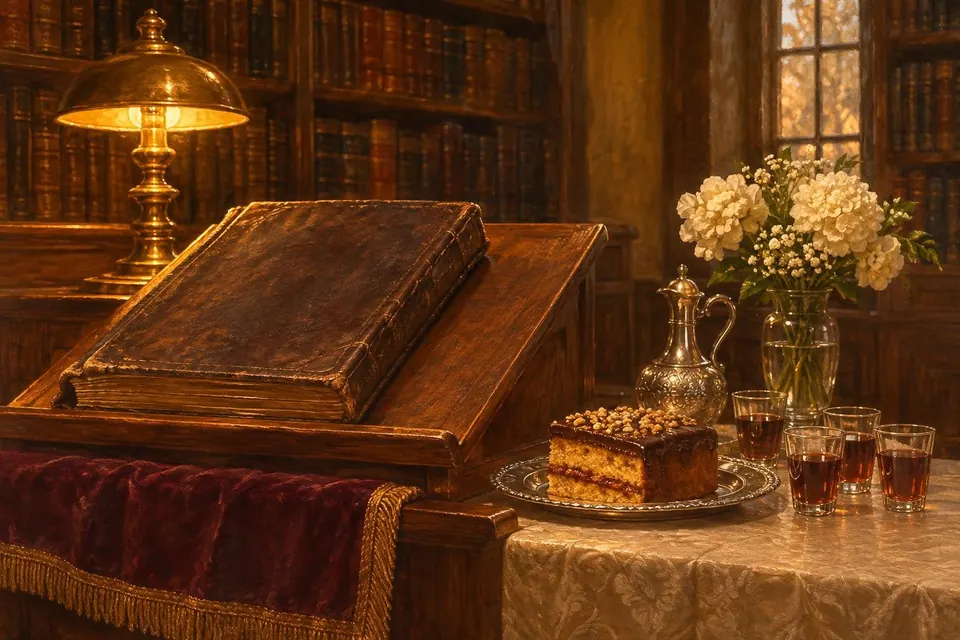
“We arrived at the rabbi’s home and put the gift on the table. It was an enormous tray, with several kinds of cookies and cakes around the edges, the volume of Talmud in the center, and the candles beside it. Everything was covered with a white cloth, as was customary.
“The rabbi greeted us warmly and joyfully. He removed the cloth from the tray and froze.
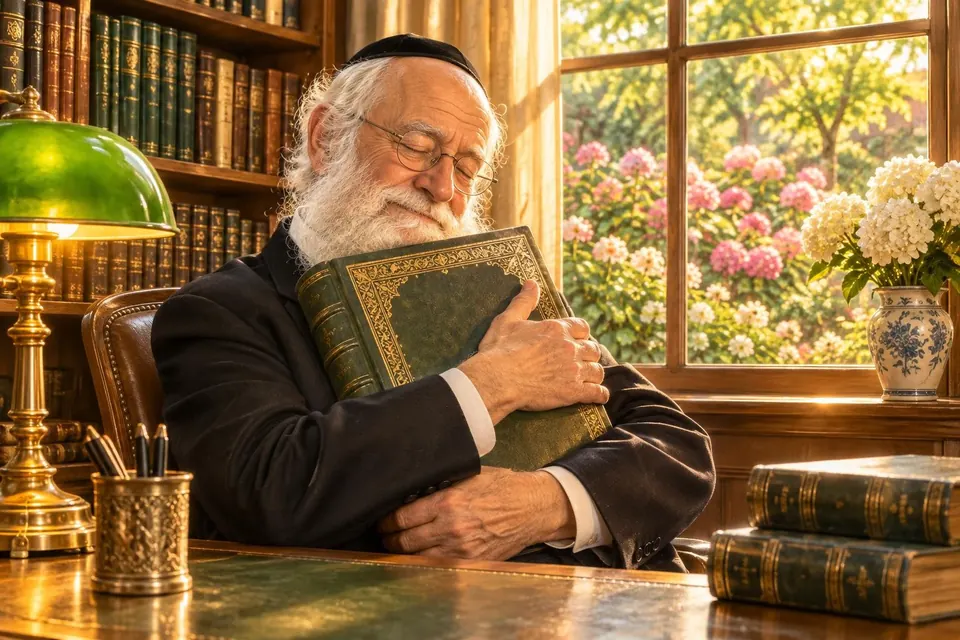
“Then he picked up a package of candles, opened it, looked inside, and closed it. He lifted the volume, kissed it, opened it, and leafed through it. His eyes filled with tears of happiness.
“‘Now,’ he said to us, ‘now I know what the Garden of Eden is! Tractate Bava Batra and a package of candles!’
“He spoke with such passion, and it was so clear that the words came from the depths of his heart, that they entered my heart and stayed there forever: This is the Garden of Eden!
“This is what is meant by ‘a life like that of the World to Come.’”
All this is true. It is said that our holy forefathers lived a life like that of the World to Come [Bava Batra 17a], and our Sages blessed one another: “May you see your (future) world in your lifetime!” [Berakhot 17a].
But a question arises: If this is good and its opposite is evil, if this is light and its opposite is darkness, if this is life and its opposite is death, why did the Torah need to instruct and advise us to “choose life”?
Who would not choose life?
And how is it that many people actually do not choose it?
The answer is already given in tractate Sotah: “A person sins only when a spirit of folly enters them” [Sotah 3a]. In other words, a person knows that it is desirable and good not to sin, and that sin is forbidden. But the yetzer hara (the evil inclination) attacks them, and they sin.
When a person violates a prohibition once and then a second time, it begins to feel as though it is permitted [Yoma 86b].
And the third time? As they used to say in Novardok, the third time it already seems like a mitzvah!
This is no joke. Proverbs says: “Every person’s way is right in their own eyes” [Proverbs 21:2], and also, “The way of a fool is right in their own eyes” [Proverbs 12:15]. A person can change their perspective to justify themselves to such an extent that the prophet cries out in lament: “Woe to those who call evil good and good evil, who turn darkness into light and light into darkness, who turn bitter into sweet and sweet into bitter” (Isaiah 5:20).
How far can a person fall? Listen to a story from the Midrash (Tanchuma, Shemini):
Once there was a righteous man whose father was a drunkard. Time and again, the son was called out of the beit midrash (study hall): His father had gotten drunk and fallen in the street, where children mocked him and threw small stones at him, shouting, “Look! A drunk!” The son had to rescue his father from these situations and take him home. The humiliation was so unbearable that he wanted to die of shame.
He suggested, “You know, Dad, I’ll bring you home whatever wines you want. Just don’t go to the tavern. It’s terribly humiliating for both of us!”
His father agreed, and the son kept his promise. He sent his father wine, the father got drunk at home, and the son put him to bed and went to study in the beit midrash.
One day, during a downpour, the son saw a drunk lying in a puddle. Water was pouring onto him from a drainpipe, but he felt nothing. Children were mocking him, throwing garbage and clumps of mud at him. The son looked at him and thought, “I’ll go and see if my father is sober now. If he is, I’ll bring him here and show him what a drunk looks like in his miserable state. Maybe it will have an effect on him, and he’ll stop drinking.”
He went and brought his father.
The father looked and his face lit up. He made his way through the laughing children, bent over the drunk, and asked, “Tell me, which tavern sells such wonderful wine that it brought you to this state of unconsciousness?”
The son said, “Dad, is that why I brought you here? I brought you so you could see his shame and disgrace and understand that they do the same to you when you’re drunk! I hoped it would move you, and that you’d try not to drink anymore. ...”
His father answered, “Son, I swear to you, there’s no greater pleasure, no greater Garden of Eden for me than this!”
The son heard him and walked away, deeply disappointed.
So they, too, have a “Garden of Eden” in this world. As the Talmud relates, the Persian shah asked Rava whether we would have pleasures in the World to Come like their disgusting orgies.
But we have an obligation to examine and distinguish between light and darkness that pretends to be light, between true, genuine life and the “life of pleasure” of the wicked, who even during their “lives” are called dead [Berakhot 18b]—and to choose life!
By Rabbi Yaakov Galinsky
Keep reading
More →Hanukkah: The Torah Will Not Be Forgotten
Hanukkah reveals why every Jew has a share in preserving the Torah for future generations.
Torah StudyWhy Must Everyone Study Torah?
The Talmud’s examples of Hillel, Rabbi Elazar, and Joseph show why circumstances do not excuse neglecting Torah study.

Lech Lecha: Where Are You Going?