Hanukkah: The Torah Will Not Be Forgotten
Hanukkah reveals why every Jew has a share in preserving the Torah for future generations.
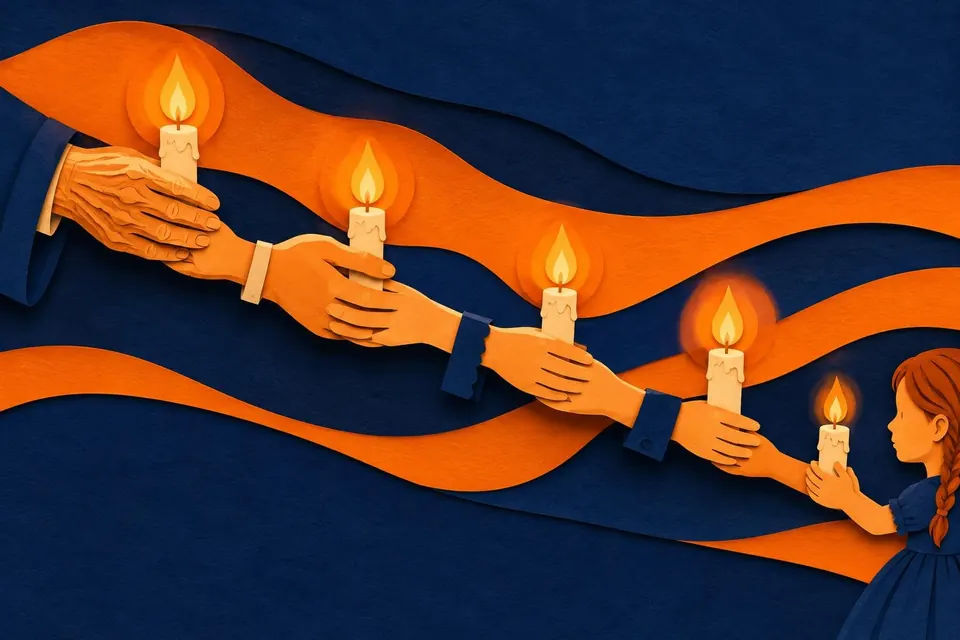
In brief
- God promised that the Torah would not be completely forgotten, but much can still be lost.
- Every Jew has a share in Torah study, including those who begin later in life.
- The Temple menorah represents the wisdom gained through work on the Oral Torah.
- Torah study connects a person’s heart and life to God.
Mesillat Yesharim (The Path of the Just) is structured as a commentary on a baraita—a teaching from the period of the Mishnah—attributed to Rabbi Pinchas ben Yair and quoted in several places in the Talmud. It begins: “Rabbi Pinchas ben Yair said: Torah leads to watchfulness” [Avodah Zarah 20b]. But what is Torah itself? What does it mean to study Torah? With Hanukkah approaching, I would like to explore these questions.
Torah and the Hanukkah Prayer#
In all the prayers during Hanukkah, it is customary to add the insertion Al Hanisim (For the Miracles), which describes what the wicked Greek kingdom intended to do. It begins: “When the wicked Greek kingdom rose against Your people Israel to make us forget Your Torah and to violate Your laws.”
Since the Greeks aimed to destroy everything spiritual within us, Torah study is clearly the key issue here. It is the spiritual backbone of our people.
The Torah itself confirms this. At the beginning of Parashat Bechukotai, a series of blessings opens with the words: “If you walk in My ways” [Leviticus 26:3]. Citing the Sages, Rashi explains: “If you labor in Torah.” This, then, is the source of all the blessings. And when the same portion lists the curses—“But if you do not listen to Me ... and reject My ways” [Leviticus 26:14–15]—Rashi again explains: “If you do not labor in Torah.” We can see clearly how turning away from the work of Torah study leads a person downward.
There is an important principle that fits this exactly: “Great is Torah study, for it leads to action” [Kiddushin 40b]. It leads to great blessings. But the reverse is also true: Turning away from Torah leads to the most terrible downfall.
Al Hanisim follows the same order and logic. First, the Greek kingdom intended to make us forget the Torah. Next, once we no longer had Torah, its aim was to tear us away from the laws of God’s will.
Will the Torah Be Forgotten?#
Let us step away from Hanukkah for a moment to consider the question of forgetting Torah. It is a very difficult subject, first of all because, on the one hand, in Parashat Vayelech God promises that the Torah “will not be forgotten from the mouths of their descendants” [Deuteronomy 31:21]. On the other hand, Rashi adds a frightening qualification at the same place: It will not be forgotten completely [Rashi on Deuteronomy 31:21]. The difference between those two ideas is enormous.
On the one hand, we study Torah and understand what we learn. When we study well, we take part in the discussions of the greatest sages of different generations. Yet on the other hand, we also come to realize how much we still do not know.
The greatest sages of recent generations were deeply concerned that Torah not be forgotten in our generation. We have been promised that it will not disappear entirely. The question is what will remain.
Another important question is: What is our role in all this? Many baalei teshuva—Jews who have returned to observant life—are skeptical. They say, “This doesn’t concern us. We’re baalei teshuva; we’ll learn as much as we manage to, and those who have been studying since childhood can worry about making sure the Torah isn’t forgotten.”
That approach is categorically wrong! Each of us has a share in Torah study, and if we do not fulfill it, the share of our entire people suffers. If we do not make sure today that each of us fills ourselves with as much Torah as we possibly can, to the limit, any one of us could become the reason the Torah is forgotten, because our own share would remain forgotten.
Consider some well-known and very ancient examples of people who did not come to Torah as children, yet were privileged to pass it on, all the way down to our generation. Without them, the Torah would not have been forgotten entirely, but it would have taken a very different form.
The first is Rabbi Akiva, who, even as a grown man, could neither read nor write. More than that, he was so filled with hatred for Torah scholars that, if he met one, he was ready to bite him as a donkey bites. Why a donkey rather than a dog? Because a dog only bites, while a donkey also breaks the bone. Despite this, all the Torah we have was transmitted through five of Rabbi Akiva’s students.
Other examples are the great converts among our people: Onkelos, Shemayah, and Avtalyon. Onkelos did not come to Judaism as a child. Yet he wrote a great work, the translation of the Torah, which the whole Jewish people studies practically every day. That is even more than Rashi’s commentary. And without sages such as Shemayah and Avtalyon, the Torah would be completely different.
Jews who return to Torah later in life should not think that their share is so small that there is no point in trying. At the same time, there is no doubt that a person who does not make the effort will not become great in Torah. But someone who does make the effort can, even in our generation, become a link through which Torah is passed to future generations.
The Menorah and the Oral Torah#
After this important digression, let us return to Hanukkah.
What did the Greeks oppose about the Torah? And what did their plan to make us forget it involve? It is not easy to answer directly, so we will approach the question from the opposite direction and arrive at the answer in the end.
Rabbi Chaim Friedlander writes in his book that the Greeks had many wicked plans: banning circumcision, banning the sanctification of the new month, and so on. Why, then, was the Hanukkah miracle of that time connected specifically to the menorah?
To answer, we must first understand what the menorah in the Temple represented. In the passages describing the construction of the Tabernacle, Rashi explains that three objects shared one small but very important feature:
- The table with the loaves was adorned with a gold rim, like a crown. Rashi explains that it represents the “crown” of kingship.
- The small altar had a similar rim, representing the “crown” of service, which in turn was granted to the kohanim (priests).
- The Ark of the Covenant, which stood in the Holy of Holies in the Temple, also had such a rim. This one represented the “crown” of Torah.
As is well known, the Ark contained both the broken and the whole tablets. It also contained a Torah scroll written by Moses. Torah is the holiest thing we have, so the other “crowns” depend on the crown of Torah. If a king of Israel does not live by the Torah, he is a great scoundrel, not a king. The role of a kohen, too, cannot exist without Torah, for a kohen is said to represent Torah. Everything depends on Torah, which is why it was kept in the holiest place, the Holy of Holies.
But there was another object in the Temple: the menorah. The Talmud, in tractate Bava Batra [25b], says that someone who wants wisdom should turn slightly toward the south during the Amidah, because the menorah stood on the south side of the Temple and represented the wisdom of Torah. What is this wisdom? The Netziv of Volozhin writes in his commentary on the Five Books of Moses, Haamek Davar, that the menorah and the olive oil poured into it represent the work of studying the Oral Torah.
What, then, is the Oral Torah, and how are we to understand it? The Five Books of Moses are the part of the Torah that Moses wrote down. But there is also a part of the teaching that he did not write down and instead transmitted orally. The mitzvot are therefore partly recorded in the Torah and partly passed down through oral tradition.
One example is the laws of kosher slaughter, or shechitah. None of the laws of shechitah itself are written in the Torah. Yet the Five Books say: “You shall slaughter ... as I have commanded you” [Deuteronomy 12:21]. How God commanded it to be done is not written there. This is one of the places in the Torah where we can see clearly that its laws cannot be understood from the text of the Five Books alone, without the oral tradition.
Although some of the Oral Torah was eventually written down, it was recorded in a way that only hints and points to the necessary information rather than serving it up on a platter. This leaves a person the opportunity to understand Torah through their own effort. As is well known, what a person has worked for and achieved stays in memory much longer than what came without any effort.
Taking Torah to Heart#
It is essential to learn to receive the words of Torah in the right way. The Shema, as well as other passages, says: “These words ... shall be upon your heart” [Deuteronomy 6:6]. This applies not only to the Shema but to the whole Torah: Its words should be in our hearts.
The Jewish heart is a vessel meant to be filled with Torah. But this is not a vessel from which everything can later be poured out. We should strive to study Torah so that the words we take in become part of who we are.
A person studying Talmud can explain that there are different views: One sage thinks this, and another thinks that. But not everyone who studies Talmud can express their own view on the question—that is, where their heart inclines. Truly understanding the Oral Torah means understanding each of the sages’ views with our minds, our hearts, and our whole being.
Rabbi Moshe Chaim Luzzatto (the Ramchal) writes in Derech Etz Chaim (The Way of the Tree of Life), which has been partially translated into Russian and published as an appendix to Derech Tevunot (The Way of Understanding), that the Torah and the Jewish people were created to resemble one another. Therefore, by studying Torah, we can truly grasp it. Torah was given to us so that we could grasp and understand it.
Moreover, we can draw from our hearts new understanding, insight, and even new laws of the Torah. Why? Because when we study Torah diligently, we cleave to its source—God. That is why our minds can draw from the Source of Torah something new that has not yet been written.
There is a well-known story about a Greek philosopher who was caught engaging in the repulsive act of bestiality. He was asked how it was possible to combine lofty philosophy with such base behavior. He replied, “Studying geometry doesn’t obligate me to be a triangle.”
But the essence of Torah is entirely different. It is Torat Chaim, a Torah of life: a Torah to live by, a Torah that truly connects us and our earthly bodies to its Divine source. This connection lies in understanding Torah with our hearts and, through that understanding, living by it.
This is the direct opposite of the Greek approach to life, which separates people from everything Divine. The Greeks believed that the Divine should not be brought into our worldly lives. More than that, how could we Jews have the audacity to think that we could influence or change anything in our relationship with God?
The Greeks planned to Hellenize our people—that is, to sever every connection with the Divine. To do this, they needed to make our people forget the Torah, above all the Oral Torah.
Torah’s Light#
If we are speaking about what stands in direct opposition to the Greek plan to make us forget the Torah, we must say a few words about the in-depth study of the Oral Torah: our holy Talmud, the source of the Jewish people’s life force in every generation. It is the Talmud that has bound us firmly to Torah and to God. For God, the Torah, and the Jewish people are one.
When we engage with Torah so deeply that it is absorbed into our hearts and becomes part of who we are, we are connected to God. This is what we must set against all outside influences.
But what was the problem with the Greeks? They too understood some things—aspects of the external world, for example. They had what is called Greek wisdom, which contained much that was beautiful. In every generation, including our own, many Jews have “drowned” in that wisdom, and it has closed their eyes and prevented them from truly delving into Torah.
We call the Greek kingdom darkness. Someone might ask: Why must it be darkness? Was there not much light in it? For example, teaching a peasant Euclid’s geometry would help him in some ways. He would begin to think, draw conclusions, and use his mind. But, as is well known, this kind of wisdom is confined to our lowly world, so it has neither the light nor the fire of Torah.
When a person immerses themselves in the wisdom of this world, they become detached from Torah and, consequently, from Divine light. That is why it is called darkness. This is an unavoidable rule of life: Where there is no light of Torah, there is nothing but darkness.
Keep reading
More →Why Must Everyone Study Torah?
The Talmud’s examples of Hillel, Rabbi Elazar, and Joseph show why circumstances do not excuse neglecting Torah study.

Lech Lecha: Where Are You Going?
What Does the Hadran Prayer Mean by “My Portion”?
Torah StudyWhat Is the Merit of Women in Judaism?
The Talmud asks how women merit the World to Come and points to their support of Torah study.







