What Is the Merit of Women in Judaism?
The Talmud asks how women merit the World to Come and points to their support of Torah study.
In brief
- The Talmud describes women's support for their husbands' and sons' Torah study as a source of merit.
- The essay distinguishes the world of souls from the world of the resurrection of the dead.
- It explains that supporting those who study Torah is a way of clinging to God and earns a share in the resurrection of the dead.
- Sons who grow strong in Torah raise their mother's soul higher and higher in the world of souls.
The Talmud (Berakhot 17a) says:
Rav asked Rabbi Chiya, “What is the merit of women? How can women merit the World to Come?”
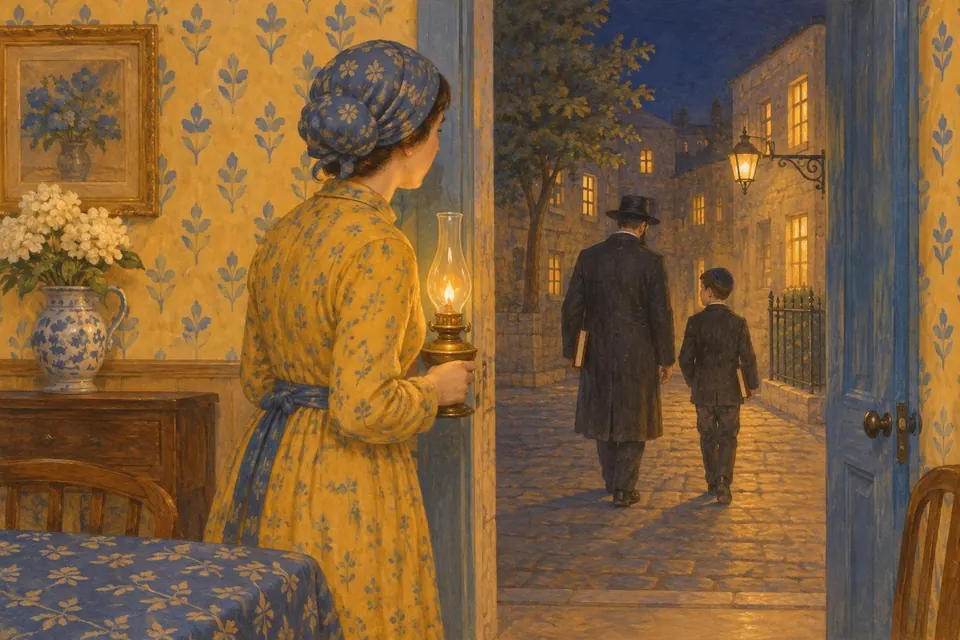
He answered, “By sending their sons to the house of study, helping their husbands study Torah, and waiting for them to return from the house of study.”
Everyone rightly asks: Don't women have enough mitzvot of their own?
Of course, women are exempt from mitzvot that are tied to a particular time. But there are so many other mitzvot that a woman must fulfill—and does fulfill. Why would she not merit the World to Come through them? Why should she merit it through others, through her husband and sons?
A first, simple explanation comes from Proverbs 6:23: “For a mitzvah is a candle, and Torah is light.” Rashi explains that the light of Torah stays with a person forever, while the light of a candle—the merit of a single mitzvah—is limited.
A more complex explanation is that there are two worlds to come. The first is the world of souls. The body remains here in the earth, while the soul leaves it and ascends higher and higher. It receives its reward and delights in the pleasure God provides. “How precious is Your kindness, God! People take refuge in the shadow of Your wings. They are satisfied by the abundance of Your house, and You give them drink from Your stream of delights” (Psalms 36:8–9).
The human mind cannot imagine this, nor can human senses feel it. It is spiritual; our physical bodies simply cannot conceive of it. It cannot be described in terms we can understand. Our Sages said, “One hour of pleasure in the World to Come is better than all the life of this world” (Mishnah Avot 4:17). And “life in this world” does not mean the life of an ordinary person. It means the life of princes and kings, people who know pleasure and whose lives are full of it. Yet in the World to Come, the soul of the simplest Jew receives, in every hour, more than such a whole “life” can give.
How can we understand this? How can we explain color to a blind person? Could we put a rose in their hand and begin to describe the beauty of its pink petals? We have no tools with which to understand the World to Come and the beauty of the life of souls there. That is the first world, the world of souls.
But the body has a complaint to bring before God. “Master of the universe! The soul has certainly done well. But with all due respect to it, who went to the synagogue? Who went to the house of study? Who lifted the lulav (the palm branch used on Sukkot)? The soul? No, the body did. Doesn't the body deserve a little pleasure as a reward? The soul rises, and the body is left behind, abandoned?”
The Mishnah (Sanhedrin 10:1; see Sanhedrin 90a) says that a person who denies the resurrection of the dead has no share in the World to Come. The Talmud asks why. Because that person refused to acknowledge the resurrection of the dead, they will not receive a share in the World to Come. From this we learn that the second world to come is the world of the resurrection of the dead, which is necessary so that the body, too, can receive its reward for the mitzvot. After all, it was the body that ate matzah on the night of the Passover Seder, not the soul. God, blessed be His name, does not withhold the reward of any of His creatures.
Rav's question concerned the world of the resurrection of the dead, not the world of souls. In the world of souls, both women and men receive reward for the mitzvot they have performed.
As Boaz said, “May the Lord reward you for what you have done, and may you receive a full reward from the Lord, God of Israel, under whose wings you have come to take refuge” (Ruth 2:12).
Rav's question concerned the world of the resurrection of the dead. The Talmud (Ketubot 111b) says:
Rabbi Elazar said, “Those who are not learned in Torah will not rise at the resurrection of the dead.”
Rabbi Yochanan asked Rabbi Elazar, “Will only the Sages rise, and not ordinary people?”
He answered, “I derive it from what is written: ‘Your dead shall live; their bodies shall rise. Awake and sing, you who dwell in the dust, for Your dew is a dew of lights, and the earth shall bring forth the dead’” (Isaiah 26:19).
The “dew of lights”—tal orot, with or meaning light—refers to Torah. A person who has the light of Torah will be brought back to life by Torah. A person without the light of Torah cannot be brought back to life by it.
According to this, most of the people of Israel would have no share in the resurrection of the dead. Rabbi Yochanan could not accept that. His disagreement was an expression of his daat Torah, his insight into Torah. Seeing his teacher's inward disagreement and pain, Rabbi Elazar found a way for ordinary people, too, to merit resurrection.
He said, “Rabbi, I have found a remedy for them in the Torah: ‘But you who cling to the Lord your God are all alive today’” (Deuteronomy 4:4).
“All alive” means alive in their entirety: the resurrection of the dead, when soul and body are together. But who are those who “cling to the Lord”? Is it possible to cling to the Divine Presence? After all, the Lord your God is a consuming fire. How can one approach fire?
The answer is that clinging to God means drawing close to those who study His Torah. This means, for example, assisting them in their affairs and helping them and their children marry. In this way, even those who do not study Torah can cling to God. They may not study to the same extent themselves, but they help yeshivas and financially support children studying in a Talmud Torah, a school for Torah study, and those who have devoted themselves to Torah study in a kollel, a Torah study program for adults. “Without flour, there is no Torah!” [Mishnah Avot 3:17] Therefore, those who support people who study Torah deserve a reward: a share in the future world of the resurrection of the dead.
Are Women Obligated to Study Torah?#
“You shall teach them—the words of Torah—to your sons, to speak of them when you sit in your home, when you walk on the road, when you lie down, and when you rise” (Deuteronomy 11:19). Your sons, but not your daughters!
Girls are exempt from the study of Torah, even though they would receive reward as “one who is not obligated but does it.” How, then, can these poor women, deprived of the light of Torah, rise at the resurrection of the dead? Rabbi Chiya's answer is that women help their husbands and sons: they “send their sons to the house of study, help their husbands study Torah, and wait for them to return from the house of study.” A woman sends her family members to study, supports and heartens them, and encourages their efforts.
Rabbi Chaim Yosef David Azulai writes in his book Petach Einayim that the passage in Ketubot cited above can be understood as follows: only those who study Torah will live in the future world of the resurrection of the dead; those who do not study it will not, as it is written, “For Your dew is a dew of lights” (Isaiah 26:19). Yet God, blessed be He, made a great promise to women: “Rise, women at ease, and hear My voice! Carefree daughters, listen to My words!” (Isaiah 32:9).
How will they merit to rise at the resurrection of the dead, if they do not study Torah? The answer is that women's merit lies in “sending their sons to the house of study, helping their husbands study Torah, and waiting for them to return from the house of study.” Through this merit, “women at ease” will rise.
In Avot, chapter 6, we read:
“When you walk, it will guide you; when you lie down, it will guard you; and when you awake, it will speak with you” (Proverbs 6:22). “When you walk, it will guide you”—in this world; “when you lie down, it will guard you”—in the grave; “when you awake, it will speak for you”—words of intercession in the World to Come. [Mishnah Avot 6:9]
Why add “when you awake, it will speak for you”? Doesn't the entire verse praise Torah? Torah and mitzvot together help and protect a person in this world and in the world of souls. But in the world of the resurrection of the dead, mitzvot do not help; only Torah does. That is why the verse singles out “it will speak for you”: it is Torah, and no other mitzvah.
There is one more point to add. The Talmud explains in Kiddushin 30a: “I created the yetzer hara—the evil inclination—and I created Torah as its remedy.” Men who study Torah, then, have a remedy against the evil inclination. But how can women overcome it? Here, too, Rabbi Chiya's answer helps us: “By sending their sons to the house of study and helping their husbands study Torah.” Through the merit of helping their husbands and sons, women receive special strength to fight the evil inclination.
What Can Such a Wife Be Compared To?#
Psalms 68:13 says, “The kings of armies flee, they withdraw, and the woman who remains at home divides the spoils.”
Who are the “kings of armies”? They are those who study Torah, who go out each day to add more and more Torah and mitzvot, like a king who goes to war to expand his territory. And who is “the woman who remains at home”? These are the women who, while at home, receive a share in their husbands' reward for Torah study. Their reward is as great as their husbands'.
The Talmud also says in Yoma 77a:
Rabbi Isaac said: What is the meaning of the verse, “In vain you rise early and sit up late, eating the bread of toil; He gives sleep to His beloved” (Psalms 127:2)?
This refers to the wives of talmidei chachamim, Torah scholars, who drive sleep from their eyes by rising early in this world. God will satisfy them with the light of the Divine Presence in the World to Come.
Rabbi Chaim Abulafia explains it this way in Mikraei Kodesh (57:3): The verse instructs ordinary Jews, workers and craftspeople, who work so hard that they drive sleep from their eyes in order to improve their lives in the corridor—that is, in this world. But they do not make the effort to build their true home, the World to Come.
Then ordinary Jews say, “What can we do? We have not merited to study Torah. We have no teacher.” He answers them, “He gives sleep to His beloved”: the Hebrew word for sleep, shenah, shares a root with shinun, study. The wives of those who study Torah also drive sleep from their eyes as they help their husbands and wait for them to return from the house of study. For their help and their waiting, they receive a reward in the World to Come alongside their husbands. You, too, ordinary Jews, can help those who study Torah and thereby merit a reward with them in the World to Come.
A question arises: It is clear that sending children to a Talmud Torah is a great mitzvah, one without equal, for “the study of Torah is greater than them all.” [Mishnah Peah 1:1]
But what merit is there in waiting for a husband after he studies? What is so great about that?
The answer is that a wife badly needs her husband's help, and he comes home late, having devoted his day to intensive Torah study. But despite the fatigue, she should value her husband who studies Torah, wait for him, give him food and drink, ask how his day went, and find out what else he needs. Perhaps he is tired and needs something prepared, or perhaps he has caught a cold, is hot, and so on. By showing this care, a wife demonstrates how much she values his efforts and how important his Torah study is to her. The same applies to sons.
Such a woman's sons will grow strong in Torah, and through them she will receive nachat (benefit) in the World to Come. She will receive an equal share with her husband in the merit she gains through his Torah study. The merit of her sons' Torah, meanwhile, will raise her soul higher and higher in the world of souls.
What does the verse in Psalms mean: “They go from strength to strength; he appears before God in Zion, the Lord, God of hosts”? Our Sages explain in Berakhot that “from strength to strength” means that “the righteous have no rest, either in this world or in the World to Come”: there they ascend ever higher, from one level of holiness to another, through their descendants and students. [Psalms 84:8–9; Berakhot 64a]
There was a Jewish sage, Rabbi Yaakov Yitzchak Horowitz, known as the Seer of Lublin. Every day thousands of Hasidim came to consult him and ask him to pray for them. There were so many people that the rabbi spent the whole day receiving visitors.
“They made me keeper of the vineyards, but I did not keep my own vineyard” (Song of Songs 1:6). The rabbi began to wonder what would become of his own Torah study under these circumstances. He had no time at all, since he received visitors all day.
He called his gabbai, his attendant, and said that from then on he would set aside three hours each day, from nine to twelve, just for study. No one was to enter during that time; the gabbai was to stand guard at the door himself.
Some time passed. One day the gabbai rushed into the room and said, “I can't bear it anymore. There's a woman sitting in the waiting room who looks about 90. She's crying and asking to be let in. I can't keep turning her away when I see her tears.”
The rabbi replied, “All right, we'll make an exception just this once today. Let her in.”
The woman entered and asked, “Does the rabbi recognize me? No? Then let me introduce myself. I was your wet nurse. Your father wanted his son to be nursed by a woman who never ate anything without saying a blessing. He looked for such a nurse and found me. I had the privilege of nursing you. Thank God, you've become a great teacher of Israel.
“Now I have one request, Rabbi. I'm over 90. All my sons died in my lifetime, and there's no one to say Kaddish for me. You're almost like a son to me. I'm asking you to say Kaddish for me.”
The Seer of Lublin promised the woman that he would say Kaddish for her.
Apparently, the former nurse had sensed that her time was near, because she passed away a week later. The rabbi put aside all his affairs and attended her funeral, walking behind her body and crying like a close relative. He said Kaddish for her, did good deeds to elevate her soul, and gave tzedakah. For 30 days he made sure to perform mitzvot in memory of his nurse.
On the night of the 31st day, he had a dream. In it, he saw the woman smiling, dressed in shining white. She spoke to him: “Rabbi, please stop saying Kaddish!”
“Why?” he asked. “Am I not saying Kaddish well?”
“No, quite the opposite!” she answered. “The Kaddish is too good! You can't imagine what's happening. Every time you say Kaddish, an angel comes to me and says, ‘Madam, this is no longer your place. You must rise higher.’ And it happens again and again—higher and higher. I'm sitting now with such righteous women that I don't even understand their language. It's the language of the wise, and I'm a simple woman. I'm very grateful, but there's no need for more.”
Yalkut Shimoni on Proverbs, section 964, says:
Rabbi Isaac ben Nechama said, “Just as God gave the Torah with 22 letters, so He praises righteous women with 22 letters.”
This refers to Eshet Chayil, “A Woman of Valor,” King Solomon's hymn to the Jewish woman. It says there, “Her children rise and praise her; her husband, too, praises her” (Proverbs 31:28). How do we know that everything said earlier in Eshet Chayil is true? Because “her children rise and praise her.” The Hebrew yeashruha can also be translated as “confirm her”: the fact that her sons became great in Torah confirms that their mother possessed all the qualities of an eshet chayil.
A woman who enables her husband to sit peacefully “at the city gates,” “among the elders of the land,” studying Torah in our difficult times, is a true woman of valor, worthy of receiving a reward equal to her husband's.
Based on articles by Rabbi Ovadia Yosef, Rabbi Yitzchak Yosef, Rabbi Reuven Elbaz, and Rabbi Benayahu Shmueli in the book Esh Shalhevet Kah.
Keep reading
More →Hanukkah: The Torah Will Not Be Forgotten
Hanukkah reveals why every Jew has a share in preserving the Torah for future generations.
Torah StudyWhy Must Everyone Study Torah?
The Talmud’s examples of Hillel, Rabbi Elazar, and Joseph show why circumstances do not excuse neglecting Torah study.

Lech Lecha: Where Are You Going?