The Sweetness of Torah
What does it mean to taste the sweetness of Torah study?
In brief
- The Or HaChaim says that Torah contains all the goodness in the world.
- The pleasure of Torah study is part of the mitzvah and helps what we learn take root.
- The Talmud tells of sages whose faces shone with the joy of wisdom.
- A person may not yet recognize the value and sweetness of Torah.
“Rejoice in all the good that the Lord your God has given you and your household” (Deuteronomy 26:11).
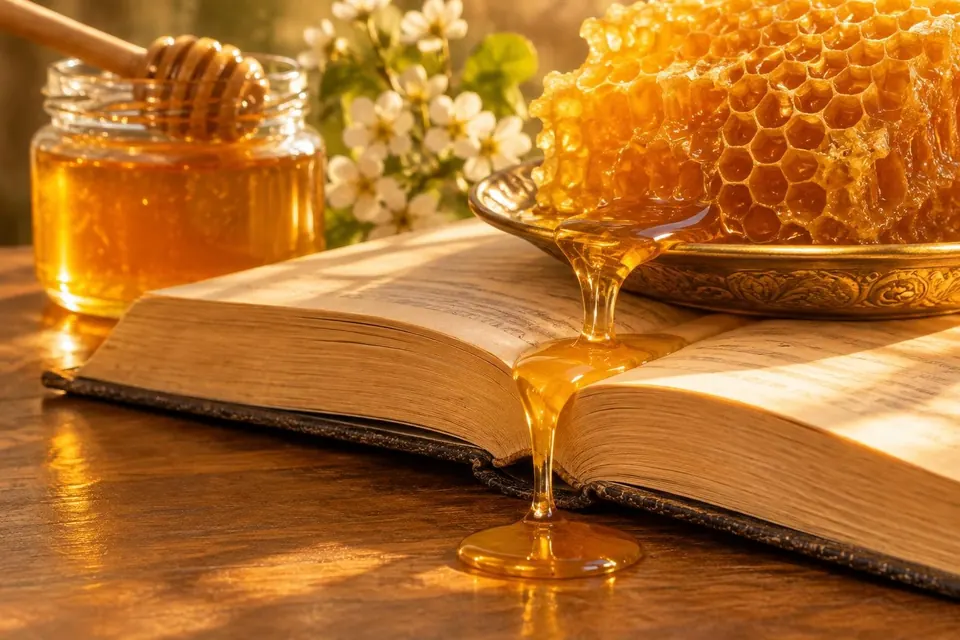
Rabbi Chaim ben Atar, author of the great Torah commentary Or HaChaim, wrote: “‘All the good’ is an allusion to the Torah, as the Sages say, ‘There is no good but Torah’ [Berakhot 5a]. As Proverbs says, ‘I have given you a good teaching; do not abandon My Torah’ [Proverbs 4:2]. If people could feel the sweetness and delight of Torah, they would be carried away with excitement, and all the gold and silver in the world would mean nothing to them. For Torah contains all the blessings and all the goodness of this world.”
If only you could have seen the light shining on the Steipler’s face as he studied, and the sweetness he poured into his ideas. What can I say? Anyone who studies a single passage in his book Kehilot Yaakov can see its author before their eyes. The Steipler, Rabbi Yaakov Yisrael Kanievsky, once said to me with a smile, “Rabbi Yaakov, the blessing over Torah is not only a blessing over a mitzvah. It is a blessing over a pleasure!”
The introduction to Iglei Tal says that the pleasure of studying is part of the mitzvah of Torah study. The greater the pleasure, the more deeply the learning takes root.
They tell a story about Rabbi Alexander Ziskind, author of Yesod VeShoresh HaAvodah. Once, while walking down a street in Grodno, he saw an ordinary man who looked very happy and content. The rabbi wondered, “What makes him so happy? Has he ever in his life tasted the pleasure of understanding a difficult passage in the Rashba?”
The Talmud (Nedarim 49b) tells of a woman who saw Rabbi Yehudah presiding over a Torah court. His face was red, like a drunkard’s. Surprised, she asked, “Is that how you do things—judging cases and issuing rulings while drunk?”
He answered her, “I give you my word, I do not touch wine except for Kiddush, Havdalah, and the four cups at Passover. Even then, my head aches afterward until Shavuot. Rather, ‘A person’s wisdom lights up his face’” [Ecclesiastes 8:1].
The Jerusalem Talmud (Shekalim) tells another story. When Rabbi Abbahu arrived in Tiberias, Rabbi Yochanan’s students came and told their teacher that Rabbi Abbahu had found a treasure on his way there.
“Why do you think so?” he asked.
“His face is simply glowing with joy!” they answered.
Rabbi Yochanan got up, went to Rabbi Abbahu, and asked him, “What new Torah teaching have you heard?”
“An ancient tosefta (an early rabbinic teaching from outside the Mishnah),” he replied. “I didn’t know it before!”
Then Rabbi Yochanan exclaimed, “A person’s wisdom lights up his face!” [Ecclesiastes 8:1]
When I read aloud the words of the Or HaChaim on our Torah portion, one man asked me, “I don’t understand. I study and study, but I don’t feel any taste, any sweetness! How can that be?”
And indeed, we need to understand what Rabbi Chaim meant when he said, “If people could feel the sweetness and delight of Torah.” Surely, what is sweet is sweet to everyone. Isn’t it?
So the man asked, “What am I—disabled, someone who can’t taste or smell?”
I answered him, “You’re not disabled. You’re just a rooster, if you’ll pardon me.”
“I’m a what?! Why are you insulting me, Rabbi? Either apologize or explain!”
“Of course I’ll explain,” I answered. “Listen to this story. A woman got up to wash her hands before the Shabbat meal. She took off her diamond ring and put it on the table. She ate, got up, and forgot to take the ring. After the meal, they took the tablecloth and shook it out thoroughly over the garbage heap—ring and all.
“The sun was warm, and the smell of food reached a rooster. He hobbled over to the heap and began pecking. What a pleasure—a real Shabbat feast! Leftover meat and fish, and even some dessert to be found. Suddenly he saw something shining: a gold ring with a huge diamond. He pecked at it and spat it out. Hard, tasteless. Yuck! He tossed the ring away in disgust; it was no use to him. But when he saw a piece of soft challah soaked in gravy, his eyes lit up!
“So what would we say about him? That his sense of taste is distorted? That he’s disabled? Of course not. He’s just a rooster. But don’t take it to heart. You’re in good company—in other words, unfortunately, there are a great many people like that in our time.”
By Rabbi Yaakov Galinsky
Keep reading
More →Hanukkah: The Torah Will Not Be Forgotten
Hanukkah reveals why every Jew has a share in preserving the Torah for future generations.
Torah StudyWhy Must Everyone Study Torah?
The Talmud’s examples of Hillel, Rabbi Elazar, and Joseph show why circumstances do not excuse neglecting Torah study.

Lech Lecha: Where Are You Going?