Why Is Torah Study Called Rest?
Jacob’s blessing to Issachar reveals a surprising path to true rest.
In brief
- Jacob’s blessing connects Issachar’s love of rest with taking on a burden.
- The Sages explain that the rest in the verse represents Torah study.
- Ordinary attempts to relax can require unexpected effort.
- Someone willing to work at Torah study can gain true rest and peace of mind.
Parashat Vayechi#
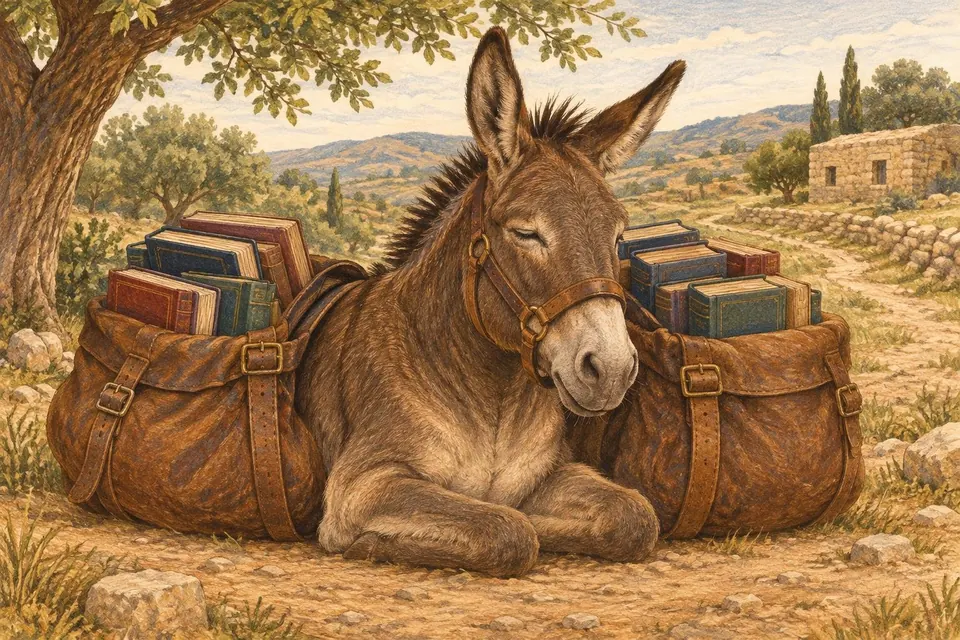
“He saw that rest was good and that the land was pleasant, and he bent his shoulder to bear the burden” (Genesis 49:15).
At first glance, there seems to be a contradiction. He saw that rest and peace of mind were good, and so he “bent his shoulder to bear the burden” and accepted a difficult life? A person who loves rest does just the opposite: he does nothing. He sits in a comfortable chair, drinks coffee, and reads an interesting book. That is roughly what we think of as rest. What does bending one’s shoulder to a burden have to do with it?
This verse speaks about the tribe of Issachar, whose members were especially distinguished by their Torah study. Members of the tribe served as heads of the Sanhedrins. Our Sages explain that rest represents Torah study. That, too, needs explanation. Can Torah study really be called rest? Torah is acquired only through hard work. Pirkei Avot (Ethics of the Fathers) lists the things through which Torah can be acquired, including “less pleasure and less sleep” [Mishnah Avot 6:6]. Can getting less sleep be called rest?
There are, of course, profound and valid explanations for why Torah is called rest. But it is also true in the most straightforward sense. Simply put, rest is granted only to someone who is willing to suffer a little and make an effort.
Consider an example from everyday life. Reuven has worked hard all morning and decides to go home early for a little rest. He arrives home, asks for something to eat and drink, and sits down in an armchair to read something interesting while he waits. His wife brings him food and a drink, and he says a blessing and begins to eat. Suddenly, he notices that the food does not taste very good: it needs salt. A little irritated, in the middle of his “rest,” he calls out, “Could I have some salt?” But no one is nearby, and no one hears him. He calls louder, “Bring me the salt!” Still, there is no answer.
Apparently, his wife has gone shopping, and the children are not home yet. There is nothing to do but get up and fetch the salt himself. He sits down again. No, it still does not taste good. He goes to get some mustard. He tries his drink. Is this what they call lemonade? He goes and adds a little sugar and a little lemon. That is better. But the book is not interesting.
He gets up a fourth time and searches the house. There is nothing to read! All right, no point being lazy. He puts on his coat and goes out to buy something interesting. Once outside, he discovers that someone in the family has taken the car. All right, he will walk to the shopping center. The walk is a little tiring, but what wouldn’t you do for some rest?
He buys something interesting and returns home. He sits down in the armchair. Is this what they call an armchair? The springs are sticking out, and it is older than his grandmother! Come to think of it, since he came home early, the stores are still open. And he has wanted to buy a new armchair for a long time.
Reuven goes back to the shopping center, visits several stores, finally finds a suitable armchair, and hauls it home. Well, thank God, now he can rest. But by now the children have come home and discovered the new chair. “I want to sit in it!” “No, you already sat there. Now it’s my turn!” The fighting goes on and on. Each of us can imagine the rest of this wonderful day of relaxation.
How remarkable, then, are the Torah’s words: “He saw that rest was good … and he bent his shoulder to bear the burden.” This, and only this, is the way: someone who is willing to suffer a little while devoting themselves to Torah study merits true rest and peace of mind.
By Rabbi Shimshon Pincus
Keep reading
More →Hanukkah: The Torah Will Not Be Forgotten
Hanukkah reveals why every Jew has a share in preserving the Torah for future generations.
Torah StudyWhy Must Everyone Study Torah?
The Talmud’s examples of Hillel, Rabbi Elazar, and Joseph show why circumstances do not excuse neglecting Torah study.

Lech Lecha: Where Are You Going?