Modern Kashrut: Supplements, GMOs, and Lab-Grown Meat
A rabbi surveys the Shabbat and kashrut questions raised by dietary supplements, genetically modified organisms, and meat grown in a laboratory.
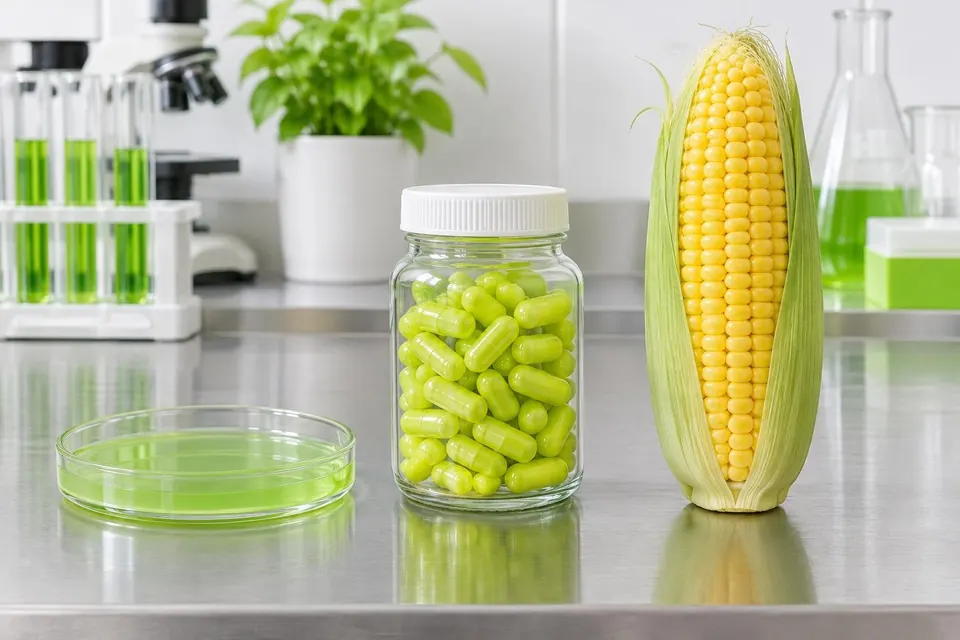
In brief
- Whether vitamins and supplements may be taken on Shabbat depends on whether they are taken as a medicine or to maintain general health.
- Supplements can raise kashrut problems: gelatin capsules, colorings, fish oil, meat and milk mixtures, and grape ingredients.
- The Torah's prohibitions on mixing species are held not to cover laboratory genetic modification, but kashrut questions remain, and the ethics of GMOs sit in a gray zone.
- Rabbis hold three positions on lab-grown meat: it is not meat, its status depends on the growth medium, or it is meat.
The topic we are starting today is partly theoretical and partly practical. It is very broad and very interesting. I am thinking of dividing it into several parts, a mini-series on modern kashrut that will not necessarily run in consecutive lessons. Today is, so to speak, part one. I want to talk about the ethical and halachic aspects (that is, those connected with Jewish religious law, halacha) of three phenomena: nutritional supplements, the so-called "dietary supplements"; genetically modified organisms, GMOs (I like that abbreviation, it sounds so good); and something that was still a fantasy just a year ago and has now become reality: artificial meat, which is to say meat that is real in essence but grown in a test tube.
Supplements: Can You Take Them on Shabbat?#
Supplements are advertised often and very aggressively, and almost all of us come across them one way or another. Observant Jews face two groups of questions here.
The first: may one take supplements (and vitamins, probably, can be counted among them) on Shabbat? Already in the era of the Talmud, the Sages forbade seeking medical treatment or taking medicine on Shabbat. This is naturally not about someone who is seriously ill or whose life is in danger. It is about a non-critical condition, where the rabbis forbade taking medicine on Shabbat. How sick or unwell a person must be for this rabbinic prohibition not to apply to them is a separate topic within the laws of Shabbat. Our question here is different. A supplement is an addition to food, but some people see it as a medicine, or as an alternative medicine. Does Jewish law consider it a medicine, or is it still food, an addition to food? The answer is not obvious, all the more so because there are different kinds of supplements. Some present themselves as medicinal products, or people understand them that way. Others are simply an addition that makes us healthier or can, in theory, relieve some symptoms.
The rabbis have discussed vitamins in the context of the laws of Shabbat for a very long time, and there are several opinions. Everyone agrees on one point. If a person takes vitamins as a medicine (for example, a doctor told them, "For a cold you need to take vitamin C," and they take vitamin C because they think it will treat them), then under Jewish law it is a medicine, and it is forbidden to take it on Shabbat. But if a person takes a multivitamin to maintain their health or energy, some rabbis say it is permitted on Shabbat, while others say it is better to refrain because it is too similar to a medicine.
Supplements: Kashrut Problems#
The second aspect is the laws of kashrut. Kashrut is not only about whether the ingredients of a product might include parts of non-kosher animals. It is a whole bouquet of other problems. If we analyze what kashrut difficulties vitamins and supplements can have, we can identify the following. I may have missed something; this is what came to mind first.
Gelatin capsules. Supplements and vitamins are often powders or small portions of liquid (elixirs) enclosed in gelatin capsules. The status of gelatin in Jewish law is unclear. Almost all modern gelatin is made from processed animal hides and bones, including those of pigs. There is gelatin made from fish bones, and there is artificial, synthesized gelatin, but it is mostly made from something that is surely not kosher. However, the final product is very different from the raw material: it looks nothing like what it was made from, and it is not quite food. For this reason, more than a hundred years ago many rabbis did not consider gelatin non-kosher. Other rabbis think differently, and in any case the question is disputed and unclear. This is worth keeping in mind when you buy a fashionable supplement in a gelatin capsule: from the standpoint of kashrut it may be problematic.
Colorings. Nowadays almost all colorings in the food industry are synthetic. But I have never studied this question in depth, and I assume that supplements that present themselves as healthy and beneficial must use ingredients of natural origin. Some colorings that are made not synthetically but from natural raw materials can be non-kosher, for example carmine, a red coloring. This too needs attention.
Fish oil and omega-3. This is perhaps the most problematic supplement from the standpoint of kashrut: everything made from fish. Many fish are not kosher, so omega-3 or fish oil from a non-kosher fish is also not kosher. Moreover, even if we assume that a supplement is made from a kosher fish, that does not mean the capsule we are buying is kosher. It is not certified, we do not know exactly what is in it, and it is not always possible to rely on the manufacturer's claims. Therefore supplements based on fish must carry a kosher certification, meaning that someone has verified exactly what they are made from.
A mixture of meat and milk. In theory, and I am only speculating here, since I have not come across such a case, a supplement might contain dairy derivatives (whey, lactose, sugar obtained from a dairy base) together with something from bones, or the same gelatin. The prohibition of meat with milk applies not only when we eat such a mixture but also when we derive some benefit from the mixture, even if it hardly resembles food. The same, in theory, applies to animal feed. When you buy food for your cat or dog, you also need to check the ingredients so that there is no problem of meat and milk.
Non-Jewish wine. Hypothetically, if a supplement is a juice or an elixir, it may contain ingredients from grapes or grape juice, and then the theoretical problem of non-Jewish wine arises, yet another kashrut problem.
Some of these problems are only theoretical, and perhaps in practice they never occur. But we need to keep them in mind if we want a supplement to be not only healthy but also kosher. I will not go into the essence of supplements themselves. I am not a specialist or a doctor, I do not understand how they work, and so I cannot say with confidence whether they are a medicine from the standpoint of Jewish law.
GMOs: From Corn to Salmon and "Fruit Salad" Trees#
Now to two amazing, truly wondrous topics that are also connected with kashrut. The first is GMOs, "genetically modified organisms." We have been dealing with such organisms for many years, if not centuries. In a way, ordinary corn, the kind we are used to seeing with even yellow or orange kernels, is genetically modified, selectively bred corn. The original corn that grows in America looks completely different (I tried to find a picture of a relatively appetizing one). Bananas, tomatoes, potatoes, even apples are also genetically modified in a way, because they have very little in common with their wild ancestors: people selected and developed these kinds of vegetables and fruits. Technically, these too are GMOs.
But when we speak of real genetic experiments and inventions, we mean something truly fantastic. A small lyrical digression. I once saw a trailer for a film about the end of the world, an epidemic, a zombie apocalypse. People who have escaped the zombies walk into a store where everything is covered in dust and no one has been for a long time, and on the counter lie the familiar green apples that are sold in any supermarket. This is not entirely fiction. Some varieties of apples, bred artificially by people, can be stored for a very long time. It is not even about the wax and glycerin that are used to coat apples, but about the special variety.
Until recently, when we spoke about genetically modified organisms, we mostly meant plants: fruits and vegetables. But a few years ago, American government agencies approved the breeding and sale of genetically modified salmon. Atlantic salmon (lox, salmon) is a fish that everyone loves, very tasty and kosher. In America they have developed genetically modified salmon that are raised artificially in special pools. They are very large, their flesh is juicy, and they do not get sick (monsters, but in a good sense). This is no longer just scientists' experiments but something you can buy in practically any store.
Another example, and this is not a joke: a few years ago in Australia they began selling "fruit salad trees," Fruit Salad Trees. These are citrus trees on which five different kinds of citrus grow at once or in turn: lemons, oranges, pomelos, mandarins, and something else. Pomelos grow on one side of the tree and mandarins on the other. It is not a mixture or a hybrid: mandarins and oranges grow on different branches, each with its own flavor. These trees are sold, admittedly, only in Australia. I found the website of the company that breeds them, and it even has instructions on how to make a similar genetically modified tree practically with your own hands. Research continues, and there are tentative attempts to genetically modify animals and even, possibly, people. This is a taboo topic. People talk about it little, and it is considered not very ethical even in entirely secular scientific circles, but attempts are made all the same. The more scientists study the genomes of plants and people and understand how all the biological diversity of the world interacts, the more such inventions we will see.
The question remains: is this permitted under Jewish law? Does the Torah allow genetically modified organisms, from the standpoint of the Torah's ethical and philosophical side and from the standpoint of the laws of kashrut? Can one buy that very Fruit Salad Tree, and which aspects of Jewish law apply to it? Is American genetically modified salmon kosher? We can also fantasize (though I think it will soon become reality): what would the law say if scientists combined the genes of a kosher and a non-kosher fish and produced a salmon that is half, for example, eel or catfish (non-kosher fish)? It could work the other way around too: catfish or eels could be bred with scales and fins. The same goes for poultry, for example special turkeys with an elephant's genome. This is not quite fantasy; it may well happen. How does Jewish law treat this?
The Ethical Side: Two Contradictory Sources#
Let us begin with ethics. In the description of the creation of plants at the very beginning of the Torah, we read: "And God said: 'Let the earth sprout vegetation, seed-bearing grass, fruit trees that bear fruit according to their kind, in which is their seed, on the earth.' And it was so. And the earth brought forth vegetation, seed-bearing grass according to its kind" (Genesis 1:11-12). God created plants according to their classification, by kinds. Already in the Torah itself we see that the world He created, in all its diversity, is divided into categories. Some commentators on the Torah, for example the Sefer HaChinuch, which explains the mitzvot, say that the Torah's prohibitions against crossbreeding and creating hybrids exist because the particular diversity and groups of living organisms created at the Creation must remain as they are. The world must not change, species must not be mixed, the ideal world made by the Creator must stay that way, and we should not interfere much in the process.
It would seem to be simple: by the Torah's ethical rules GMOs are forbidden, it is bad, we should not engage in this. But it is not so simple. In Jewish religious literature there are two sources that contradict each other.
The first is a passage of the Talmud about the creation of the world. The Sage Rabbi Yosei says that there were two things God planned to create during the six days of Creation but created at the departure of Shabbat, motzei Shabbat. One of them is fire. God showed Adam how to produce fire, and that is why at the departure of Shabbat we have the ritual of Havdalah and light a special candle. It refers precisely to this comment of the Talmud. This is a relatively well-known point. But the same passage reports that God brought two animals to Adam, and after they were crossbred a third came out, the mule, a mixture of donkey and horse. God had planned it but had not created it. Therefore the Torah's verses saying that everything was created according to its kind and species do not, to some extent, apply to the mule: God created the mule only at the end of the seventh day of Creation, at the departure of Shabbat. It turns out that within certain limits, breeding new species or genetic modification is ethical and permitted. After all, one can always say that we are not creating anything new, and that it was built in by the Creator during the six days of Creation, as in that story with Adam. [Pesachim 54a]
The second source is the weekly portion of Vayishlach, which gives the genealogy of Esau's descendants. There is a verse there that few people pay attention to: "These are the sons of Tzivon: Ayah and Anah" (ve-eleh bnei Tzivon: Ayah ve-Anah). Like the other verses of that portion, it simply names people, but then the Torah gives an additional detail: "This is the Anah who found..." (matza et ha-yemim ba-midbar). In the Russian translation printed in the "little blue books" (I took it from there and do not remember exactly whose it is), the word yemim is translated as "mules": "He found mules in the wilderness as he pastured the donkeys of Tzivon his father" (Genesis 36:24). The commentaries on the Torah report that he did not simply find them but, one might say, invented them. One of the commentaries says that Anah, by analogy with Adam (apparently without knowing about it), crossbred horses and donkeys and got mules.
Next, a passage of the Oral Torah that explains this story (this is the Jerusalem Talmud [Berakhot 8:5], a commentary of our Sages) says that when God saw that Anah had done this, He said that it was bad, that it could harm the world and even destroy it. Why do we need to know this, why does the Torah tell it? Because any negative action of ours causes a negative reaction in the spiritual world, just as a positive one causes a positive reaction. And God's reaction to the deed of Anah, who created mules, was that He crossbred a snake and a turtle, and a new, very poisonous organism came out: a super-venomous snake that did people a great deal of harm and perhaps still crawls somewhere in the Asian deserts. From this passage it is clear that crossbreeding living organisms is not good, even when it produces harmless mules. And in the first passage, God Himself shows Adam how to do it. This gives us a contradiction.
The commentators on this story in the tractate Pesachim of the Babylonian Talmud explain it. They suggest that everything depends on the circumstances, on the intention of the person who modifies the organism. If they are driven by useful, good, holy motives, it is permitted, since it was built in by God during the six days of Creation. If a person is driven by selfish, negative motives, it is bad, as in the story of Anah, son of Tzivon. To sum up: the ethical aspect of genetic modification is not simple. We cannot say for certain either that it is bad or that it is good. It all depends, as the commentators on the Talmud in the tractate Pesachim say, on the person's intentions. But what these intentions must be, these same rabbis do not define for us. So the question sits, so to speak, in a gray zone of Jewish ethics.
The Torah's Prohibitions on Mixing and Genetic Engineering#
Now to Jewish law. The Torah has quite a few prohibitions against crossbreeding and mixing anything, not only organisms, plants and animals, but even clothing. The book of Leviticus says: "Keep My statutes: do not breed your livestock with a different kind" (a prohibition against crossbreeding animals), "do not sow your field with two kinds of seed" (this prohibition is called kilayim), and one may not wear clothing of mixed fabric, wool and linen (this prohibition is known as shaatnez) (Leviticus 19:19).
In all, the Torah has six, and actually seven, prohibitions against mixing one thing with another or deriving benefit from a mixture:
- Shaatnez: it applies only to clothing whose fabric consists of wool and linen;
- the prohibition against crossbreeding animals of different species to produce another species;
- the prohibition against working with two types of animals at once (this is not crossbreeding but work);
- the prohibition against crossbreeding fruit trees, producing a third kind from two kinds of fruit trees;
- a separate prohibition against growing any plant in a vineyard (fruit or vegetable alike), thereby mixing grapes with other kinds. The grape is a special plant that plays a special role in Jewish tradition (this is a very interesting prohibition, and some time we will certainly talk about grapes and wine);
- the prohibition against growing two different kinds of grain together, side by side, close to each other: wheat and barley and so on may not be planted next to each other.
These are all prohibitions that concern the crossbreeding and mixing of two organisms. Roughly speaking, genetic modification in these categories is forbidden. Most likely almost all of them have no rational explanation, just like the prohibition of mixing meat and milk or shaatnez. One can find attempts by the Sages in the commentaries to explain the essence of these prohibitions, but all of them belong to the category of laws called chok, which are not rationally explainable.
In the Oral Torah the prohibition is somewhat expanded. The prohibition against crossbreeding animals is expanded, in principle, to the crossbreeding of any plants, except those that Jewish law classifies as herbs. The reason is that in the account of Creation the Torah says that God created plants and animals according to their kinds and species, but nothing of the kind is written about herbs, roughly speaking vegetables. So the prohibition does not extend to them, but it does extend to animals and to plants.
Does the prohibition against crossbreeding and developing new organisms apply to non-Jews? This is also an interesting topic. Jewish tradition holds that it does: the prohibition against crossbreeding animals and fruit trees falls within the general category of the seven laws of Noah. The laws of Noah are not just seven items but a whole spectrum of rules, and the prohibition against crossbreeding animals and plants is among them. Whether one may use a crossbred plant and benefit from it, or only the process of crossbreeding itself is forbidden, is yet another topic that there is no time to discuss in detail now. In brief: in some situations, for example if a person has bought a field on which genetically modified (that is, hybridized, crossbred) cucumbers or cherries are growing, the fruit of those plants may be used. If any of you has a field or an orchard or works in agriculture, then on all these questions you must consult a competent rabbi. There are very, very many nuances.
All of this concerns only manipulation of living organisms by combining and mixing them: planting them side by side, grafting something else onto a fruit tree, crossing a grapefruit with a grape, developing a new species of grain from existing ones. The Torah forbids this, and in some cases forbids it even to non-Jews. But do these prohibitions apply to genetic modification, where there are no two physical plants or animals being crossed, and everything happens in laboratories, in test tubes, where the genetic material of one organism is implanted into another? Contemporary rabbis hold that this is permitted and does not fall within these categories of prohibition, because it is not the same thing: the amount of genetic material is small, and it is something invisible to the naked eye. Therefore the Torah's prohibitions do not apply to it.
The Kashrut of Genetically Modified Fish and Animals#
But even if it is not forbidden, many open questions remain, including about kashrut. What if a new species of fish is developed, a fish that was previously kosher, but genes of non-kosher fish are implanted in it? On the outside the fish is kosher, with scales and fins, but in its essence it is not kosher. What will Jewish law say in this situation? The rabbis have no single position. There are two groups who reason in completely different ways, and their reasoning rests on the following question. The signs of kosher animals that the Torah tells us (for a fish, scales and fins; for animals, split hooves and a special arrangement of the stomach, and so on): are they the reason these organisms are permitted by the Torah? Or are they a siman, an indication that the organism is kosher, while the signs themselves do not make a non-kosher animal kosher? According to the first position, if a pig were to develop a special stomach like a cow's, it would have signs of kashrut that would make it a kosher organism. According to the second, the signs of kashrut are merely outward marks, and such a pig with a special stomach would not become kosher.
This is a very interesting topic, which the rabbis developed several centuries ago, but it was always purely theoretical. Now we see that it is slowly coming back onto the agenda. Such organisms have not been developed yet. As far as I know, genetically modified salmon are the only non-plants among GMOs that not only exist in laboratories but are actually sold. But who knows what awaits us in the near future. Then we will have to return to this topic, and the rabbis will have to take a clear position.
Artificial Meat#
Before the questions, I will briefly tell you about one more fascinating, wondrous topic: artificial meat. In the English-speaking part of the internet this product is called Clean Meat. The first attempts by scientists to grow meat in laboratories were made decades ago, but now there are already companies that sell such meat, and it is not very expensive. The industry is developing very quickly, and I assume that in a few years it will be completely accessible: muscles and sinews, with all the texture and flavor, will be created in a laboratory and bought or ordered to one's taste. Today's companies do the work thoroughly, and such meat is practically indistinguishable from ordinary meat in appearance, and those who have tried it say the same about the taste.
A question of halacha: is artificial meat, grown in a test tube, meat? The consequences are very large. May one eat such meat with milk (artificial milk, by the way, has also existed for a long time)? Is it kosher at all? I do not know all the details of the technology, but as I understand it, such meat is produced from the stem cells of some animal, which are grown on special scaffolds and placed in nutrient solutions, and by various manipulations the multiplied cells are given a structure that makes them resemble meat. Suppose the stem cells are taken from a cow that was slaughtered in a kosher way, that is, the cells are, so to speak, kosher, but the medium in which the meat is grown consists of non-kosher ingredients. Or the reverse: the medium consists of some sugars, say fructose, but the stem cells are taken from a non-kosher animal. Will such meat be kosher? And is it considered meat at all? Does one need to wait six hours after eating such meat before drinking milk, and so on? There are many questions, and the rabbis have no single opinion. Analytical articles on this subject appeared more than ten years ago, a large rabbinic study of the question was published in America, and rabbis have touched on it in many places. If we gather all the opinions on this question, which is still theoretical, at least this year, we can find three positions.
The first position: artificially made meat, grown in a laboratory, is not meat, because only the flesh of an animal that was born naturally counts as meat. This opinion is supported by an amusing story from the Talmud about the Sage Rabbi Shimon ben Chalafta. He was walking along a road and met a lion that wanted to eat him. Rabbi Shimon ben Chalafta recited a particular verse from the Prophets, and a miracle happened: two pieces of meat fell from the sky. One fell in front of the lion, and it was distracted by it, so Rabbi Shimon ben Chalafta was able to run away. The second piece he took and brought to the study hall, and he asked his colleagues, "Is this kosher or not kosher?" His colleagues answered that it is kosher, because it fell from heaven: how can something non-kosher come from heaven in a miraculous, unnatural way? Relying on these and similar sources, many rabbis say that artificially produced meat is not meat. According to the principles of the Torah and halacha, only the flesh of an animal that came into the world naturally counts as meat.
The second position: everything depends on the medium in which the artificial meat is grown. Jewish law has the concept of maamid. The Sages say that if some ingredient of a mixture is the main forming one, even if it is in the minority, it plays a large role in the mixture and affects the kashrut status of the product. Therefore if the stem cells, the basis of artificial meat, come from a non-kosher animal, then this meat too may be non-kosher, but it depends on the specific circumstances and the production technology.
The third position: it is meat. It smells like meat, tastes like meat, has the structure of meat, so it is meat, with all the halachic conclusions that follow. (There is no time now to go through the specific case in the Talmud from which this is derived.)
That is my brief, quick survey of these modern, wondrous topics. I hope that in the future we will develop this interesting subject of modern kashrut, and I will try to tell you something more useful and interesting.
From a lesson by Rabbi Daniel Naftoli Surovtsev
Keep reading
More →What Blessing Do You Say on Crackers, Croutons, and Matzah?
The blessing depends on how the food is made, how it is eaten, and, in the case of matzah, family tradition.
Guide · KosherWhat Blessing Do You Say on an Ice Cream Cone?
The blessing depends on how the cone is treated in relation to the ice cream.
KosherCan You Eat Meat and Milk Outside Israel?
A teaching on Parashat Mishpatim explains why the prohibition applies both in Israel and beyond.
ParashaToldot: Finding Holiness in Eating
A meal can be a moment of closeness to God when we recognize the life and pleasure He gives us through food.







