The Havdalah Candle Blessing
When and how to say the blessing over fire at the end of Shabbat.
In brief
- The blessing over fire is said at the end of Shabbat.
- A flame from several joined wicks is preferred, but a single candle may be used.
- The flame must be bright enough to distinguish between different coins.
- The blessing can be said throughout the night after Shabbat, until dawn.
The third blessing of Havdalah is the blessing over fire: בורא מאורי האש, “who creates the lights of fire.” The Sages established that this blessing be said at the end of Shabbat because the Talmud (Pesachim 54b) says that Adam first struck a fire at the end of the first Shabbat after the creation of the world.
The blessing is said over a flame from several wicks. But if there is no special Havdalah candle and no way to join the flames of two candles, the blessing may be said over an ordinary candle or even two burning matches. If there is no way to light a fire at all, the blessing may be omitted and Havdalah recited without it. Someone who did not say the blessing over fire during Havdalah may say it upon seeing a fire at any time during the evening or night after Shabbat. Once dawn has begun the next day, however, the blessing may no longer be said.
The blessing cannot be said over just any fire. It may not be said over a fire lit for heat rather than light, or over one that is not bright enough to distinguish between two different coins.
Someone who cannot make Havdalah over a cup because they have neither wine nor another drink suitable for Havdalah must still say the blessing over fire. The same applies when Tisha B'Av falls on Shabbat and is postponed until the next day, or when it begins at the end of Shabbat. Since eating and drinking are forbidden even in the evening and at night, Havdalah over wine is postponed until the following evening. But the blessing over fire is said at the end of Shabbat, before reading the Scroll of Lamentations.
During Havdalah, it is forbidden to light anything from the flame of the candle used for Havdalah, because it is an object designated for a mitzvah (Shulchan Aruch, Orach Chaim 298:1; Mishnah Berurah, Orach Chaim 298:1–4 and 556:1, Dirshu).
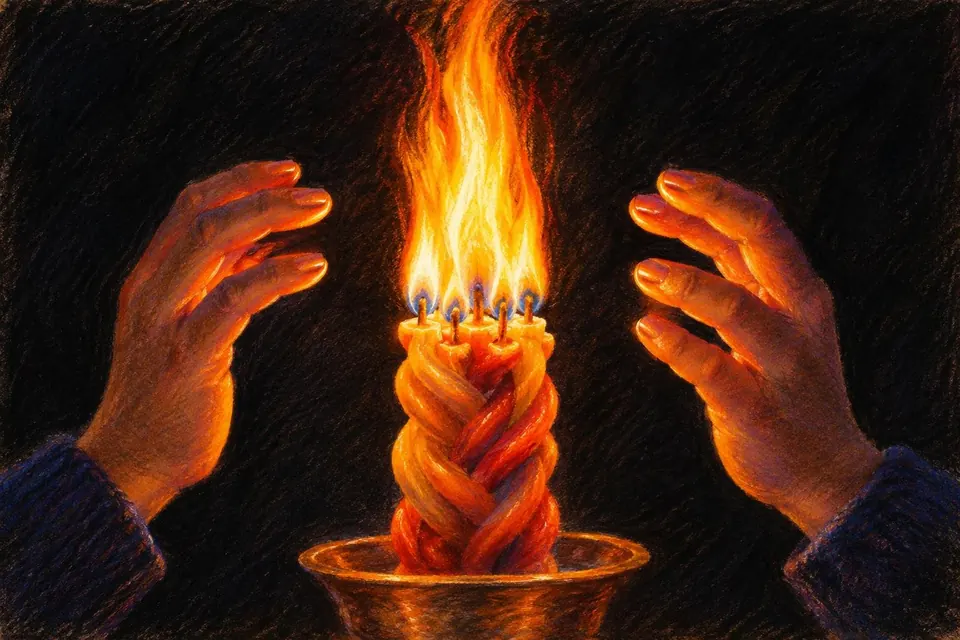
The Talmud says that the blessing over fire should be said over a “bundle”: several wicks joined together. The Mishnah Berurah explains that the wicks should be close enough to one another for their flames to merge into one.
Wax is the best material for a Havdalah candle. It is therefore best to obtain a special braided wax Havdalah candle. If that is not possible, the blessing may be said, as mentioned above, by simply joining two candles together. If that is not possible either, it may be said over one candle. If there is not even one candle, it may be said over two burning matches held together.
The Mishnah Berurah writes that, according to some opinions, the blessing may not be said if the fire is behind glass. It is therefore preferable not to use a kerosene lamp for Havdalah. But if nothing else is available, a kerosene lamp may be used.
Some authorities wrote that when a festival begins at the end of Shabbat, two candles should not be joined, because one might accidentally be extinguished. Rabbi Moshe Feinstein and Rabbi Yosef Shalom Elyashiv, however, permitted joining the flames of two candles even on a festival. The important thing is to remember that it is forbidden to extinguish a fire on a festival.
It is very important to remember that festival candles and Havdalah candles may be lit only after Shabbat ends. When Shabbat precedes a festival, no preparations for the festival may be made on Shabbat, and certainly no work forbidden on Shabbat may be performed.
As we wrote above, before saying the blessing over fire, one should look at its reflection in the fingernails of the right hand. Bend the four fingers so that they cover the thumb, and look at the fingers and palm at the same time. The candlelight should be bright enough to see where the nail ends and the skin of the finger begins.
To say the blessing over fire, one must be able to distinguish by the candlelight between a coin from one country and a coin from another. Someone attending Havdalah in a large crowd who cannot get close enough to the candle may expressly intend not to be included in the blessing over fire said by the person leading Havdalah. After Havdalah, they may approach or take the candle and say the blessing.
On the other hand, if the fire is very bright and its light makes it possible to distinguish coins at a great distance, being far away does not prevent a person from saying the blessing over that light.
The blessing over fire may be said only if the flame was lit for illumination rather than heat. Therefore, the blessing may not be said over the flame of a gas stove. As for a stove lit specifically for Havdalah, Rabbi Shlomo Zalman Auerbach was uncertain whether the blessing over fire could be said in that case. It is therefore better not to do so, but to use a candle (Shulchan Aruch, Orach Chaim 298:3–4; Mishnah Berurah, Orach Chaim 298:9–13).
Practical law. This page reports a ruling given for a specific question. For your own situation, ask a rabbi who knows you.
Keep reading
More →How to Make Havdalah on Wine
A guide to the wine and cup used for Havdalah after Shabbat and holidays.
Keeping Shabbat During the Holocaust: Rabbi Neuwirth’s Story
Guide · ShabbatCan Women Make Havdalah?
- Wine and Women
What Can You Use for Havdalah Without Wine?
Grape juice, raisin broth, and certain other drinks may be used for Havdalah when wine is unavailable.







