Keeping Shabbat During the Holocaust: Rabbi Neuwirth’s Story
Rabbi Yehoshua Yeshaya Neuwirth recalls his family’s survival and the events that inspired his classic book on Shabbat.
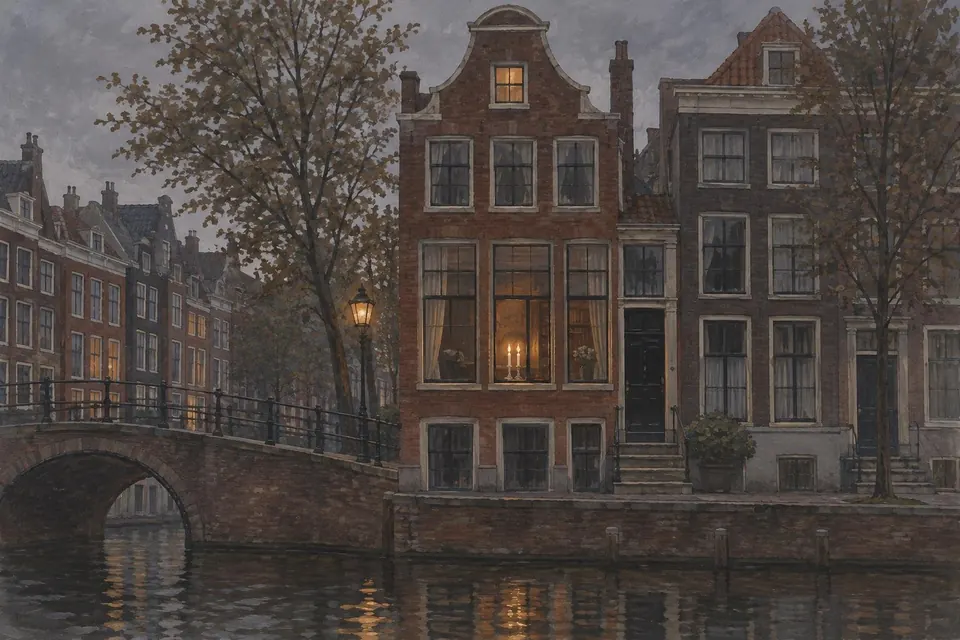
In brief
- Rabbi Neuwirth and his family survived the Nazi occupation while hiding in Amsterdam.
- He recalled moments when keeping Shabbat protected his family.
- After the war, he reached the Land of Israel and studied at Kol Torah in Jerusalem.
- He went on to write a widely used guide to the laws of Shabbat.
The light of Shabbat candles expresses the holiness and centuries-old tradition of Jewish family life. Throughout the ages, the holy day of Shabbat has been one of the enduring symbols of our people. Knowing its laws and observing them in all their details requires sustained, focused study. This is no less important for women than for men.
God has sent many miracles to help our people preserve the holiness of this day. We, in turn, have made great sacrifices to keep Shabbat during times of persecution against our people and our faith.
A Family Reunited in Amsterdam#
With great gratitude for all the blessings the Creator has sent me throughout my life, I would like to tell of the miracles He performed in my youth, during and after the Second World War.
My family lived in Berlin, Germany. When Hitler, may his name be erased, came to power and antisemitism became official state policy, my family decided to leave. My parents sent me and two of my brothers to Belgium.
For the first time in my life, I had to live without my parents. I celebrated my bar mitzvah without my father and mother, with a foster family in Belgium.
After some time, my parents managed to escape Germany. By a special decision of the Dutch queen, a small number of rabbis, including my father, were permitted to enter the Netherlands in 5699 (1939). With God’s help, my parents managed to bring us from Belgium, and our family was reunited in Amsterdam.
There, my parents miraculously managed to contact the Hungarian ambassador. He was sympathetic to Jews, and we obtained special documents from him stating that we were Hungarian subjects awaiting permission to enter the country. These papers later saved our lives. He also helped us avoid having to wear the yellow Stars of David with which the Nazis, may their name be erased, marked Jews.
In 5700 (1940), the Germans occupied the Netherlands. As soon as the occupation began, they turned against the Jews and imposed many restrictions. One was a reduction in food rations. It is important to note that the treatment of Jews in the Netherlands differed significantly from what was happening in the occupied territories of Eastern Europe—editor’s note.
All food was distributed through ration cards. Throughout the occupation, members of the local underground supplied us with forged cards. Under the Nazis’ occupation policies, it was extremely difficult for Jews to obtain genuine ones.
One event in our dealings with the Dutch underground still seems to me an absolute miracle, even after so many years. Having ration cards did not mean having food: some of the food allotted on the cards still had to be paid for. Unlike ration cards, money was impossible to obtain. Without it, our already meager rations would be reduced to almost nothing.
One day, a Jewish member of the underground approached its leaders and asked that Jewish fighters in the anti-Nazi resistance have a rabbi of their own. What is more, he proposed a “suitable” candidate for the position: my father. The underground’s leaders approved the appointment and agreed to pay my father a monthly salary as an official rabbi of the Dutch underground. Every month they paid him and made sure the money reached us. It was an extraordinary event and an act of the Creator’s mercy during those terrible years.
My sister, who did not have a recognizably Jewish appearance and did not wear a yellow star, would leave the house and buy food with the ration cards, blending into the Dutch crowds.
Among the first restrictions imposed on Jews was a ban on buying fish. Nevertheless, our family obtained fish, and my mother fried it and sent it through the underground to prisoners in the camps. Of course, this was forbidden. One day, something terrible happened: the Germans came to our house. Perhaps someone had informed on us, or perhaps the Germans had smelled the fish. Mother explained that she was preparing it for a family celebration, and the villains accepted her explanation. Later it happened again: the Germans burst into the house when the fish was wrapped and lying on the table, ready to be sent, but miraculously they did not notice it.
Arrest and Hiding#
Then the searches and arrests of Jews began. For a while, our family was spared. But one day they came to search our home too. The Germans found the aron hakodesh, the ark in which a Torah scroll is kept, that my father had brought out of Germany. One of them asked him, “What is that?” My father was a fearless man, and his faith was stronger than stone. He opened the ark. Pointing to the Torah scroll, the German asked, “What does it say in there?” In a calm voice, my father answered in German, “You shall not murder” [Exodus 20:13]. “What else?” the soldier pressed. Father continued, “Love your neighbor as yourself” [Leviticus 19:18]. We were all shaking with fear, but Father was full of resolve and faith. Somehow, these words had an effect on the Nazis, and they went away without harming us.
For a while, the searches and arrests stopped, but the lull did not last. Soon they resumed with renewed force. Our entire family was arrested and imprisoned. The Germans went from house to house with a prepared list and plan, arresting every Jew they found. Earlier, on a doctor’s advice, we had put a sign on our door: “Danger of infection. A dangerously ill person is in this house.” For a time, the sign helped us, and the Germans were afraid to enter. But not this time. They came in and arrested us all, sending my younger brother to a “Jewish” hospital—it was his turn to be “sick.” Apart from him and my sister, who was not home at the time, the whole family was imprisoned.
My younger brother soon learned that the Germans intended to “evacuate” the hospital. In Nazi language, the euphemisms “evacuation” and “relocation” meant nothing other than sending people to concentration camps—editor’s note. He changed into someone else’s clothes and escaped from the hospital, saving his life.
We were in custody, afraid to think about what lay ahead. Each day, the Germans called the names of several families on a list, and they were “evacuated.” For us, those were days of judgment in every sense: it was the end of Elul and the beginning of Tishrei. Despite the risk, my father had not forgotten to bring a shofar. But how could he blow it right under the guards’ noses? Our blankets provided the answer. We covered our heads with them, and Father blew the shofar under the blankets for each of us. In this way, we were able to fulfill the great mitzvah of hearing the shofar, right under the noses of the hated Nazis.
One day, the German calling out the families named ours. We were sure our turn for “evacuation” had come. But an unmistakable miracle occurred: we were released. At the time, we did not know why. Had the Hungarian documents helped us, or had our contacts in the Dutch underground played a part? Whatever the reason, we were certain that divine providence was watching over our family.
After our miraculous release, Father decided we should go into hiding. Our suitcases had long been packed. We took shelter in the attic of a nearby house, which was full of junk. It was winter, and the whole attic was bitterly cold. After a few days, Mother asked Father to let us go downstairs, but he was firm. He was right: they were looking for us, and going down into the house could have cost us our lives. In the attic, we heard the pounding of German boots and shouts of “Where are the Jews?” We were all afraid of death, but with God’s help, we were never found.
After some time, the searches stopped. People in the underground knew about us and tried to make sure we had food. Still, we remained in the attic a while longer, trying to be as quiet as possible.
When it finally became clear that the Germans had given up looking for us, Father allowed everyone to go downstairs. We were frightened, dirty, and hungry, but alive.
Our secret life in the house began. For almost three years, we could not go outside or even approach a window. It is hard to believe that an entire family stayed in a house for so long without being able even to look out. In that difficult time, prayer and the constant recitation of Psalms sustained us. Father also studied with us from the few books we had. We studied the Talmudic tractate Ketubot with him. On my own, I studied the third part of the Mishnah Berurah, which is devoted to the laws of Shabbat—editor’s note.
Father decided to send my sister to work as a housekeeper for a Dutch family. She looked “Aryan” and could move freely around the city. It was important to Father that even if the worst happened and the whole family was caught, at least one of us might survive.
My sister found work in the home of a judge on the Dutch Supreme Court. She told us that the work was hard and that, because she was thought to be a non-Jew, she was made to work on Shabbat as well. After a few weeks, Father decided to bring her home. Despite all his original calculations, he could not accept her breaking Shabbat. My sister returned to us on Friday. On Sunday, we learned that the family’s house had been completely destroyed in a bombing and that they had all been killed.
Keeping Shabbat protected our family more than once. On one occasion, Father was in severe pain and asked a doctor to prescribe medicine. The doctor gave him a prescription for his back pain, and Father took the opportunity to ask for a prescription for rat poison as well. On Shabbat evening, Father wanted to take the medicine, but he realized it tasted very bitter. He decided that such bitter medicine would spoil his enjoyment of the holy day, so he put off taking it until Shabbat was over. After Shabbat, we discovered that the pharmacist had made a mistake and given Father poison in the medicine bottle. Father never forgot this rescue, and he had no doubt that keeping Shabbat could save a human life.
A Day of Deliverance#
Meanwhile, the net was closing around the few Jews left in Amsterdam. The Germans were preparing a “final evacuation” on 21 Iyar 5703 (May 26, 1943). They went from house to house, pulling the few remaining Jews out into the street. Starting on the outskirts, they gradually made their way toward the city center. Curiosity overcame our fear, and we secretly watched from the window as lines of Jews made their way from every part of the city toward the train station.
We sat in the house, waiting for a knock at the door. A long time passed; on this occasion, the Germans were searching houses especially thoroughly. We heard them approaching, but instead of knocking, they came up to the house and shouted, “Are there any Jews here?” Perhaps they were simply tired, but there is no doubt that this was another clear miracle from the Creator. Another miracle was that a non-Jewish resident of the building, which contained several apartments, came out to meet the Germans and said, “There are no Jews here.” We had been very afraid of him. He could not possibly have been unaware that we were Jews. I am absolutely certain that the Creator put those words in his mouth and made the soldiers believe him. In this way, our whole family was saved from destruction at that terrible hour, when all the remaining Jews of Amsterdam, except those sheltered by the Dutch underground, were sent to their deaths in concentration camps. To this day, our family marks this date as our own “Purim.”
After that miraculous rescue, our life became even more secretive than before. Approaching a window was out of the question. We lived in almost complete silence; according to every document, we simply did not exist. Our contacts in the underground helped us obtain the bare minimum of food: bread and a little jam.
Before Passover, we were very worried that we would have nothing to eat during the holiday. The underground’s usual provisions were not suitable. Then one morning we saw two sacks of potatoes on our doorstep. The miracles did not end there. The following year, before Passover, we found a sack of flour in the same way. With God’s help, we baked small matzahs from it.
Of course, we could not use an ordinary oven. Apart from questions of keeping kosher, it would have been dangerous: smoke from the chimney of an unoccupied house might have been noticed. We made an oven from two of our pots. We put twigs in the lower pot and baked in the upper one. Father made sure that the required time of 18 minutes was strictly observed during baking, which was not at all easy in a homemade oven with a small fire. Through the underground, we sent this matzah to Jewish families hiding in Amsterdam.
Liberation and the Journey to Israel#
Through God’s great mercy, we lived to see the day of liberation. I have two special memories of that period, essentially the first days of our freedom from the hated Nazis.
The first concerns the first Shabbat after liberation. We searched the whole city for Jews to complete a minyan, the quorum needed for communal prayer. For the first time after long years of semi-legal existence, wandering, and sorrow, we had a chance to pray with a minyan. It was no easy task: the few Jews left alive in Amsterdam were unwilling not only to join a minyan but even to speak openly about being Jewish. Then another miracle occurred. A truck carrying Allied soldiers stopped in front of us, and it was full of Jews. They were soldiers of the so-called Jewish Brigade. After so many years without a minyan, God sent us this joy.
The second story belongs to a later period. It was a difficult time after the war. Europe lay in ruins, and people who had survived those terrible years lacked even the bare necessities. Once, I had to spend six days traveling—three days each way—to bring my family kosher cheese that had been made under my supervision.
We were still in Amsterdam, but we very much wanted to leave for the Land of Israel. In the spring of 5706 (1946), we joined a group of Jewish migrants traveling without authorization. The postwar borders were still closed, and leaving legally was impossible. We managed to get through disguised as American soldiers. We dressed in their uniforms and, after many weeks of wandering, arrived in Marseille on France’s Mediterranean coast. There we learned that the only ship that could take us to the Land of Israel was leaving on Shabbat.
I remember it clearly: after all the war years, when keeping the mitzvot, and especially the holy Shabbat, had saved us from the Nazis, our final freedom was in jeopardy. How could it be? Did we have to violate Shabbat?
Our situation seemed hopeless: we had no money, food, or belongings, and we were in an unfamiliar place, where we had arrived illegally and without documents. At the time, it seemed obvious to me that our lives were in danger, a situation in which the laws of Shabbat are set aside. But my heart was uneasy, and my soul trembled at the thought of having to violate Shabbat. Years later, it became clear that this had all been arranged by people who had abandoned the faith, deliberately to make our family—a small group of observant Jews—violate Shabbat.
Our voyage lasted three difficult weeks. The scant food and harsh conditions aboard brought illness and death. The bodies of those unfortunate people who never lived to see deliverance were thrown overboard to prevent disease from spreading. As soon as we reached the coast of the Land of Israel, the British arrested us and placed us in the Atlit camp for displaced persons.
After some time, Rabbi Yaakov Katz of Haifa and Rabbi Shlomo Greenfeld came to the camp. They secured the release of me and several other Jews. Rabbi Katz later arranged for me to attend the Kol Torah yeshiva in Jerusalem. Some people advised me to go to work to help my family, but I wanted to study in a yeshiva. I wrote to my father about the question. His answer left no room for doubt: “The One who has helped us until today will continue to help us. We went through five terrible years so that our son could study Torah. If you wanted to go to work, there was no reason to leave the Netherlands. You must study Torah. After five years in which we were granted physical deliverance from above, may we now be granted spiritual deliverance.”
A Book for Every Home#
As I said, I entered the Kol Torah yeshiva in Jerusalem. My teachers were the head of the yeshiva, the great Torah scholar Rabbi Yechiel Michel Schlesinger; the great Torah scholar Rabbi Baruch Kunstadt; and the distinguished mashgiach, or spiritual mentor, Rabbi Gedaliah Eisman, a great Torah scholar and righteous man. Despite all the hardships of that time, I studied constantly at the yeshiva. After Rabbi Schlesinger’s death, my teacher Rabbi Shlomo Zalman Auerbach, a great Torah scholar and guide to his generation, became head of the yeshiva. I became especially close to him, and he was my teacher for many years.
When I had to violate Shabbat because I feared for my life, I resolved that I would do something in honor of this holy day. After my first son was born, I reflected that there was still no book explaining all the details of the laws of Shabbat in language everyone could understand and answering the many questions people encounter. So, almost 40 years ago, with the Creator’s help, I published the first edition of Shemirat Shabbat Kehilchatah. Since then, the book has been republished, supplemented, and expanded more than once, and I have had the privilege of going over many passages in the Talmud and the codes of our legal authorities many times.
This is the story of the unique book Shemirat Shabbat Kehilchatah, told by its author, Rabbi Yehoshua Yeshaya Neuwirth, of blessed memory, who was called to the heavenly yeshiva on 3 Tammuz 5773.
The book became a classic almost immediately. It introduced an entirely new format for studying the laws of Shabbat. In this sense, Rabbi Neuwirth created a whole new approach in modern halachic literature. Earlier books of this kind were generally organized according to the Shulchan Aruch. Rabbi Neuwirth organized his book differently, by subject, enriching the main text with important commentary and a keyword search.
It is hard to overstate this Torah scholar’s unique contribution to our people’s observance of Shabbat: his book can be found in practically every Jewish home.
Keep reading
More →How to Make Havdalah on Wine
A guide to the wine and cup used for Havdalah after Shabbat and holidays.
Guide · ShabbatCan Women Make Havdalah?
- Wine and Women
What Can You Use for Havdalah Without Wine?
Grape juice, raisin broth, and certain other drinks may be used for Havdalah when wine is unavailable.
Guide · ShabbatHow Much Wine Should You Drink for Havdalah?
- How Much Wine Should You Drink?
- Spilled Wine
- When No Wine Is Available







