How Much Wine Should You Drink for Havdalah?
The amount to drink, what to do if wine spills, and when Havdalah can be made without wine.
In brief
- It is best to drink a reviit of wine or grape juice for Havdalah.
- Someone who cannot drink enough may give the wine to another person to drink.
- If the wine spills before anyone tastes it, another cup and blessing are needed.
- Havdalah after Shabbat can be made until sunset on Tuesday.
How Much Wine Should You Drink?#
The Sages wrote that the Almighty calls someone who makes Havdalah over wine “holy.” In the merit of making Havdalah over wine, God gives a person sons who are Torah scholars and the opportunity to gain a share in the World to Come.
Havdalah should therefore be made joyfully and in good spirits, while wearing Shabbat clothes. It is desirable to place the cup of wine on the Shabbat table, covered with a festive tablecloth.
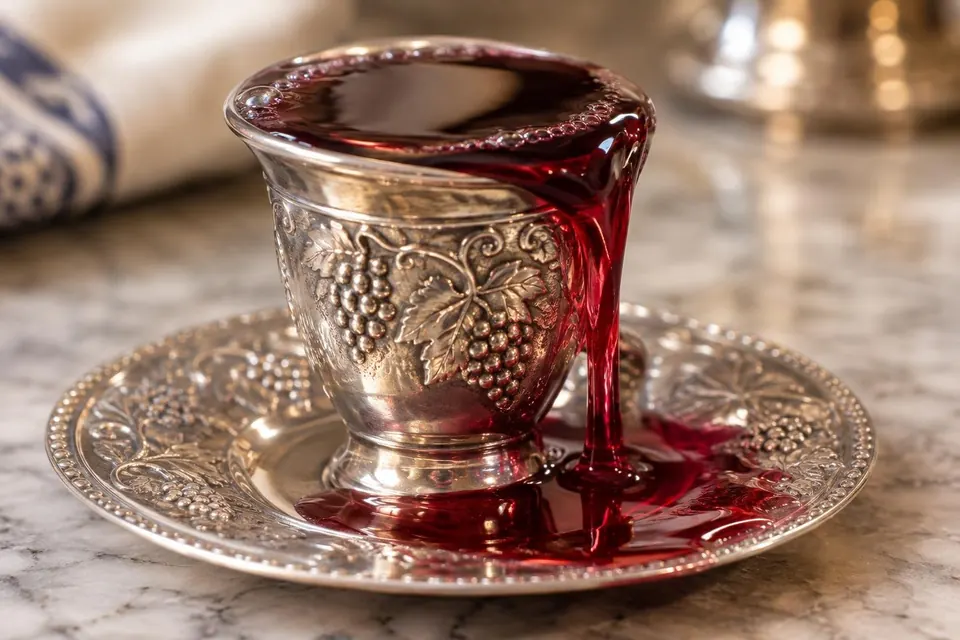
How much wine or grape juice must one drink to fulfill this mitzvah? The Mishnah Berurah writes that the minimum is melo lugmav, a “full mouth” (מלא לוגמיו), which equals half a reviit (רביעית, a quarter of a log, a traditional liquid measure). According to the most lenient opinion, that is approximately 43 ml (about 1.5 fl oz). But another problem arises: the authorities disagree about whether someone who drinks this amount of wine must say a blessing afterward.
It is therefore best to drink a reviit of wine or grape juice, which is between 86 and 150 ml (about 3 to 5 fl oz), according to different opinions. This amount should be drunk in one go. Someone who cannot do so should drink it within one to two minutes. According to the Mishnah Berurah, someone who does not drink the required amount within that time has not fulfilled the mitzvah.
According to other opinions, someone who makes Havdalah over a cup containing the required amount of wine and merely tastes the wine has fulfilled the mitzvah, though not in the best way.
Someone who was unable to drink enough wine or grape juice—43 ml (about 1.5 fl oz)—should therefore try to hear Havdalah from someone else. They may not, however, make Havdalah again themselves, since some opinions maintain that they have already fulfilled their obligation.
Someone who finds it difficult to drink the required amount of wine or juice may say the blessing, taste the wine, and give it to someone else. The wine or juice may even be given to a boy under the age of 13. However, the person who will drink it must be told in advance that the blessing over the wine is being said for them as well. According to some opinions, the person saying the blessing does not even need to taste the wine. Since their blessing over the wine counts for the other person, this is sufficient for Havdalah and is not considered a blessing said in vain (Piskei Teshuvot 296:1, 11).
Spilled Wine#
What should someone do if they say the blessing over the wine and accidentally spill it before they or anyone else has had a chance to taste it? They must pour another cup of wine and say the blessing over it again, since the first blessing did not count. If the wine was spilled after the blessing “Who distinguishes between sacred and ordinary” (המבדיל בין קודש לחול) had been said, they should quickly pour another cup of wine without speaking and say the blessing “Who creates the fruit of the vine” (בורא פרי הגפן) over it again. They should not repeat the blessing “Who distinguishes between sacred and ordinary” (המבדיל בין קודש לחול).
But if, after saying the blessing “Who distinguishes between sacred and ordinary” (המבדיל בין קודש לחול), they spilled the wine and began conversations not directly related to Havdalah, left the house, or did something similar, they must again say the blessing over a cup of wine and again say the blessing “Who distinguishes between sacred and ordinary” (Piskei Teshuvot 296:11).
When No Wine Is Available#
The Shulchan Aruch cites two opinions about a situation in which, at the end of Shabbat, no wine or other drink suitable for Havdalah is available. According to one opinion, since the person cannot make Havdalah over wine anyway, they may eat immediately after praying Maariv, the evening prayer. According to the other opinion, if they expect to obtain a suitable drink before noon the following day, they may not eat until they have made Havdalah.
The Mishnah Berurah writes that a healthy person should follow the stricter opinion and not eat until they have made Havdalah, if they expect to be able to do so before noon the following day. If they do not know when they will be able to make Havdalah, they may eat immediately. Someone who is weak or finds fasting difficult may eat immediately after Maariv.
As mentioned above, someone who forgot to say Havdalah in the prayer and does not expect to be able to say Havdalah over wine must pray Maariv again, this time without omitting the required passage.
Someone who, for any reason, did not make Havdalah over wine at the end of Shabbat must make it later. The time for Havdalah lasts until sunset on Tuesday.
Someone who makes Havdalah later, rather than at the end of Shabbat, should not say the blessings over the spices and the flame. They say only the blessing over the wine and the blessing “Who distinguishes between sacred and ordinary.”
Someone who did not make Havdalah over wine during the evening and night at the end of a festival can no longer make it up once dawn arrives (Shulchan Aruch, Orach Chaim 296:3 and 299:6; Mishnah Berurah 296:18–22 and 299:16–19).
Practical law. This page reports a ruling given for a specific question. For your own situation, ask a rabbi who knows you.
Keep reading
More →How to Make Havdalah on Wine
A guide to the wine and cup used for Havdalah after Shabbat and holidays.
Keeping Shabbat During the Holocaust: Rabbi Neuwirth’s Story
Guide · ShabbatCan Women Make Havdalah?
- Wine and Women
What Can You Use for Havdalah Without Wine?
Grape juice, raisin broth, and certain other drinks may be used for Havdalah when wine is unavailable.







