When and How to Say Kiddush Levana
A guide to the timing, customs, and practical requirements of the monthly blessing of the moon.
In brief
- Kiddush Levana is a blessing said over the moon at night.
- Authorities differ on whether it may be said three or seven days after the molad.
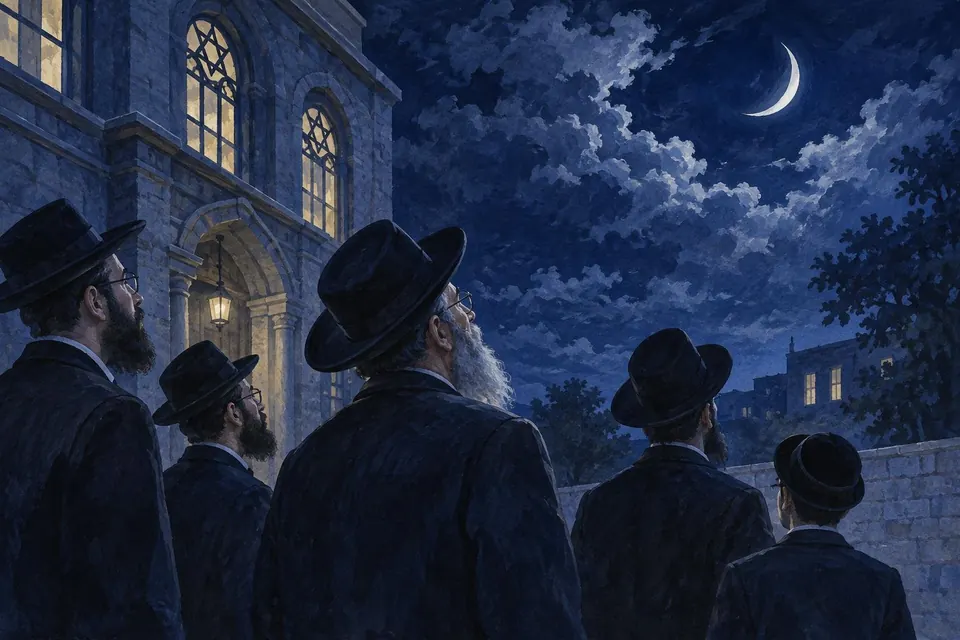
- The blessing is usually said outdoors, preferably with a group.
- The guide addresses clouds, illness, mourning, Shabbat, and other circumstances.
Overview#
Kiddush Levana (sanctification of the moon), also called the blessing of the moon, is one of the blessings composed by the members of the Great Assembly. Reciting it is a very important mitzvah, and one should make every effort to fulfill it properly. The Talmud says that someone who fulfills this mitzvah is considered as though they are standing before the Creator (Sanhedrin 42a; Shulchan Aruch, Orach Chaim 426:1; Yosef Ometz 467).
Why do we say a blessing over the moon rather than over some other celestial body that is much larger? The moon is a visible example of the constant renewal of creation, which clearly points to the Creator’s ongoing relationship with His creations (Aruch HaShulchan, Orach Chaim 426:2).
The Time Window#
Because a person must benefit from the moon’s light when saying the blessing, Kiddush Levana may be recited from the time the moon reflects enough sunlight until it begins to wane. Halachic authorities differ about when the blessing may first be said.
Some maintain that the mitzvah begins only seven full days after the birth of the moon. Most Sephardim and Hasidim follow this opinion (Shulchan Aruch, Orach Chaim 426:4; Rema MiPano 78; Ben Ish Chai, Vayikra, second year, 23; Kaf HaChaim 426:61). There are different opinions regarding the night of the seventh day after the moon’s birth (see Birkei Yosef 426:4; Rema MiPano 78, among others). According to another opinion, Kiddush Levana may be recited after three full days (Aruch HaShulchan, Orach Chaim 426:13; Mishnah Berurah 426:20). The birth of the moon, or molad, is the time when the moon is not visible because it is closest to the sun.
Even someone who always waits seven full days may, on a one-time basis, rely on the second opinion and say the blessing after three days if, for some reason, they cannot fulfill the mitzvah after the seventh day. For example, someone may need surgery before then and be unable to recite Kiddush Levana until the middle of the month (Halichot Shlomo, Tefillah 15:10 and Rosh Chodesh 1:27).
To determine precisely when the moon begins to wane, and therefore when the time for the blessing ends, we need to know the length of the lunar month. According to an oral tradition received at the revelation at Sinai, a lunar month lasts 29 days, 12 hours, 44 minutes, and 3.3 seconds. After the full moon, which occurs approximately halfway through the lunar month, the moon begins to reflect less and less sunlight. Dividing the length of the lunar month in half therefore gives us the precise beginning of the moon’s waning, after which Kiddush Levana may no longer be recited. In other words, the time for the blessing ends 14 days, 18 hours, and a little over 22 minutes after the moon’s birth.
The calculation begins not from the start of the month but from the precise time of the molad, which occurs a day or even two before the new month. According to some opinions, on which the ruling in the Shulchan Aruch is based, Kiddush Levana is recited with the Creator’s name until the end of 15 days after the new moon. Until 16 days have passed, it is recited without the Creator’s name; after that, it is not recited at all (Shulchan Aruch, Orach Chaim 426:3).
Differences in Custom#
The core of Kiddush Levana is the blessing over the moon found in the Talmud. Much of the rest of the text printed in prayer books depends on each community’s customs. For example, Ashkenazim conclude with the Aleinu prayer, while Sephardim do not. After the blessing, Sephardim say Kaddish deRabbanan (the Rabbis’ Kaddish), while Ashkenazim say the Mourner’s Kaddish.
How to Perform the Mitzvah#
Before reciting Kiddush Levana, check that it is permissible to say sacred texts in that place: there should be no uncovered sewage pits, garbage dumps, toilets, excrement, or manure nearby (Mishnah Berurah 426:21). The person saying the blessing must have clean clothing, a clean body, and clean hands, and everyone present must be dressed modestly.
Even someone who has memorized Kiddush Levana should read it from a prayer book each time (Mishnah Berurah 100:2).
Before reciting Kiddush Levana, look at the moon, but do not gaze at it intently.
The mitzvah may be fulfilled only if the moon is not obscured by clouds. A light cloud through which the moon can be seen clearly is not enough reason to postpone the blessing (Mishnah Berurah 426:3). Many Sephardim nevertheless prefer, when possible, to wait until the moon is not covered even by a transparent cloud (Moreh BeEtzba 184; Kaf HaChaim 426:18). If a dense cloud covers part of the moon but another part can be seen clearly, Kiddush Levana may be recited (Halichot Shlomo, Rosh Chodesh, chapter 1, Devar Halacha 44). If clouds cover the moon after the blessing has begun, it is completed (Mishnah Berurah 426:3). If it appears likely that clouds may cover the moon before the blessing can be completed, postpone it until the moon can be seen clearly (Mishnah Berurah 426:3).
If the moon is visible in general but a person cannot see it—for example, because of a vision problem or because they cannot go to a place where it is visible—they should listen to someone who can see it recite Kiddush Levana and answer “Amen.” The person saying the blessing must intend to say it on behalf of the person who cannot see the moon, and that person must likewise intend to fulfill the mitzvah through the blessing. If no one is available to say the blessing properly, the person who cannot see the moon recites Kiddush Levana without mentioning the Creator’s name in the blessing (Biur Halacha on Shulchan Aruch, Orach Chaim 426:2; Or LeTzion, part 3, chapter 4; Chazon Ovadia, Dinei Kiddush Levana, pp. 364–366).
Someone who cannot see the moon without glasses but can see it sufficiently clearly with them says the blessing themselves (Shaarei Teshuvah on Shulchan Aruch, Orach Chaim 426:1).
Kiddush Levana is not recited indoors. When we sanctify the moon, we figuratively stand before the Creator. To show Him respect and reverence, we should go out to greet Him rather than stay inside and wait for Him to come. A person sometimes goes out of the house to meet an important guest; all the more so should one do this for the King of kings (Kiddush Levana 5:1). If going outside poses a health risk, or if a person feels unwell, they may recite Kiddush Levana in a room from which they can see the moon through an open window or door (Mishnah Berurah 426:3). If, for some reason, such as cold or wind, the window cannot be opened, the blessing may be said with the window closed, provided the moon can be seen through the glass (Mishnah Berurah 426:21; Shaar HaTziyun 426:25).
The moon may be blessed while standing under an umbrella or a tree canopy (Yaskil Avdi, part 8, 38).
Ideally, Kiddush Levana should be recited standing, without leaning on anything. Someone who recited it sitting has nevertheless fulfilled the mitzvah. A person who finds it difficult to stand may say the blessing while leaning on something, sitting, or even lying down, provided they can see the moon (Shulchan Aruch, Orach Chaim 426:2; Biur Halacha on Shulchan Aruch, Orach Chaim 426:2).
When fulfilling the mitzvah, one should face the Land of Israel. Those in Israel should face Jerusalem, and those in Jerusalem should face the Holy of Holies. One should stand straight with feet together, as during the Amidah (Yesod VeShoresh HaAvodah, gate 9, chapter 1, Kiddush Levana; Levushei Mordechai, Tinyana, Orach Chaim 117).
One should look presentable when fulfilling the mitzvah, like a person granted an audience with a king (Shulchan Aruch, Orach Chaim 426:2). Someone who does not wish to put on festive clothing specifically for Kiddush Levana should at least try to look dignified (Mishnah Berurah 426:7).
During the blessing, one may not interrupt even to respond to someone who says “Shalom Aleichem” with “Aleichem Shalom”—and certainly not for unrelated conversation (Ishei Yisrael 40:33).
A person who finds it difficult to say the words loud enough to hear them, as is normally required for prayers and blessings, may say the blessing of the moon in a whisper. Someone who cannot recite Kiddush Levana even in a whisper should listen to another person say the blessing aloud. If that is not possible, they should read the text of Kiddush Levana silently, without pronouncing it at all (Shulchan Aruch, Orach Chaim 185:9 and 206:3).
Ideally, Kiddush Levana is recited with a large gathering, because the more people participate in a mitzvah, the more significant its performance: “A king’s glory lies in the multitude of his people” (Proverbs 14:28). When a large gathering is not possible, one should try to fulfill the mitzvah in the presence of a minyan, a quorum of at least ten Jews over the age of 13. Someone who finds it difficult to arrange a large gathering should try to bring together at least two other participants (Chayei Adam 68:11). If even that is not possible, they should bless the moon alone (Kaf HaChaim, Orach Chaim 426:13).
When Kiddush Levana is recited without a minyan, Aleinu and Kaddish are not recited (Imrei Yosher, Moed 111, in the name of the Chazon Ish).
When to Recite It#
Kiddush Levana is recited only at night, from the appearance of the stars until dawn (the Rema on Shulchan Aruch, Orach Chaim 426:1; Ben Ish Chai, Vayikra, second year, 23; Yaskil Avdi, part 8, 20:53).
The most favorable times to bless the moon are after the evening prayer at the conclusion of Shabbat, Yom Kippur, and Shavuot, when people are in an uplifted mood and dressed in festive clothes (Shulchan Aruch, Orach Chaim 426:2; Mishnah Berurah 426:5). If the next Saturday night will fall after the 11th of the month, do not wait for it. Instead, bless the moon on another evening, out of concern that the coming days may be cloudy and the opportunity to fulfill the mitzvah may be lost (the Rema on Shulchan Aruch, Orach Chaim 426:2; Mishnah Berurah 426:6). In places and seasons where weather conditions make it uncommon to see the moon, fulfill the mitzvah as soon as the time arrives rather than wait until Saturday night (Yeshuot Yaakov).
As mentioned above, Kiddush Levana should be recited with a large gathering or at least a minyan. If there is an opportunity to fulfill the mitzvah with a minyan on another night, and a minyan will probably not be available on Saturday night, do it now rather than wait.
Kiddush Levana is not recited on Shabbat or festival nights, even if a festival night begins at the conclusion of Shabbat. There are several reasons for this, some connected to Kabbalah and others based on practical reasoning. When blessing the moon, we ask God for various benefits, and on Shabbat we do not pray for personal needs (Minhagei Maharil, Hilchot Chag HaShavuot 7). There is also concern that someone might mistakenly carry a prayer book into an area not enclosed by an eruv—a halachic enclosure that permits certain carrying on Shabbat—and thereby unintentionally violate the prohibition against carrying an object from a private domain into a public one (Sdei Chemed, Maarechet Rosh Hashanah 2:2). In their joy at fulfilling the mitzvah, a person might also begin to dance, which is prohibited on Shabbat and festivals (Shaar HaTziyun 426:12).
If the time for the mitzvah will end after Shabbat or the festival, one may bless the moon on Shabbat or the festival night, taking the concerns above into account so as not to unintentionally violate the laws of Shabbat or the festival (Shulchan Aruch, Orach Chaim 426:2; Mishnah Berurah 426:12). On Shabbat, the mitzvah should be performed before the evening prayer (Mateh Ephraim 625:5; Elef HaMagen 625:6). Only the text of the blessing is recited; the other requests and prayers are omitted (Aruch HaShulchan, Orach Chaim 426:10).
Many do not bless the moon until Tisha B'Av is over, because the first nine days of Av are days of mourning for the destroyed Temples. After the evening prayer at the conclusion of the communal fast of Tisha B'Av, they put on shoes, wash their hands, have a small snack, and hold the ceremony for sanctifying the moon (Shulchan Aruch, Orach Chaim 426:2; Mishnah Berurah 426:8).
Who Is Obligated#
Women are exempt from Kiddush Levana because it is a time-bound mitzvah, and women are generally exempt from mitzvot of this kind. The custom is that women do not perform this mitzvah even as a voluntary stringency (Magen Avraham 426:1).
It is customary to train children to fulfill Kiddush Levana from the age of six or seven (Mishnah Berurah 426:1).
A person one of whose seven closest relatives has died is generally exempt from mitzvot until the deceased is buried. Such a person is called an onen (a mourner before burial). If the time for Kiddush Levana may pass, however, and other people are arranging the funeral so that the onen’s participation in the preparations is not needed, the onen must recite Kiddush Levana (Daat Torah 71:1).
During the first seven days of mourning, or shiva, a person mourning one of seven closest relatives—an avel (mourner)—does not participate in Kiddush Levana. If the time for the mitzvah will pass by the end of the week of mourning, the avel may leave the house and recite Kiddush Levana alone (Mishnah Berurah 426:11).
Kabbalah#
According to Kabbalah, after reciting Kiddush Levana one should shake out the hems of one’s clothing (Pri Etz Chaim, gate of Rosh Chodesh, chapter 3, in the name of the Arizal; Magen Avraham 426:11, in the name of Kitvei HaArizal). Some look at the threads of their tzitzit and check that they are kosher. What do tzitzit and the blessing of the moon have in common?
As mentioned above, when we bless the moon at the beginning of the month, it is as though we stand before the Creator. The Talmud also says of tzitzit that someone who fulfills the mitzvah with devotion and love merits standing before God (Menachot 43b; Margaliot HaYam on Sanhedrin 42a).
Checking the tzitzit during Kiddush Levana also alludes to a future time when God will make the moon’s light equal to the sun’s. The mitzvah of tzitzit, which is currently fulfilled only during the day, will then be fulfilled around the clock. For the Torah says of the threads, “You shall see them” [Numbers 15:39], meaning that the mitzvah applies at a time when the threads can be seen (Har Tzvi, Orach Chaim, part 1, 11; Halichot Shlomo, Rosh Chodesh, chapter 1, Orchot Halacha, note 124). May the Creator grant us this soon, in our days!
The blessing we have discussed is called Kiddush Levana. This reminds us of the ceremony of kiddushin (betrothal), through which a bride becomes a lawful wife. Like the moon, the bride was hidden from her husband until a certain time; after kiddushin, she is revealed to him in all her beauty (Darchei Moed 417).
In Kiddush Levana we proclaim, “David, king of Israel, lives and endures!” Although the moon is hardly visible at the very beginning and end of the month because it is very close to the sun, we are completely certain that it will soon reappear and shine in full by the middle of the month. Similarly, the kingdom of David’s dynasty, whose greatness is temporarily hidden from view, will be restored and appear to the world in all its splendor. And the Jewish people, like a faithful wife, will return once again to their husband, the Creator of the world (the Rema on Shulchan Aruch, Orach Chaim 426:2).
By Rabbi Leib Nachman Zlotnik
Practical law. This page reports a ruling given for a specific question. For your own situation, ask a rabbi who knows you.
Keep reading
More →Why Does the Jewish Calendar Have a Second Adar?
The Jewish leap month keeps Passover in the spring and carries meanings of its own.
Guide · Jewish CalendarRosh Chodesh Laws and Customs
- Blessing the New Month: Shabbat Mevarchim
- Yom Kippur Katan
- Rosh Chodesh Laws and Customs
Why Did Mordechai Refuse to Bow to Haman?
Mordechai’s choices in the Purim story reveal his understanding of spiritual and material effort.
PurimPurim, Lots, and the Meaning of Chance
The name Purim invites us to consider the difference between chance and divine providence.







